


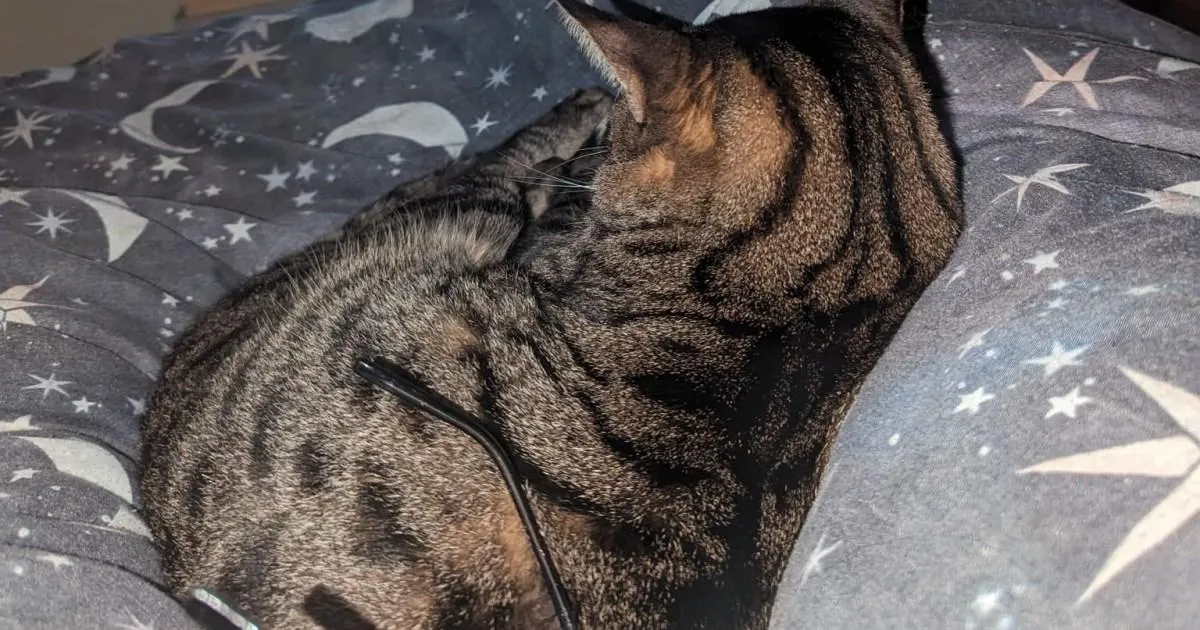
For Louise and Lisa, Max was never just a cat. He was the small, steady presence that made their house feel like a home—an eight-year-old tabby with a distinctive white-tipped tail, a quiet companion who had become a “real homebody” after the family moved into their new place in July. They had imagined him sunning himself in the garden, padding along the fence, perhaps wandering into a neighbouring yard as he sometimes did, but always coming back. On Monday, September 14,that illusion of safety cracked. Louise put Max out in the front garden at around noon, assuming he would spend the afternoon doing what he always did: lounging, sniffing, watching the world go by. But by evening, there was no sign of him. At 7 pm, panic set in. They called his name into growing darkness, checked every bush and hedge, knocked on doors. The following day, they printed missing posters and plastered them around the neighbourhood, with Max’s face and that unmistakable white-tipped tail staring out from lampposts and shop windows. They told themselves he would turn up, that cats wander and stray, that someone had perhaps taken him indoors. But in their quieter moments, they must have felt the first cold tremor of dread. The garden, once a simple threshold between their lives and the world, had become the place where their world began to unravel.
Five days after Max vanished, the ordinary rhythm of their morning was ripped apart in the most grotesque way imaginable. Lisa went to collect their mail from the shared post area at their block of flats, the way she had done hundreds of times before. She opened the letterbox, expecting bills, leaflets, perhaps a card. Instead, she found something that made her scream—something that will never leave her: Max’s distinctive white-tipped tail, severed and placed there deliberately,as if it were nothing more than a package. Louise heard the screaming first. She rushed out and found Lisa crying, shaking, unable to explain. “I just heard Lisa screaming and crying,” Louise later said. “That is something I will never forget.” The horror was not only in what they saw, but in what it meant. Someone had taken their cat, harmed him, and then chosen to return a piece of him through the home’s own postbox—a brutal message, a deliberate violation of the one place they were supposed to be safe. It was impossible to process: the shock, the disgust, the overwhelming sense that this was not random cruelty but something personal, something calculated. Numb and trembling, they contacted police, and within hours the investigation into Max’s disappearance became something far darker.
The investigation moved quickly, though it could never move quickly enough for two women reeling from such a loss. Detectives from Humberside Police began piecing together a case that seemed to have no obvious motive but clearly involved more than one person. Three people were eventually arrested: a 37-year-old woman and two men, aged 47 and 75, all taken into custody and questioned. All three were arrested on suspicion of malicious communications and of failing to prevent the causing of unnecessary suffering to an animal. The charges hinted at a disturbing dynamic—not necessarily that all three had harmed Max themselves, but that at least one may have known about his suffering and done nothing to stop it, and that the communication of that suffering to his owners was itself a criminal act. The 47-year-old man faced additional suspicion of assault and criminal damage, while the 75-year-old man was also arrested on suspicion of witness intimidation and harassment. The presence of such varied allegations painted a picture of something more tangled than a simple act of cruelty—perhaps a campaign of intimidation, perhaps violence spilling over, perhaps an attempt to silence those who knew what had happened. All three remained in police custody, their names not yet released, their stories not yet told. For Louise and Lisa, the arrests brought a strange, uneasy relief: someone was being held accountable, but it also deepened their bewilderment. How could anyone look at Max—a friendly, unassuming tabby—and decide to do this? What could possibly justify the horror left in their letterbox? Police offered no answers yet, only the grim mechanics of the investigation.
As police worked to reconstruct Max’s final days, the evidence became even harder to bear. Six days after the tail was discovered, a dog walker walking through woods close to the couple’s home came across the rest of Max’s body. The discovery confirmed what Louise and Lisa had feared from the moment they opened that letterbox: Max was not coming home. His body was collected, and samples of his fur were taken by investigators as part of the search for DNA, a forensic detail that made the loss feel clinical and raw at the same time. Meanwhile, Max’s tail had been sent to a specialist veterinarian in Liverpool for forensic examination, as if science might somehow explain the inexplicable. Inspector Lucy Kevan, of Humberside Police, acknowledged the community’s unease, saying: “I understand a report of this nature causes concern amongst the community. However, I would like to provide reassurance that we believe this to be an isolated incident.” Her words were meant to calm, but for Louiseand Lisa, there could be no calm. Every corner of their neighbourhood now felt suspect; every rustle in the bushes carried a memory of Max; every knock at the door made their hearts lurch. The woods where his body was found—once perhaps a place they had walked, or where Max had wandered—became a site of grief, avoided yet impossible to forget. They were left with questions that forensic tests and police interviews might never answer: Had Max suffered? Had he called for them? Had he known how much they loved him? The phrase “unnecessary suffering” from the arrests seemed almost absurdly inadequate; no suffering necessitated by anything could justify what had been done to this gentle creature, and no charge could undo the image of that white-tipped tail in the letterbox.
.
In the midst of such darkness, Louise and Lisa tried to honour the light that Max had brought them. They held a candlelit memorial for him outside their flat, beside his favourite tree, a spot where he must have stretched, scratched, and napped hundreds of times. Mourners came; neighbours who had seen his missing posters, friends who knew how much he meant, people who simply understood that a life does not have to be human to matter. They tied yellow ribbons around the tree—bright, fragile flags of remembrance, fluttering in the wind like small prayers. It was a tender act of defiance against cruelty, a way of saying that Max had existed, that he had been loved, and that he would not be remembered only as a victim but as a companion, a family member, a cat with a white-tipped tail who had found his way into their hearts. But grief does not pause for rituals, and it seeped into every corner of their lives. Louise and Lisa had been together for nine years and had been planning their wedding—a celebration of their love, of the life they had built together. But after Max’s death, the thought of celebrating felt impossible. They cancelled the planned pub celebration and buffet that were to follow their ceremony, telling themselves they could no longer bear the idea of raising glasses and laughing while Max’s body lay in the woods and his tail was evidence in an investigation. A wedding should be a beginning, but now it felt shadowed by an ending. The joy they had earned over nearly a decade together had been stolen, at least for now, by three strangers and an act of cruelty that defied comprehension. Their love remained, but its expression had been muted, postponed, wrapped in the same grief that bound them to Max.
The case has reverberated far beyondone household, touching everyone who heard it with a particular kind of horror. There is something uniquely disturbing about cruelty to animals—especially when it is so deliberate, so theatrical, so aimed at the humans who loved them. Max was an eight-year-old tabby with a distinctive white-tipped tail; he was not a trophy, not a message, not a pawn in someone else’s grievance. He was a creature who trusted the world enough to sit in his own front garden at noon on a September day, expecting nothing more than sunshine and the familiar smells of home. What happened to him is a reminder that the capacity for cruelty can hide in plain sight, in neighbourhoods, in shared post areas, in the spaces where we think we are safe. Police have stressed their belief that the incident was isolated, an abuse of the word that offers little comfort to Louiseand Lisa, who will forever associate their home with the moment Lisa opened that letterbox. The three people in custody—the 37-year-old woman, the 47-year-old man, the 75-year-old man—now face the weight of those choices, but justice, however it unfolds, cannot bring Max back. It cannot undo the screaming, the crying, the cancelled wedding celebration, or the yellow ribbons tied around a tree in memory of a cat whose only crime was being loved. What it can do, perhaps, is send a message that such cruelty will not be tolerated, that animals are not ours to use as weapons against each other, and that belonging to someone—being a pet, being a companion, being a family member—ought to mean being protected, not being made into a warning. Until then, Louise and Lisa are left with their memories, their grief, and one small, impossible comfort: Max died beloved. And in the woods, beneath the trees, somewhere near the home he chose, a tabby cat with a white-tipped tail is gone—but he will not be forgotten.