

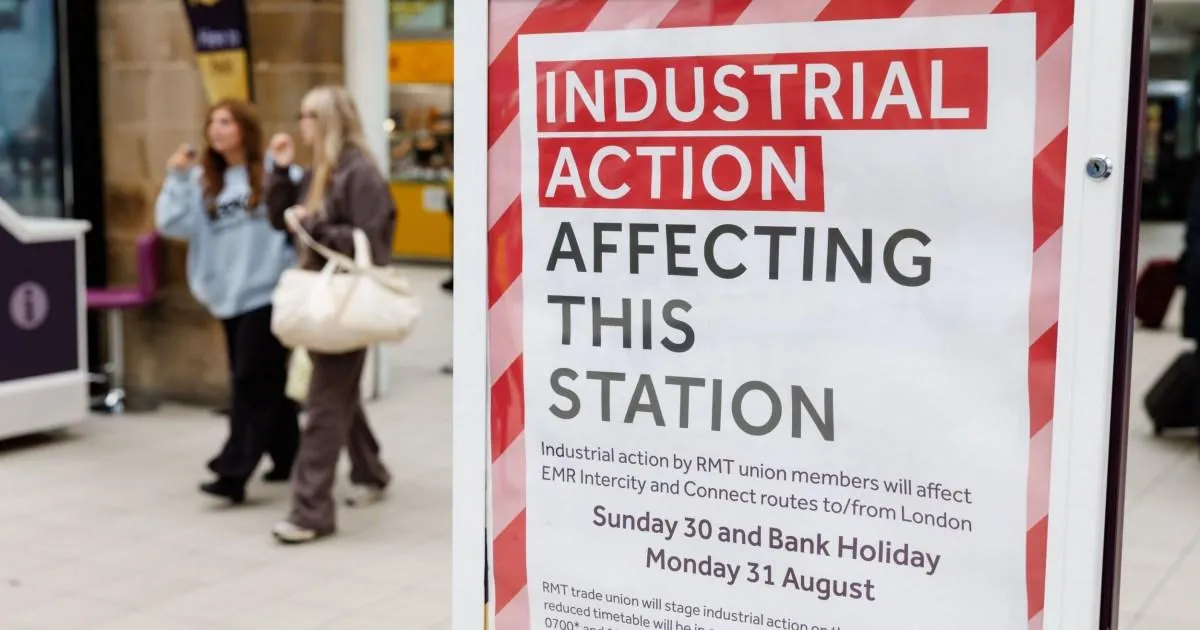
If you had been dreaming of a lazy August bank holiday weekend away, a city break in London, or a long-awaited reunion with family and friends, the latest rail disruption news may have just thrown a rather large spanner in the works. East Midlands Railway (EMR) has announced that services to and from London St Pancras will be “significantly reduced” over the bank holiday weekend because of strike action by members of the RMT union. The walkout is not over pay or working hours, but over safety concerns connected to a specific fleet of trains, the Class 810 “Aurora” units. This means that anyone hoping to travel between the capital and places like Nottingham, Sheffield, Derby, or Leicester will likely face crowded platforms, long queues, and a service that is anything but normal. The railway company has gone as far as to issue what is essentially a very polite but firm plea: do not travel to or from London unless your journey is absolutely essential. For thousands of passengers, that advice comes all too late after tickets were booked, hotels reserved, and plans made in the expectation of a smooth escape for the final long weekend of summer.
The trouble centres on the Aurora trains, a modern-looking fleet manufactured by Japanese engineering giant Hitachi and introduced into service only last December. On paper, these trains were supposed to represent the future of East Midlands travel, offering fresh interiors, faster journeys, and a more comfortable riding experience. In practice, however, they have been plagued by a series of technical problems that are more than just annoying: faulty air-conditioning, stubborn doors that refuse to behave, and toilets that have been locked out of use. For passengers travelling for hours, particularly with children in tow or in the summer heat, these are not minor inconveniences but genuine quality-of-life issues. For train drivers and onboard staff, they are something far more serious: potential safety hazards that could affect their ability to do their jobs safely and securely. The RMT has therefore instructed its members to refuse to work on these trains until the problems are properly addressed. This is not a decision that would have been taken lightly, and it is one that is bound to divide opinion, but the union is holding its ground, insisting that the safety concerns of its members are real, pressing, and must be acted upon without further delay.
It is important to understand the wider context of this bank holiday chaos. The strike does not exist in a vacuum, and passengers on other routes are also feeling the pinch. Alongside the EMR walkout, there is programmed engineering work taking place on the East Coast Mainline, one of the country’s most vital rail arteries. On Sunday, no LNER trains will run between London King’s Cross and Peterborough because of signalling upgrade works. This means passengers travelling from London to the North East, Yorkshire, and Scotland will need to find alternative arrangements, likely replacement bus services or entirely different routes. The combination of industrial action and essential engineering works creates a perfect storm for travellers, and the knock-on effects are likely to be felt across several networks. At major stations like Nottingham and Sheffield, passengers can also expect to queue for EMR services as the reduced schedule struggles to carry the same number of people who would normally travel. For those who are still determined to make their journey, patience will be more than a virtue; it will be a survival tool. The advice from the rail companies is simple: check your entire journey, including first and last trains, before you even leave the house, and be prepared for disruption at every stage.
Behind the official statements and service warnings, there is a human story that deserves attention. Bank holidays are supposed to be a moment to relax, to spend time with loved ones, and to step away from the pressures of everyday life. Instead, many people will be standing on crowded platforms, staring at departures boards with growing frustration, wondering whether they should have booked a coach or simply stayed at home. There are families travelling with suitcases and restless children, couples heading to weddings, friends meeting up for weekend adventures, and people needing to visit relatives in hospital. Every single one of those journeys matters to the person making it, and the disruption will be genuinely upsetting for many. Philippa Cresswell, customer experience director at EMR, acknowledged as much in her official statement, offering an apology to customers and recognising how frustrating the disruption will be, especially because this comes on top of three Saturdays earlier in August that were already affected by RMT strike action. She stressed that the company continues to have constructive discussions with the union and has met with them six times in an effort to resolve the issues at the heart of the dispute. Still, for passengers, the fact that talks are ongoing offers little comfort when they are left standing in a queue.
The union’s position, meanwhile, is rooted in a principle that many workers and passengers will understand: safety must always come first. RMT general secretary Eddie Dempsey has called for the 810 trains with faults to be taken out of service entirely, rather than allowing staff to keep working on them with unresolved issues. It is not an unreasonable demand. Nobody wants to board a train with dodgy doors or a broken air-conditioning system, and the people who work on these trains day in and day out have every right to expect a safe environment. The frustration from management is equally understandable, though, because they are trying to run a railway and serve the public, and every day of strike action deepens the inconvenience and erodes public confidence. But the dispute is not going to vanish overnight, and as the bank holiday weekend arrives, the simple truth is that the situation remains unresolved. For travellers, this means preparing for the worst while hoping for the best. It is wise to carry water, snacks, charging packs, and plenty of patience, and to keep an eye on live updates from Network Rail, EMR, and LNER as the weekend unfolds. If your journey is not essential, the strongest advice is to reconsider it altogether. If you must travel, consider alternative routes, travel at quieter times if possible, and allow generous extra time for every connection. No one can promise a smooth ride, but by being prepared, you can at least reduce the stress of an already difficult situation. For now, all anyone can do is wait, watch, and hope that the talks succeed and that the bank holiday rail chaos becomes a distant memory rather than a recurring nightmare.