


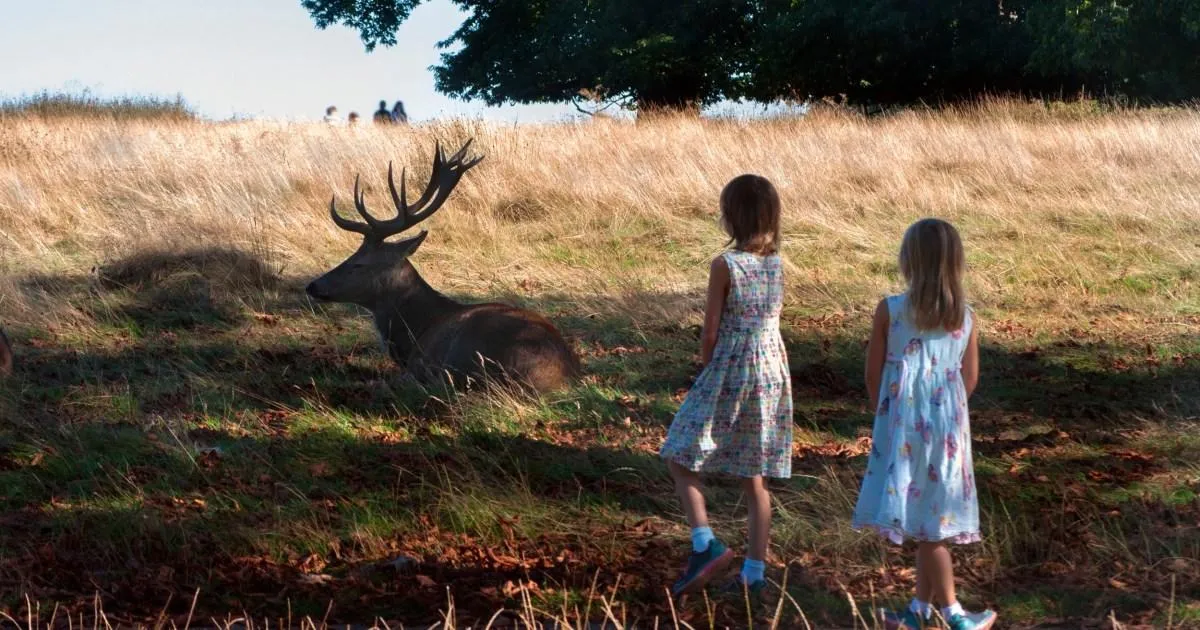
The recent viral footage circulating online from Richmond Park has sent a wave of alarm through the community, capturing a scene that most park rangers and wildlife experts find deeply unsettling. In the videos, groups of adults and children are seen gathering around, physically touching, and even stroking the wild deer that call the park home. For those watching, it might look like a quaint, charming moment of connection between children and nature. However, for the professionals tasked with managing this iconic London landmark, it represents a reckless lapse in judgment that could easily spiral into a horrific tragedy.
Richmond Park Manager Paul Richards has been vocal about his shock regarding these encounters, emphasizing that the deer are not the gentle, domesticated creatures they might appear to be. While their docile demeanor often fools the public, these are wild, powerful animals that command respect. Richards warns that crowds surrounding the deer, especially those involving small children, are creating a high-stakes environment where a sudden, defensive reaction from a stag could lead to life-altering injuries or even a fatal incident. The perceived calmness of the animals is a facade; beneath it lies the instinct of a creature weighing up to 25 stone, capable of reaching speeds of 30 miles per hour.
The urge to snap a quick photo or capture a selfie with a wild animal is a modern impulse that is increasingly clashing with the realities of nature. Park officials are pleading with the public to recognize the inherent danger of closing the gap between human and beast. By stripping away the animal’s space, park-goers are essentially forcing the deer into a corner where their only option for self-defense is aggression. It is a cautionary tale of human ego versus natural behavior, where people prioritize digital mementos over the essential safety protocols that have been established for the well-being of both the visitors and the wildlife.
This behavior has prompted a broader conversation about the shifting management of London’s green spaces, particularly concerning the oversight of these interactions. The dissolution of the specialized Royal Parks Police unit—a decision necessitated by significant budget cuts—has left many feeling that the park is now less protected than it once was. When photographers and regular visitors remark that they have “never seen it this bad,” it highlights a breakdown in public decorum that might have previously been curtailed by a more visible and authoritative police presence, whose primary role was to enforce regulations and educate the public on the spot.
Local leaders, including Richmond Council Leader Gareth Roberts, have long argued that removing a dedicated police force was a fundamental error in judgment. Without that specialist presence, the burden of monitoring these vast, popular spaces falls onto already overstretched police services, creating a vacuum where park regulations are treated as mere suggestions rather than life-saving rules. For the public, this means that the responsibility for safety has been shifted squarely onto their own shoulders, yet the recent behavior in the park shows that many are not equipped—or perhaps not willing—to exercise the caution required for such an environment.
As we move into the sensitive deer birthing season, which spans from May through July, the need for heightened caution has never been more critical. During these months, the maternal instincts of the deer make their behavior inherently unpredictable and potentially more aggressive toward perceived threats. It is a time for the community to recalibrate its relationship with the park: to appreciate its beauty from a distance and leave the animals to their natural lives. We must move past the idea that nature is an interactive petting zoo and accept that true respect for wildlife is measured not by how close we can get for a photo, but by how well we honor the boundaries that keep us all safe.