

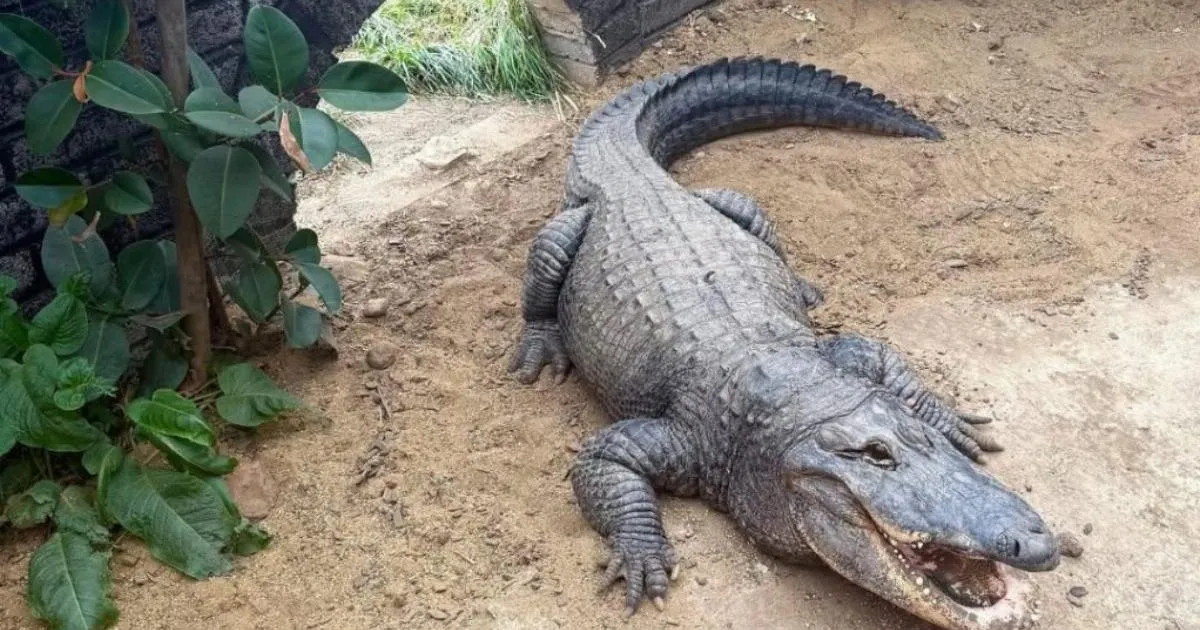
A scene of afternoon leisure at a family-run zoo in Huntingdon, Cambridgeshire, spiraled into a nightmare this past Thursday, leaving a three-year-old boy fighting for his life. Visitors at Johnsons of Old Hurst, expecting a peaceful day observing the zoo’s collection of reptiles, instead witnessed an unthinkable event: a young child being thrown 15 feet into a crocodile enclosure. The boy plummeted onto the unforgiving concrete floor of the pit, sustaining a broken arm and a fractured pelvis, while his horrified family looked on. In an act of immense bravery, Tracey Johnson, the 55-year-old wife of the zoo owner, leapt into the enclosure to rescue the toddler before the reptiles could inflict further damage. The boy remains in a critical but stable condition, following a terrifying ordeal that has left the local community in a state of deep shock and disbelief.
The circumstances leading up to this tragedy are now under intense police investigation. A 30-year-old man, who was a total stranger to the family, has been arrested on suspicion of attempted murder. Reports from witnesses at the scene suggest that the suspect, who is believed to have hearing difficulties, was accompanied by two carers. Disturbingly, onlookers have since come forward to claim that these caretakers appeared to be significantly distracted during their visit. A woman who was present at the zoo described seeing a large man matching the suspect’s description walking with two individuals who seemed detached from their responsibilities. She noted that they were trailing roughly ten meters behind him, deeply engrossed in their own conversation and their mobile phones rather than keeping a watchful eye on their charge.
The gravity of this situation is compounded by the fact that the suspect, following his arrest, was deemed “not fit for interview.” Given his health conditions, authorities have released him on bail until September while they continue to piece together the sequence of events. The zoo itself, which is known for its “Tropical House” exhibit—a converted cattle shed that serves as a home for ancient reptiles—has been shuttered for further inquiry. Among the animals housed in the pits are formidable creatures like “Cuddles” and “Romeo,” massive Nile crocodiles weighing in at over 120 kilograms. The realization of how close this incident came to being a fatal tragedy has cast a somber cloud over the zoo, which prides itself on being a family-friendly venue.
This event has ignited a broader conversation about accountability and the nature of public oversight in environments where wild, unpredictable animals are kept. Johnsons of Old Hurst had clear signage throughout the facility, reminding guests that “these animals are real and dangerous” and explicitly stating that children must be supervised at all times. Yet, as this case highlights, even the most robust safety warnings can be rendered meaningless when the human element of care fails. While the zoo offers specialized, supervised interactions—such as their “meet and feed” sessions for older visitors—the general exhibit areas rely on the vigilance of the public. This incident serves as a heartbreaking reminder that in public spaces, the duty of care is not just a legal obligation but a vital social contract that, when neglected, can have devastating consequences.
The legal and administrative fallout of this event is only just beginning. As the police inquiry deepens, questions are inevitably being raised regarding the level of supervision provided to the suspect and how he was able to gain access to the enclosure despite the presence of his designated carers. The tragedy has also forced a renewed focus on the physical security measures of the crocodile pits themselves, although the primary focus for most remains the physical and emotional recovery of the young boy. His survival is a testament to the quick intervention of the zoo staff, whose courage in a moment of extreme peril almost certainly prevented a much darker outcome.
Ultimately, as the zoo remains closed and the investigations proceed, the local community is left grappling with the senselessness of the attack. It is a stark reminder that even in seemingly safe, everyday environments, safety can be fragile. We entrust institutions to be secure, but we rely on each other—and especially those in a position of responsibility—to be mindful of the spaces we share. For now, the thoughts of many are with the toddler and his family, holding onto the hope that this young boy will recover from both his physical trauma and the unimaginable terror of that day. The incident stands as a somber lesson in the necessity of constant vigilance, particularly when the lives and safety of the most vulnerable are in our hands.