



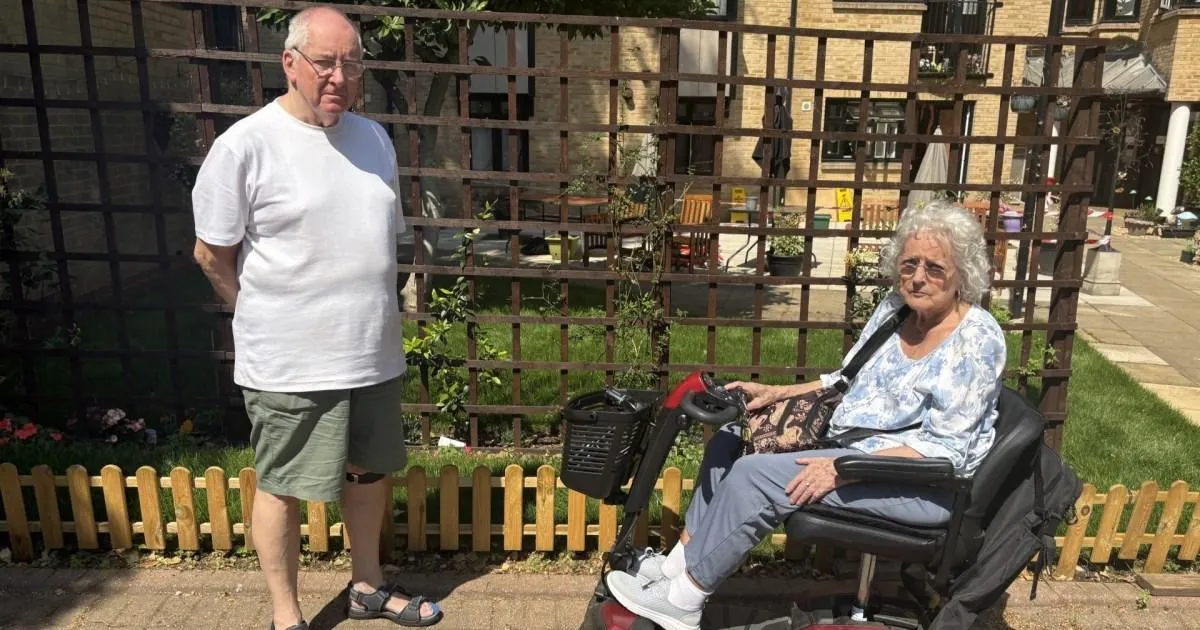
In the heart of Norwich, a quiet retirement complex called Helgate Court has become the unlikely stage for a standoff between local seniors and a national housing management group. For the 31 residents—many of whom rely on wheelchairs and mobility aids—the communal garden was once little more than a neglected, muddy eyesore. That changed when 80-year-old resident Julian Philips decided to take matters into his own hands. Over two weeks of painstaking labor, he cleared the dirt, laid down fresh grass, and planted flowers to create a sanctuary where there had previously been only debris. To protect his hard work from being crushed by vehicles, he installed a modest, one-foot-high picket fence, believing he was simply improving the quality of life for his neighbors.
The reaction from the retirement community was overwhelmingly positive, with residents praising the garden as a “beautiful space” that finally made the complex feel like a true home. However, the joy was short-lived when the housing group, Orbit, issued a stern letter demanding the fence be removed within seven days. The notice claimed the structure was a “trip hazard,” did not meet “specifications and standards,” and was an issue of poor workmanship. For the elderly residents, the notice felt less like a safety regulation and more like a display of cold, bureaucratic pettiness that ignored the significant emotional investment they had made in their own living environment.
The situation spiraled into a defiant protest, with 86-year-old Pauline Taylor leading the charge against the property managers. Expressing her profound frustration, Mrs. Taylor claimed that Orbit had completely disregarded the well-being and happiness of the residents, noting that they had been perfectly content with the muddy mess before Mr. Philips stepped in. Embodying the spirited resilience often found in the Greatest Generation, she famously declared that she would go so far as to chain herself to the tiny fence before she let it be torn down. It was a sentiment shared by many at Helgate Court, who viewed the fence not as a hazard, but as a protective barrier for a space they had restored with care and dignity.
Orbit, for its part, has scrambled to manage the PR fallout while maintaining its stance on safety and communal policy. Their spokesperson issued a statement highlighting that while they supported the gardening efforts—even providing turf for parts of the project—the fence in question had been erected without broader consultation. They argued that the fence encroached into a limited parking area, a point of contention in a complex where access is already tight. They maintained that residents with mobility scooters and walking aids had expressed concerns about navigating around the new barrier, essentially framing the conflict as a difficult balance between personal initiative and collective safety requirements.
Despite the initial threat of immediate removal, the public outcry and the residents’ refusal to back down appear to have forced a change in strategy. Orbit has since paused the demolition of the fence, extending the deadline to allow for a period of ongoing dialogue. The housing group now claims they are committed to finding a “safe alternative” that keeps the garden’s landscaping intact while resolving the navigation issues. It is a rare moment of local confrontation where the voices of the elderly have managed, at least momentarily, to stall a large institution, proving that even a one-foot-high fence can become a symbol of community autonomy.
Ultimately, this dispute serves as a poignant reminder of the tension between corporate property management and the human need to shape one’s surroundings. For the residents of Helgate Court, the garden was never just about grass and wood; it was about taking control of a small corner of the world in their later years. By choosing to fight for their garden, these seniors have highlighted a fundamental truth: people do not just want to be housed—they want to be heard, and they want to live in a place that feels cared for. As negotiations continue, the residents remain hopeful that their hard work will remain standing, preserved by the same tenacity that brought the garden to life in the first place.