

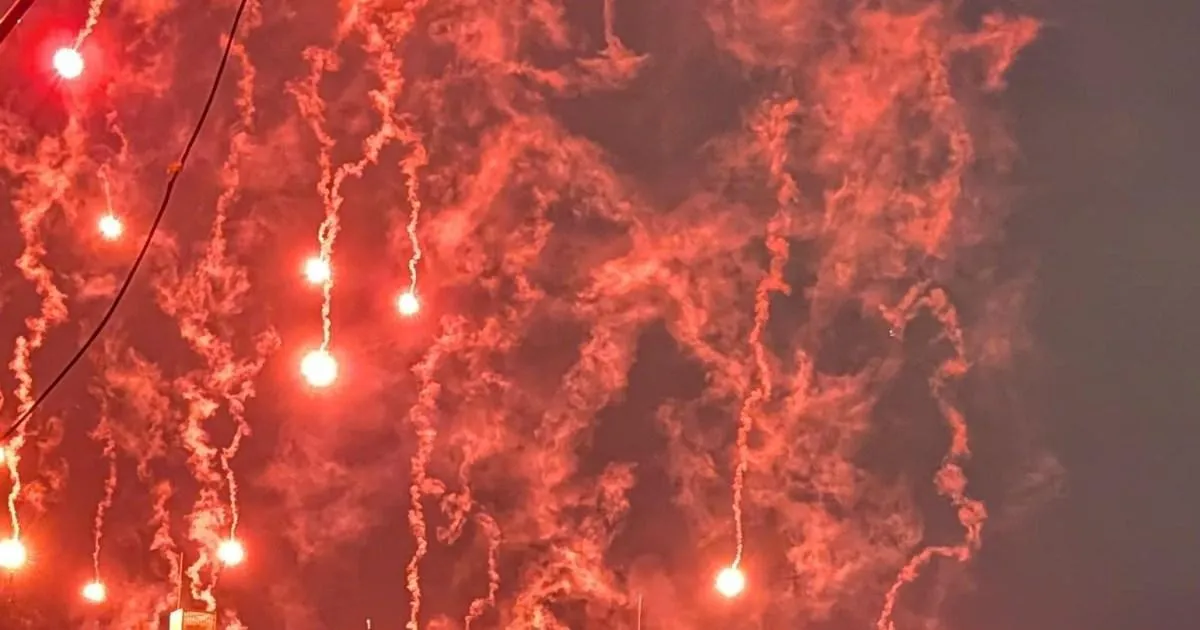
The quiet of a Sunday night in Wapping was shattered late last week when a shower of falling red flares turned the London skyline into a scene of terrifying chaos. Residents, many of whom were already asleep, awoke to a surreal and dangerous display as parachuted pyrotechnics drifted down over the Thames. What began as a spectacle of light quickly turned into a fight for survival for the local community, as the flares—capable of burning at temperatures exceeding 600 degrees Celsius—began to land on boats, vehicles, and recreational spaces. The incident, which onlookers compared to a war zone, felt deeply personal for those left to deal with the aftermath in the dark.
The origin of the disturbance remains a mystery, though there are unsettling reports of a group of men chanting victory songs from a housing development on the south side of the river just as the projectiles were launched. Witnesses like Apoorv Srivastava watched in disbelief from their windows, noting that these were not ordinary fireworks. These were professional-grade marine flares, specifically designed to withstand water and remain alight under the most extreme conditions. Because they are intended for emergency rescue situations at sea rather than civilian entertainment, they posed an immediate, life-altering threat to anyone unlucky enough to be in their path as they drifted toward the north bank of the Thames.
The Hermitage Moorings, a tight-knit community of houseboats, bore the brunt of the assault. As the red-hot flares descended slowly via parachutes, they ignited multiple blazes on the vessels. It was only through the extraordinary bravery of local resident Thomas Zatorski that the situation did not escalate into a full-scale tragedy. While the rest of the neighborhood was caught off guard, Zatorski took it upon himself to scramble between the boats and extinguish the fires before they could spread. His quick thinking likely prevented the scenario everyone dreaded: the ignition of petrol tanks attached to outboard engines, which would have claimed lives and destroyed homes in an instant.
The aftermath of the event the following morning revealed the extent of the damage caused by this reckless display. Burn marks scarred the local John Orwell football pitch, and several cars parked nearby were left damaged by the debris. For those who live in the area, the event was a stark reminder of how quickly a thoughtless moment of “fun” can jeopardize the safety of an entire neighborhood. Many residents expressed deep frustration, emphasizing that while they were incredibly lucky to escape without human casualties, the sheer irresponsibility of firing high-intensity pyrotechnics into a densely populated, flammable area is difficult to comprehend.
Official responses to the incident have been somewhat disquieting for the local community. The London Fire Brigade (LFB) confirmed that they received multiple calls reporting both the flares and the subsequent fires. However, when crews arrived, they were unable to pinpoint the active blazes, likely because neighbors had already taken swift action to douse them. The LFB has since issued a stern reminder regarding the dangers of such pyrotechnics, urging the public to use them only for their intended safety purposes and well away from residential property or dry vegetation. Despite the severity of the incident and the clear property damage, no arrests have been made, leaving residents feeling exposed and searching for answers.
Ultimately, Sunday’s event serves as a harrowing lesson in the fragility of urban living when faced with the inexplicable actions of others. The sight of red flares drifting through the night sky, once a signal of hope for those lost at sea, became a source of genuine fear for Londoners in Wapping. It is a credit to the spirit and vigilance of neighbors like Thomas Zatorski that the night did not end in total catastrophe. As the dust settles, the community is left to reckon with the “what-ifs” of a night that could have easily turned into a local tragedy, while authorities look for those responsible for turning a quiet riverside evening into a scene of such dangerous, unnecessary chaos.