

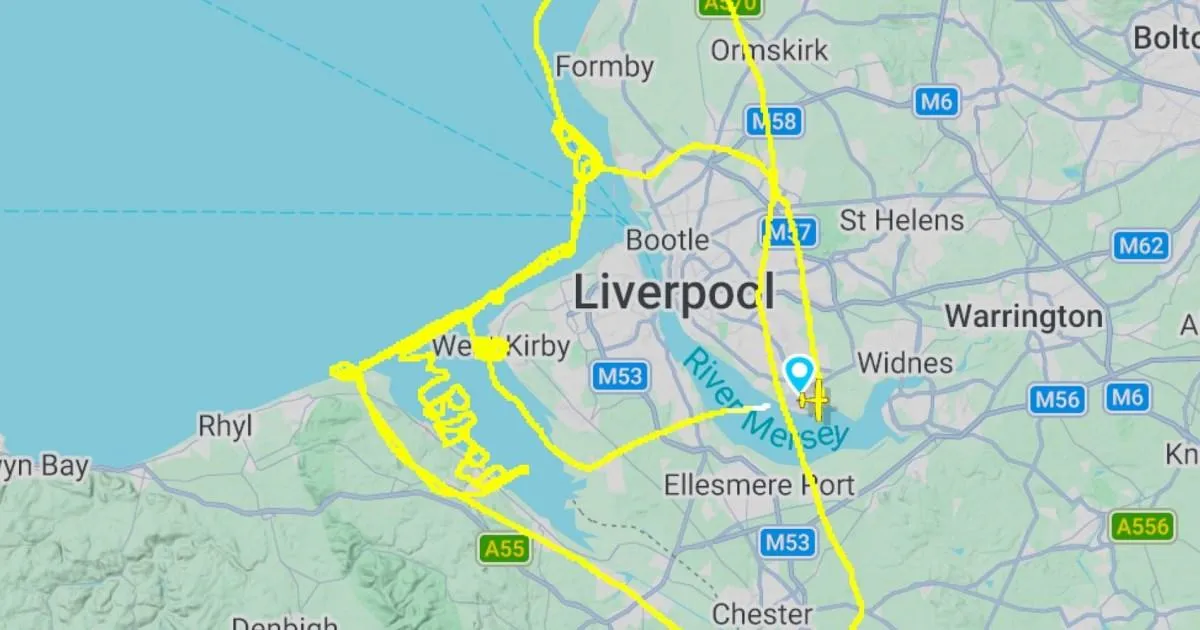
In a world where aviation is often defined by rigid schedules and the somber, technical nature of flight paths, a young pilot recently decided to inject a bit of candid humor into the skies. Over the weekend, eagle-eyed users of the popular flight-tracking website Flightradar24 noticed something unexpected appearing above the Dee Estuary, along the border between England and Wales. A Ravenair aircraft, which had departed from Liverpool for what should have been a routine test flight, began tracing a blunt, two-word message in the air: “I’m bored.” The stunt was a refreshingly human moment, turning the atmosphere into a giant digital canvas for a pilot clearly looking to liven up a monotonous task.
The journey itself spanned two hours, covering areas like Southport, the Wirral, and North Wales, but the real magic happened in a 20-minute window over the water between Talacre and Greenfield. Navigating at a modest altitude of 1,100 feet and speeds just under 100 knots, the pilot executed tight, angular loops with remarkable precision to ensure the text was perfectly legible to anyone watching the tracker. For those who track aviation data, it was a first; as TikTok flight blogger Aaron Rheins humorously noted, it is incredibly rare to see someone literally skywrite their state of mind when things get a little too quiet in the cockpit.
The aircraft involved was a Piper Tomahawk, a small plane that had been taken up specifically to test a new part recently fitted to the engine. Ravenair’s operations manager, Wayne Barrett, later explained that the pilot was a flying instructor in his twenties. Rather than viewing the incident as a breach of professional conduct, the airline took a surprisingly lighthearted approach. Barrett defended the stunt, noting that while the specific flight path hadn’t been pre-authorized, the pilot’s flying skills were undeniably impressive. It’s hard not to admire the irony: the man claims he’s bored, yet manages to execute a flight maneuver that requires the kind of high-level focus and coordination that most of us couldn’t dream of achieving.
In many workplaces, a stunt like this might invite a reprimand, but Ravenair seems to be taking it in stride. Wayne Barrett’s reaction to the event struck a pragmatic, almost supportive note, even suggesting that the pilot wouldn’t be facing any disciplinary action. By acknowledging that the pilot was simply dealing with the restlessness of a test flight, Barrett humanized the flying instructor’s position. It suggests a culture that values the human behind the controls, recognizing that even the most disciplined professionals sometimes need to find a creative outlet when the skies are empty and the schedule is wide open.
Ultimately, the incident became a brief viral sensation, drawing attention to a small, sleepy test flight that otherwise would have gone unnoticed. The aircraft is now safely back in the hangar, and the pilot—having enjoyed a moment of international notoriety—was reportedly off work the following day. It’s a gentle reminder that behind every dot on a radar map and every automated flight plan, there is an actual individual sitting in the cockpit, subject to the same feelings of monotony and the same urge to be playful as any of us in an office chair. It takes a certain kind of confidence to admit your boredom to the entire world from a thousand feet in the air, and for that moment, the sky felt a little more relatable.
Looking at the broader picture, the event serves as a quirky footnote in the often-serious world of aviation logistics. While passengers typically expect their pilots to be entirely focused on safety and navigation, this instance highlights the meticulous level of control required to “draw” with an aircraft. It wasn’t just a scribble; it was a feat of aerial geometry. By allowing the pilot a bit of grace, Ravenair hasn’t just kept their employee out of trouble; they’ve also humanized the airline industry, proving that even in the high-stakes world of flight, there’s always a little room for a personality to shine through—or, in this case, to manifest itself in the clouds.