

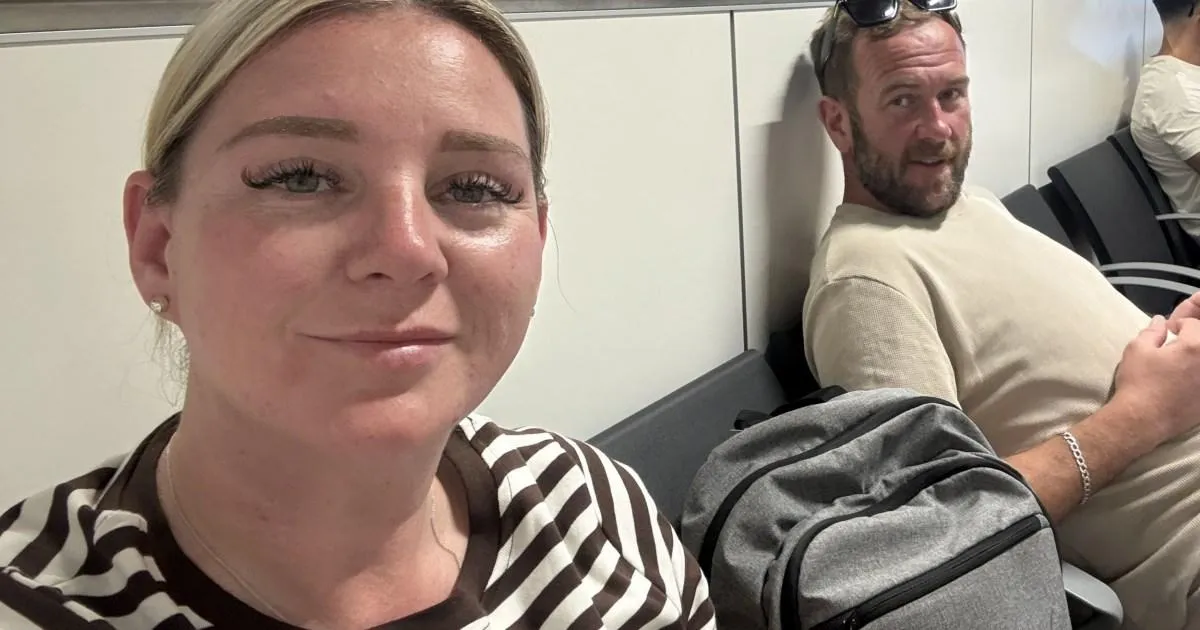
It was supposed to be a rare and hard-won escape. Karen Cassidy, a 36-year-old mother of three and the owner of an events planning business from Bexley in southeast London, had spent the summer making sure her children had everything they could possibly want. She had poured money, energy and love into their happiness, and at the end of it all, she allowed herself one small thing: a five-day all-inclusive holiday with her husband, George Gale, in the warm, sun-drenched south of Spain. The night before their 7am Jet2 flight to Malaga, however, the universe seemed determined to test that fragile plan. Their young baby kept Karen awake until 2am. The alarm clock, set for 4am, was never going to be enough. By the time the couple’s exhausted bodies obeyed the call of morning, their flight was already a lost cause. In that awful, sinking moment, many people would have accepted the loss and crawled back into bed. But Karen was not ready to give up. She scrambled to find a replacement journey leaving later that same day, found a 4pm flight, paid for it out of pocket, and steeled herself for a stressful, last-minute departure. The flight was delayed by an hour, but that felt like a minor inconvenience, because they were still going to make it. When they finally touched down in Malaga and made their way to the hotel, they believed the hardest part was behind them. They could not have been more wrong. The night air was warm, but the reception they were about to receive would turn that warmth to ice.
At the hotel front desk, Karen’s smile faded as the receptionist’s expression turned confused. There was no booking under their name. The cheerful check-in ritual became something much colder: a quiet apology, a tapping of keys, a shaking head. “We can’t find your booking,” Karen remembers being told. Then came the strange and devastating clarification: “Actually there is a booking, but it’s a past booking.” It took a moment for the words to land. As Karen stood there in the lobby, her heart sinking deeper with every second, the truth emerged. Jet2 had cancelled their entire holiday at 3pm that afternoon. While Karen and George were making their way through airports, boarding their replacement flight and dreaming of paella and sea views, the company had quietly erased the package they had paid for. The reason was a clause buried in the airline’s terms and conditions, a rule that most travellers have never heard of: the “no-show” policy. Under this policy, if a passenger does not use the outbound flight originally booked with Jet2, the entire holiday booking is automatically nullified, as if it had never existed. The same rule applies to flight-only bookings, where missing the outbound leg means the return flight is automatically cancelled too. Karen had no idea. She had assumed that because she had paid for a replacement flight and was still arriving in Malaga on the same day, the rest of the holiday would be honoured. Instead, she was left standing in a foreign hotel at night, exhausted, emotionally drained, and facing the very real prospect of being stranded with nowhere to go.
The financial blow was staggering. The original five-day all-inclusive trip had already cost the couple £1,100. The replacement flight had cost them even more on top of that. Now, to salvage the holiday they had dreamed about, Karen was forced to hand over another £1,500. That meant the trip, which was meant to be a modest and affordable escape, was becoming a financial black hole. And still the misery did not end. After paying out £1,500 to rescue the booking, Karen and George were charged £350 for their first night in southern Spain, only to be shown to a room that faced a fenced wall. The view, or lack of it, felt like a cruel joke. They had paid again and again, sacrificed sleep, endured delays, and battled through absolute chaos, only to stare at a barrier while on holiday. They made the decision to move, and that move cost them another £350. What should have been a relaxing break had turned into an ordeal that was costing them far more than they could comfortably afford. Karen, a mother who had already spent every spare penny making sure her children had a magical summer, was now watching her own small moment of self-care explode into an expensive nightmare. The guilt was enormous. She felt as though she was being punished for daring to take two minutes for herself, for wanting to do something that was not entirely for her children. The holiday she had imagined, golden and carefree, had become a source of stress, shame and regret.
The emotional weight of the experience was perhaps harder to bear than the financial loss. Karen described feeling distraught, crying in the hotel for twenty minutes, unable to stop the tears once they started. “This cannot be happening to us,” she remembers thinking, the words echoing inside her as the reality of the situation set in. It was not just that the holiday had been cancelled; it was the way it had happened. The couple had been treated as numbers, as entries in a system, with no flexibility, no compassion and no warning. They had every reason to believe that flying out later in the day would be enough, and they had paid a significant amount of money to make that true. Yet no one had flagged the consequences at the time they rebooked. No automated message had warned them that their package would be cancelled at 3pm. No one had told them to call Jet2 as soon as they missed the original flight. They had simply been wiped out of the system, like names erased from a list. For Karen, there was something profoundly dehumanising about that. She felt reduced to a line in a database, a statistic, a customer who had failed to follow an invisible rule. “We just felt like a number,” she later said. It is a phrase that captures the heart of the whole ordeal: the gap between the way corporations see a booking and the way a person experiences their own holiday. For the company, the cancellation was logical, automatic and compliant with the terms and conditions. For Karen, it was the shattering of a dream she had worked hard to build.
Seeking some kind of outlet, Karen shared her story on TikTok, and the response was immediate and divided. Many viewers thanked her for spreading awareness. “I never even knew this could happen, thanks for spreading awareness. I hope you still have good time on your holidays,” one person wrote. That comment speaks to the real value of Karen’s story: hidden policies exist in the fine print of travel contracts, and most of us do not read them until it is too late. Other commenters were far less sympathetic. One wrote, bluntly: “So if you had called the company the rest of your holiday would have been saved?” The implied criticism was clear: you should have known, you should have phoned, this is your fault. But the truth is more complicated. Karen and George were not trying to cheat the airline or dodge a fee. They missed a flight because a baby had kept them awake, and they had done everything in their power to still make it to their destination as quickly as possible. They had assumed that arriving was what mattered. The idea that a holiday could be cancelled even though the travellers had actively reached their resort, on the same day, would not occur to most ordinary people. Jet2 later confirmed that Karen might have saved the holiday had she called them immediately after missing the original flight. That is a useful piece of information, and it may help other travellers in the future. But it also underscores how unforgiving the system can be: one missed connection, one delayed phone call, one mistake made in a state of panic and exhaustion, and a paid-for holiday can simply vanish.
In the end, Karen and George did eventually salvage some kind of holiday, but it was not the one they had planned, and it came at a staggering cost. They paid for their mistakes, and then they paid again, and again, until the holiday was less an escape and more a ransom. Karen’s story is a reminder that travel rules are often written in fine print and enforced with a ruthless logic that takes no account of human frailty. It is also a story about a mother who worked hard, gave everything to her children, and then tried to take a small piece of happiness for herself. When that happiness collapsed, she was left not only with a financial loss but with a feeling of being punished. Perhaps the real lesson for all of us is simple: if you miss a flight, no matter how quickly you can rebook, call the airline and tell them you are coming. Do not assume the system will connect the dots. Do not assume that an automated cancellation will not fire while you are in the air. But there is a deeper lesson too, one that goes beyond travel advice. Rules exist to protect companies, but they should not be allowed to crush people without a moment of compassion. Karen Cassidy is a mother, a business owner, a person who wanted a short break from the exhausting work of caring for everyone else. She found herself crying in a hotel lobby, watching her holiday and her money disappear through a crack in the system she never knew existed. Her story is a warning, but it is also an appeal: that behind every booking there is a human life, with sleepless nights, tired eyes, and dreams that deserve a little more grace.