


At the charming Blue Anchor station in Somerset, life usually moves at the gentle, rhythmic pace of a bygone era. As part of a living history exhibit, a stationary pair of mannequins—designed to look like a mother and child evacuated during World War II—has long served as a nostalgic centerpiece for visitors. These figures, originally curated by the STEAM museum in Swindon, were intended to evoke the bittersweet emotions of a time when children were sent away for safety. However, the station’s quiet atmosphere was recently punctured by a bizarre and lighthearted mystery that left staff both baffled and amused.
The peaceful monotony of the station’s recent Diesel Gala, a bustling event that draws crowds of vintage train enthusiasts, provided the perfect cover for a prank of unexpected proportions. Amidst the chaos of incoming locomotives and excited passengers, an unknown group of revelers—suspected to be a bachelor party—managed to spirit away “Annie,” the child mannequin, without drawing a single glance from the crowds. For several hours, the empty bench where Annie once sat went unnoticed, as station staff were far too preoccupied with the logistical demands of the gala to realize that their pint-sized period piece had gone missing.
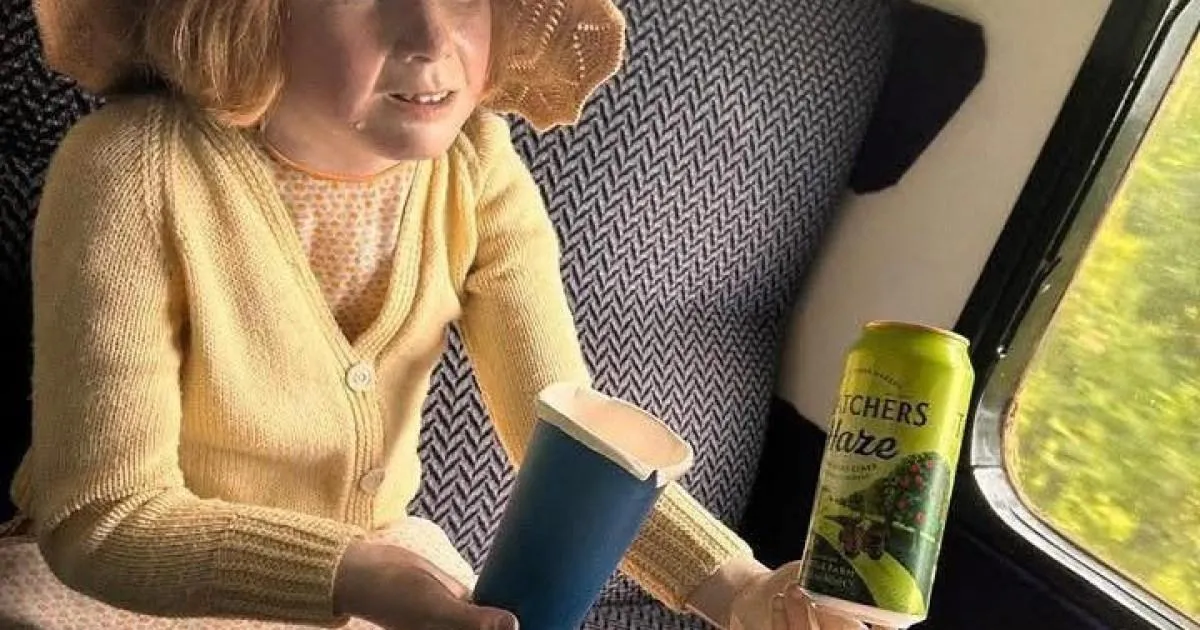
The mystery didn’t stay unsolved for long, though the resolution was far wilder than anyone could have anticipated. Five miles down the line at Minehead station, staff were stunned to discover Annie sitting nonchalantly in a train carriage. What made the sight particularly jarring—and undeniably hilarious—was that the “evacuee” had been posed with a can of Thatchers Haze cider clutched firmly in her hand. It appeared that Annie had been on quite an adventure, enjoying a festive excursion that was entirely unsanctioned by the station management.
When the staff at Blue Anchor finally received the call from their colleagues in Minehead, the news was delivered with a mix of disbelief and laughter. The station master, Robin Whichard, took the incident in stride, noting that Annie seemed entirely unfazed by her impromptu escapade. There is something inherently humorous about the image of a stoic, 1940s-themed mannequin being treated as a guest of honor at a modern-day stag party, complete with an alcoholic beverage in hand. It was a classic “missing in action” case that resulted in more smiles than stress.
The logistics of bringing Annie home were managed with the level of care usually reserved for VIPs. Given her “inebriated” state—a clever nod to the pranksters’ handiwork—the Minehead staff placed her into a wheelchair and saw her safely boarded onto the next train back to Blue Anchor. When she finally arrived home, she was returned to her usual position next to her mannequin mother, who, in a display of true stoicism, hadn’t seemed to notice her daughter had been on a five-mile booze cruise. It was a surreal moment of reunion that highlighted the playful spirit that often hides beneath the surface of heritage railway sites.
Looking back, the incident has become a favorite anecdote among the workers, serving as a reminder that even the most grounded historical exhibits can stumble into modern-day absurdity. While the station master admitted they were relieved to have Annie back, there is a lingering sense of affection for the “rebellious” streak she displayed. The Diesel Gala, meant to celebrate the engineering marvels of the past, ended up being remembered for the night a cardboard-stiff evacuee decided to break the rules and have a little fun. Ultimately, Annie remains at her post, now a local legend with a story far more colorful than the museum records ever intended.