



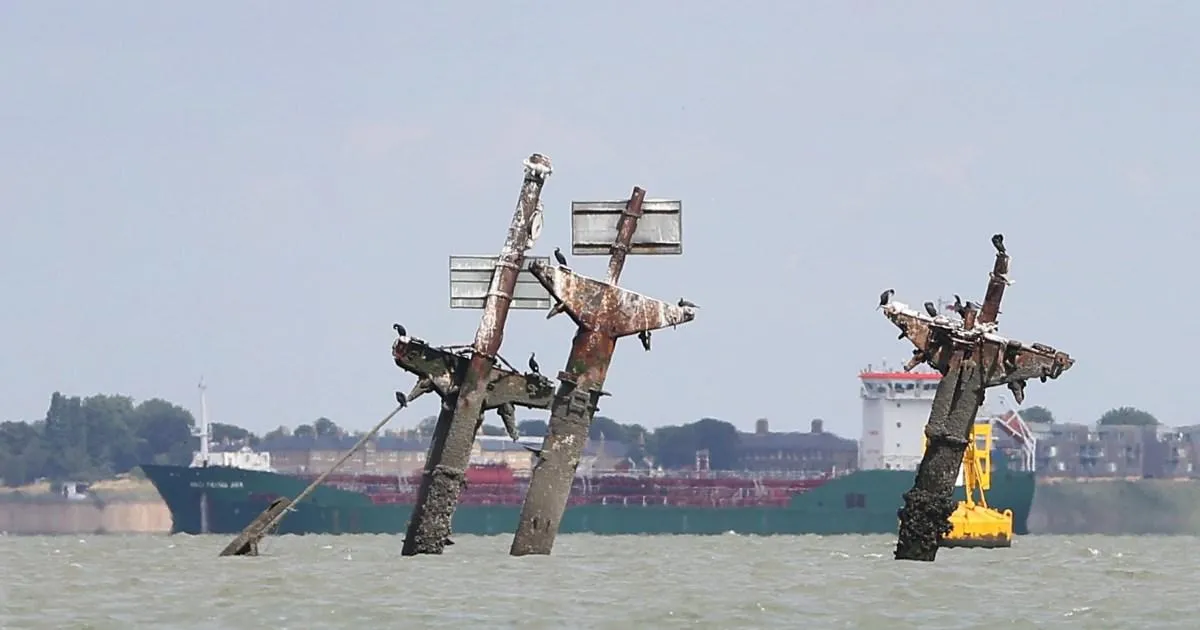
For decades, the waters of the Thames Estuary located just off the Kent coast have been home to an eerie, rusting sentinel: the SS Richard Montgomery. Known locally and globally as the “doomsday wreck,” this American Liberty ship met its tragic end in 1944 when it ran aground and sank while carrying a massive cargo of wartime munitions. Even after eighty years beneath the waves, the ship’s three masts have remained visible above the waterline, serving as a stark, skeletal reminder of the Second World War. Soon, however, this familiar silhouette will vanish forever as authorities undertake a precise and necessary engineering operation to preserve the site’s future safety.
The decision to dismantle the masts is not born of a desire to erase history, but rather an urgent need to protect the structural integrity of the wreck. Experts from the Department for Transport have determined that the aging, towering masts now pose a significant physical threat to the ship itself. As the steel weakens under the relentless assault of tide and salt, there is a mounting risk that they could collapse, potentially crashing down onto the 1,400 tonnes of unexploded munitions still resting in the hold below. By carefully removing these masts to a point below sea level, the government hopes to eliminate this hazard and prevent a potentially catastrophic incident.
The operation, scheduled to begin this September, is a marvel of maritime engineering. Robin Rickard, a strategic expert on explosive ordnance, explains that a specialized “jackup barge”—a robust, stable floating platform anchored firmly to the seabed—will be used to ensure the work is performed with absolute precision. Using high-tech diamond wire saws, the team will systematically cut away the steel structures, recovering them for transport. It is a delicate process that requires meticulous planning to ensure that the surrounding environment and the volatile cargo remains undisturbed throughout each stage of the project.
Once retrieved, the history of the SS Richard Montgomery will not be consigned to a scrap yard. Instead, in a move that bridges the gap between past and present, the masts are set to be relocated to Britain’s historic Chatham Dockyard in Kent. For local residents who have grown up watching these masts peer out from the horizon, this decision ensures that a piece of their maritime heritage remains accessible. Maritime minister Keir Mather has emphasized that these artifacts will be preserved for future generations, allowing communities to engage with the story of the vessel in a meaningful and permanent setting.
The project has required significant international cooperation, highlighting the ship’s unique status as a piece of American property resting in British waters. Collaborative discussions between the Department for Transport and Washington were essential to clear the way for this preservation effort. U.S. Ambassador to the UK, Warren Stephens, has officially voiced his support for the plan, endorsing the vision to transform these reclaimed wreckage pieces into educational displays. This cross-Atlantic teamwork underscores the shared history of the ship’s original journey and the collective responsibility to manage its final, precarious legacy with the utmost care.
Ultimately, the removal of the masts represents a responsible turning point in the long, monitored life of the “Monty.” While the masts may soon disappear from the surface of the Thames Estuary, the exclusion zone around the wreck will remain firmly in place, ensuring that the site continues to be managed with strict oversight. Project manager Nolan Conway of Resolve Marine noted that this effort stands as a significant milestone in marine operations, balancing the need for public safety with a profound respect for history. As we bid farewell to the familiar skyline of these masts, we move toward a safer, well-documented future for one of the UK’s most famous and sensitive historic sites.