

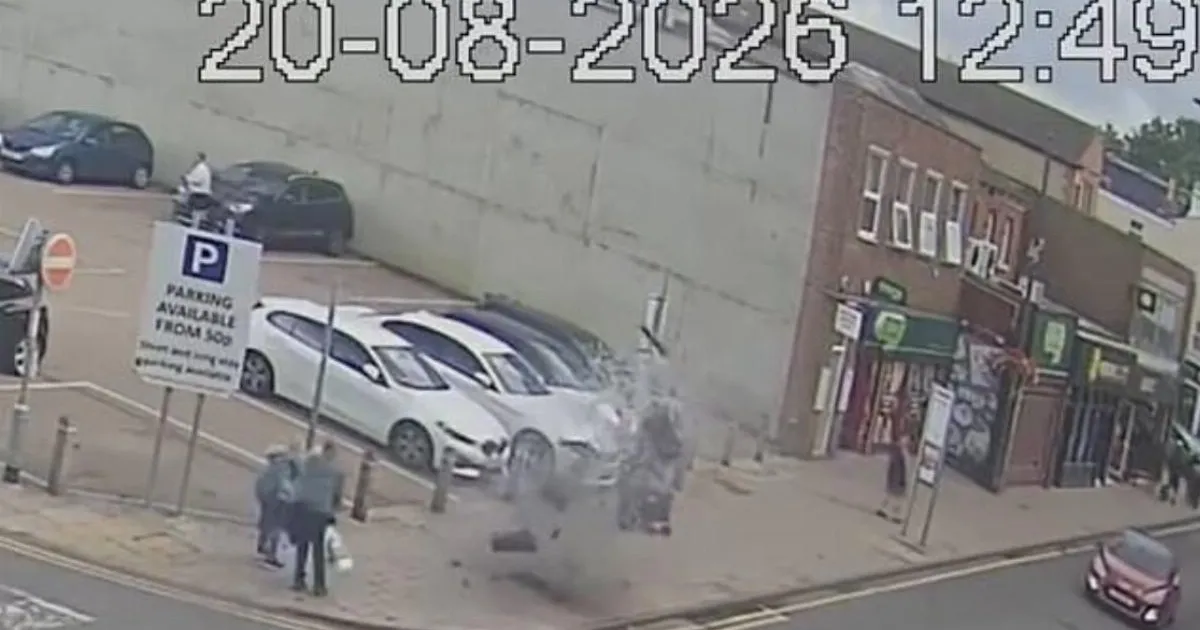
It was the kind of quiet, late-August moment that seems almost unremarkable at first. The streets of Boston, Lincolnshire, were carrying on as they always do—people finishing errands, a car easing along the road, a few pedestrians crossing near the Bond Street car park. Then, without any warning, the ground itself rebelled. In the space of a heartbeat, the pavement erupted in a violent burst of energy, sending concrete slabs cartwheeling through the air like leaves in a sudden storm. Flames clawed up from beneath the footpath, smoke curling into the daylight, and the entire street seemed to jolt as if struck by something enormous. It might sound like the opening scene of a disaster film, but this was real life, captured in sharp, unblinking detail by a municipal CCTV camera. The footage, later released by Boston Borough Council, shows just how terrifyingly random these moments can be. What is now clear is that an underground electrical fire had been smoldering beneath the street, building until it found a way out—straight upward, through the concrete that ordinary people walk on every single day without a second thought.
The near-miss aspect of the incident is what makes the video so difficult to watch. Two pedestrians are visible crossing the street just moments before the explosion, entirely unaware of the danger sitting beneath their feet. A car drives past at almost exactly the wrong time, its driver as oblivious as everyone else. Had any of them been in a slightly different position—a step slower, a pause to check their phone, a moment of hesitation—the outcome could have been devastating. Instead, the blast tore through the pavement right after they passed, sending debris high into the air and dislodging a heavy manhole cover as if it were a bottle cap. The raw force of it is shocking to witness, even through a grainy security feed. There is something deeply unsettling about seeing an environment we treat as completely stable suddenly become violent and hostile. We trust the ground beneath us. We never think about the electrical cables, gas pipes, and hidden infrastructure that hum and pulse below the surface. And then, on a random afternoon in a small English town, that trust is broken in an instant, and all it takes is seconds for chaos to spill into ordinary life.
Miraculously, no one was injured. That simple sentence carries an enormous weight when you watch the footage. The explosion could easily have killed or seriously harmed someone, and the fact that it did not feels less like luck and more like a strange kind of grace. The immediate priority after the blast was safety. Boston Police closed the road without delay, cordoning off the area while firefighters and other emergency services arrived to deal with what the council later described as flames coming from underneath the footpath. The street remained closed as crews worked to make the area safe, and the underground electrical fire was brought under control. For the people living and working in Boston, the sight of blue lights and caution tape was probably unsettling, a reminder that danger can emerge from the most ordinary settings. The council later confirmed that the incident was caused by an underground electrical fire, and while such events are rare, they are not entirely unheard of. Aging infrastructure, fluctuating power loads, and environmental factors can combine in unpredictable ways. But for most people, the wider lesson was simpler and more personal: today, the ground held. Tomorrow, perhaps, we should be grateful for every step we take on solid pavement.
Boston Borough Council chose to share the dramatic footage on Facebook, and in doing so, they highlighted something that often goes completely unnoticed. “No two days are ever the same,” the council’s post began. Last Thursday, CCTV operators captured an underground electrical fire on West Street. Thankfully, nobody was injured, and our partner agencies were soon on the scene. That short, understated message barely scratches the surface of what actually happens behind the scenes. While the rest of us go about our days, CCTV operators are watching over our high streets, car parks, and residential areas, monitoring thousands of hours of footage from control rooms tucked away in municipal buildings. They see the mundane and the extraordinary, the late-night arguments and the lost children, the shoplifters and the sudden medical emergencies. They are the quiet eyewitnesses to the life of a town, and their work is not always appreciated. When they spot something like the early signs of a pavement fire, they can act immediately, alerting the emergency services and giving them the real-time information that makes fast, effective responses possible. The council’s post made a point of thanking these operators, and it was a reminder that public safety is not just about police officers and firefighters—it is also about the people who sit behind screens, paying attention when no one else is.
The footage from Boston is a strange kind of public service announcement, even if that was not the intention. It reminds us that the world is more fragile than it looks. We walk across pavements, drive down streets, and stand on corners without ever considering what is beneath us. A network of cables, pipes, and ancient foundations lies just a few feet below the surface, and most of the time it works without complaint. But when something goes wrong, the consequences are immediate and dramatic. This incident also highlights the importance of infrastructure maintenance and the quiet work of local councils and utility companies who inspect, repair, and upgrade the systems we take for granted. It is not glamorous work, and it rarely makes the news, but it is exactly what prevents small problems from becoming catastrophes. In this case, the system failed—an electrical fire took hold beneath the street—but the rapid response from CCTV operators and emergency crews meant that a terrifying moment did not become a tragedy. The near-disaster in Boston could have been a viral video of a different kind: one showing serious injuries, frantic attempts to help, and a community shaken by loss. Instead, it is a video of shock and relief, a story with a happy ending that almost did not happen.
Perhaps the most human response to this footage is simply gratitude. Gratitude that no one was walking directly over that spot when the pavement exploded. Gratitude that the car had already passed. Gratitude that the two pedestrians who are seen crossing the street just before the blast had the ordinary grace of timing on their side. We can imagine how those individuals felt when they watched the video later—the cold flush of realization, the sudden awareness of how close they came to being part of something terrible. For the CCTV operators, it was another day in a job that is never predictable, a moment of intense focus followed by the calm rhythm of alerting the right people. For the council and the emergency services, it was a test of coordination and preparedness, one that they passed. And for the rest of us, it is a reminder to hold our ordinary moments a little more closely. We never know when a street might shake, when the ground might open, or when a quiet afternoon might turn into a memory we carry for the rest of our lives. The pavement in Boston will be repaired, the fire will be investigated, and life will return to normal. But the footage remains, a strange and powerful document of a day when a small English town came within inches of disaster—and walked away untouched.