


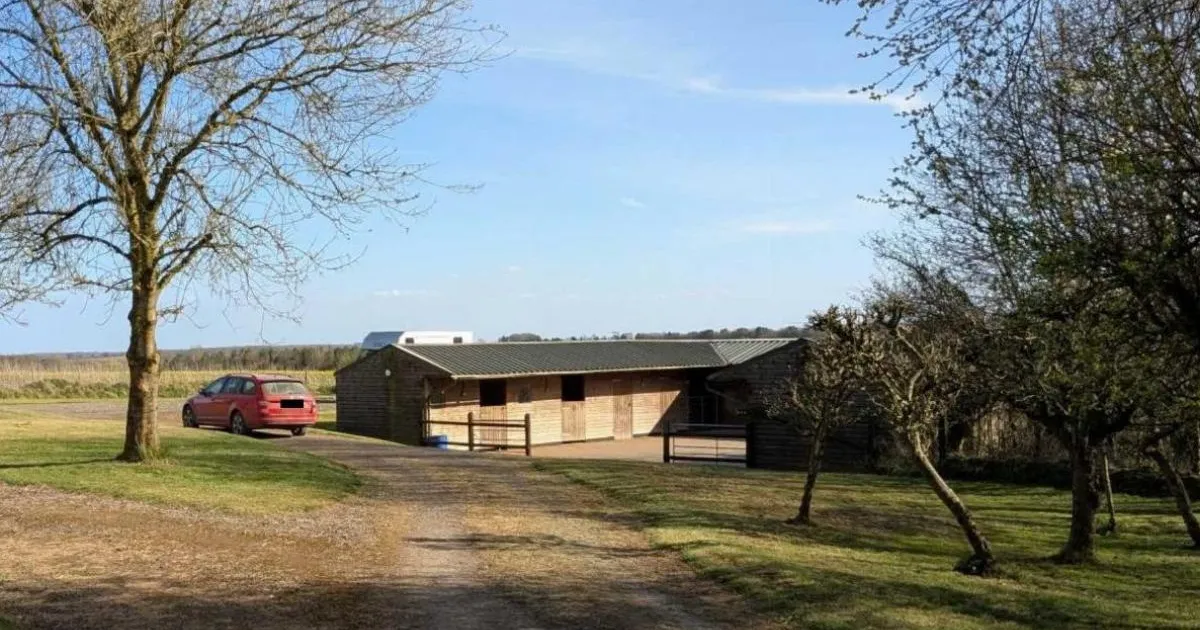
Nestled amid the rolling, honey-colored hills of the Cotswolds, an Area of Outstanding Natural Beauty in rural Oxfordshire, sits Chalford Paddocks—a sprawling 15-acre estate that seems to embody the very essence of English country elegance. The property boasts a traditional stone-walled farmhouse with four bedrooms, sweeping countryside views, and an array of equestrian facilities that would make any horse lover swoon. For the past five years, however, the most curious feature of this £2.25 million idyll has not been the horseshoe-shaped timber stable block that stands behind the main house, but rather the secret life it has been hiding. Within those weathered wooden walls, behind the tack room and the feed store, a fully functioning one-bedroom flat has been quietly serving as a home for the estate’s 54-year-old owner, James George—a hardworking haulage boss who has made the unlikely space his sanctuary after an amicable separation from his partner. From the outside, the building looks like any ordinary stable, perhaps a bit large for the eight horses it was originally designed to house, but nothing more. Yet inside, the living quarters occupy the largest portion of the structure, complete with a compact kitchen, a snug lounge area, plumbing, insulation, and all the comforts of a modern granny flat. It is a hidden world, invisible from the road, that has become the center of a bitter planning dispute now forcing its creator to tear it all apart.
James George’s story is not one of arrogance or defiance, but of personal tragedy, family duty, and an earnest attempt to do right by those he loves. In 2014, he decided to replace the dilapidated stables on his estate with a newer, more functional building. As he planned the construction, his thoughts turned to his elderly mother, whose health was beginning to decline. He envisioned a self-contained living space within the stable block where she could stay, close to family yet with her own privacy, as she aged. The project was completed with care, and his mother did indeed live there for several months—a period made all the more poignant because it coincided with her battle against cancer. While undergoing chemotherapy, her immune system was severely compromised, and she needed to self-isolate from the rest of the household because James’s sister, who lived with her, worked as a hospital cleaner and posed a potential infection risk. The stable flat became her refuge, a place of safety and solace during her treatment. Sadly, she later passed away, but the flat’s purpose did not end there. Over the years, James opened his unusual dwelling to friends in need—two friends who had gone through divorces found temporary shelter within its walls, and another friend’s father stayed there after returning from working in South Africa. For a man who clearly values family and friendship above all else, the stables became more than just a building; they became a haven for those experiencing life’s hardest moments.
Then, five years ago, James’s own life took an unexpected turn. Following an amicable separation from his partner, he found himself in need of a home that would keep him close to his young son. The stable flat, already warm and familiar, was the obvious choice. “For the past five years or so I’ve ended up living in it after amicably splitting with my partner,” he explained. “Living in the stables has been ideal. It’s allowed me to continue regular access and support to our seven-year-old son.” The arrangement gave him the flexibility to be present in his son’s life every day, to share meals, help with homework, and tuck him in at night—a routine that would have been impossible had he moved elsewhere. He diligently woke at 3:15 AM each day to drive his truck, working more than 60 hours a week to provide for his child. The tiny flat, with its modest kitchen and minimalist living space, became his anchor in an otherwise turbulent period. It was not a luxury apartment or a grand country retreat; it was simply a place where he could be the father his son needed. Yet, for all its personal significance, the flat had never received official planning permission for residential use, and that technicality would soon come to haunt him.
In November 2023, James decided to formalize the situation. He approached West Oxfordshire District Council, seeking a Certificate of Lawfulness—a legal recognition that the conversion had existed long enough to be exempt from planning enforcement. His argument rested on time limits: he claimed that the dwelling had been completed in 2014, and that he had continuously lived there for five years, which he believed was sufficient under a four-year rule that applies to certain breaches. His planning consultant and solicitor both advised that the four-year limit was the applicable one. To support his application, he gathered a trove of evidence: receipts for building materials, sworn testimony from his builder, and detailed accounts of when the work began in March 2014. The council, however, was not convinced. They rejected his application, insisting that the relevant period was actually ten years—the longer limit for residential conversions where there is no evidence of continuous occupation. A planning inspector, David Jones, was brought in to adjudicate, and he ultimately sided with the council. While Jones acknowledged that the living quarters had been completed more than a decade before the enforcement notice was served, he found that George had failed to prove that the space had been continuously used as a home for the required number of years. The distinction between construction and occupation proved fatal to his case, and he was ordered to strip out all residential fixtures and fittings within six months, returning the stable to its intended equine purpose.
The council’s stance was not without its own suspicions. They reportedly alleged that the dwelling had been deliberately concealed from authorities, pointing to the lack of a separate postal address, the absence of any council tax registration, and the fact that the accommodation was virtually invisible from the road. They also noted that there was little evidence the stables and tack rooms had been used for “equine activities,” suggesting the building had been effectively repurposed without any intention of disclosure. However, Inspector Jones did not accept this darker narrative. He found no evidence of a “deliberate, elaborate and sustained plan to deceive,” instead concluding that the building had been “constructed unlawfully” but without a calculated effort to hide it. This nuanced ruling left James in a strange limbo: he was not branded a liar, but he was still legally required to dismantle his home. The inspector’s decision meant that establishing when the conversion was finished was not enough; he needed to demonstrate continuous residential use for a decade, which he could not do given that he himself only moved in five years ago. The law, as it stood, offered no mercy for his mother’s memory, his friends’ recoveries, or his own role as a devoted father.
James George’s reaction to the ruling is a mixture of resignation, bitterness, and a stubborn sense of injustice. He describes feeling that the council’s action is motivated by “jealousy and envy”—a charge they firmly reject. “Absolutely I do feel there’s been an injustice,” he told the Daily Mail. “It’s been adjudicated on and the law’s the law, so as bitter as I am, I don’t think there’s anything to be gained from [talking about] it.” He has no plans to appeal, accepting the decision with the same stoicism he applies to his early morning starts. The practical consequences are stark: he will have to remove the plasterboard, insulation, and plumbing, leaving an empty shell. He cannot even retain a toilet or convert the space into a playroom for his son. In a cruel irony, he is allowed to keep the heating oil tank, but the boiler that depends on it must go. “Perversely I’m allowed to keep the heating oil tank but the boiler that runs off it has to go,” he said with a rueful shake of his head. As for the estate itself, it is already on the market, listed through Maxwell Douglas with glowing descriptions of “comprehensive equestrian facilities” and seven stables alongside a tack room, feed room, hay store, store room, and workshop. The stable block will continue to stand, but the human story it once sheltered will be erased—a footnote in the battle between bureaucratic regulation and one man’s desperate attempt to keep his family together against the backdrop of England’s most beautiful countryside.
In the end, this tale resonates far beyond a single Cotswolds estate. It speaks to the fragile line between personal need and public planning law, the invisible struggles many people face behind closed doors, and the often-unforgiving nature of regulations that cannot account for the messy, emotional realities of human life. James George is not a property developer flouting rules for profit; he is a father, a son, and a friend who repurposed a stable block to shelter his dying mother, support a friend through divorce, and raise his son in close proximity. The council’s response, while legally sound, feels cold and mechanical: “Anyone undertaking building work or carrying out a material change of use of land or buildings should check whether planning permission is needed and obtain it before starting. We take breaches of planning control seriously and act proportionately, taking enforcement action where necessary to protect communities and the local environment.” Proportionate, perhaps, but devastating to one man’s home. As the heating oil tank remains and the boiler goes, one cannot help but wonder if the true cost of this enforcement is measured not in pounds and pence, but in the quiet sadness of a father who must now say goodbye to a place that allowed him to tuck his son into bed each night. The stables will return to their rightful purpose, but the heart of the home has already been broken.