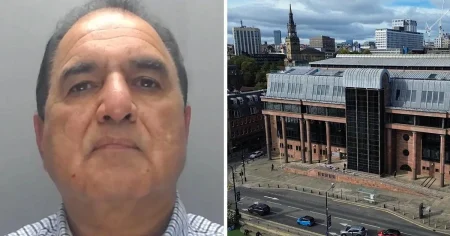




For more than two decades, Linda Razzell’s family have lived in a strange, suspended grief—a grief with no grave to visit, no funeral to hold, and no final answer. This week, that grief was thrust back into the open as her convicted murderer, Glyn Razzell, appeared in public for the first time in twenty years, leaving the Royal Courts of Justice in London. The sight of Razzell, now 66, was a stark reminder of a case that has haunted Wiltshire since March 19, 2002, when Linda, a 41-year-old mother of four, vanished on her way to work at Swindon College. She had been in the middle of divorce proceedings from Razzell, a fact that would later form part of a grim picture of control and violence. In 2003, Razzell was convicted of her murder and jailed for life with a minimum term of 16 years. He has never revealed where Linda’s body is, and he has always denied killing her, even as a jury found him guilty beyond reasonable doubt. For Linda’s children, relatives and partner, the absence of her remains has made every day an endurance. They have been forced to relive the horror in parole hearings, in courtrooms and in the media, while Razzell has remained silent, preserving what one family member called his “narrative of innocence.” That silence, they argue, is not passivity but an active cruelty—a way of maintaining power from behind bars. For them, each parole hearing is not a technicality but a reopening of a wound that has never had the chance to heal. The latest chapter in this long ordeal began when the Parole Board, despite acknowledging Razzell’s capacity for “wholesale deceit,” decided he could be released on licence. The Ministry of Justice disagreed and asked the High Court to review the decision. On Friday, a senior judge overturned the parole decision, ordering that Razzell remain in prison. But the relief, as Linda’s daughter Catherine said, was bittersweet—the family should never have had to fight for safety in the first place.
The legal backdrop to the case is Helen’s Law, a piece of legislation formally known as the Prisoners (Disclosure of Information About Victims) Act 2020, designed to make it harder for killers to win parole if they withhold information about their victims’ remains. Named in memory of Helen McCourt, the law was intended to stop killers from hiding behind silence. The law was meant to recognise the ongoing harm caused by a killer’s silence, and Linda’s family had hoped it would be a turning point. Razzell became the first prisoner to be refused parole under the new law in 2021, a milestone that gave Linda’s family a small measure of hope that the system finally understood their suffering. But that hope was tested again in August, when Razzell’s third and most recent review hearing took place. The panel accepted there was “ample evidence” that Razzell is capable of wholesale deceit and that his deliberate withholding of information meant he continued to pose a risk. Yet months later, in April, the same Parole Board ruled he could be released on licence—a decision that stunned the family and prompted the Ministry of Justice to intervene. To the family, it felt like a betrayal, not just of them but of the principles behind Helen’s Law. What was the point of a law designed to keep killers like Razzell in prison if the Parole Board would release them anyway, without the truth ever being told? The High Court’s subsequent ruling, quashing the release decision, restored a measure of faith in the process, but it also exposed the fragile, exhausting nature of that process. Every time Razzell comes up for parole, Linda’s family must relive the details of her disappearance and death, write victim impact statements, and brace themselves for the possibility that he could walk free. Catherine Razzell spoke of her relief at the judge’s ruling, but she was quick to point out that relief is not the same as peace. The family are not asking for revenge; they are asking for accountability—and for the basic human dignity of being able to bury their mother.
In the two-day hearing earlier this week, Linda’s family spoke with raw eloquence that moved even the judge. Catherine Razzell described her father’s refusal to disclose the location of her mother’s body as “cruel” and “abusive.” She said: “By choosing to withhold the only information that could provide us with some comfort and closure, and preventing us from being able to hold a funeral for our much-loved mother, he is clearly demonstrating he is still abusive—retaining power over the situation and prioritising his narrative, where he can deny killing her, despite being found guilty and given a life sentence.” Catherine noted that her father is of sound mind, which makes his choice all the more deliberate. “There is no reason for him to be released while he is still actively choosing to be controlling and abusive from within prison,” she said. Linda’s cousin, Julie Westmore, described Razzell as a “master manipulator” who has never taken responsibility for what he did. She told the court that releasing him now would extinguish any hope of finding Linda’s remains. “If Glyn Razzell remains in prison, it will be the incentive he needs to eventually do the right thing. It will be the right thing for everyone concerned, himself included. If Glyn Razzell is released now, all hope of ever finding Linda’s remains will be lost. We will not feel safe if Glyn Razzell is released. We know him to be a violent man and an accomplished liar.” Linda’s partner, Greg Worrall, appeared via video link and made a searing observation: Razzell is continuing to exert “coercive control over people even in death.” Worrall noted that throughout multiple parole applications, Razzell could have shown remorse and disclosed where Linda’s remains are, but he has chosen not to. “He knows the pain this is causing Linda’s family and children,” Worrall said. The family’s statements painted a portrait of a man whose violence did not end with Linda’s murder—it simply changed form. Their words were not just statements in a legal process; they were cries from a family that has been kept in limbo for more than two decades. From prison, he still dictates their emotional landscape, forcing them to fight year after year for basic justice.
The Ministry of Justice’s barrister, Tristan Jones KC, argued that Razzell had made a “degree of progress” and that professionals who worked with him supported his release, but he warned that the Parole Board’s report had “lost sight of the fact that he has not been honest or transparent.” Jones described Razzell as “a deeply deceitful individual” who carried out a campaign of violence against Linda, some of it witnessed by their children, and then planned and carried out her murder. “He is so attached to his narrative of innocence that he is willing to continue inflicting pain on the victims,” Jones said. It is a chilling assessment, and one that speaks to why the family cannot trust the idea of Razzell walking free. Razzell, now in an open prison in Suffolk with a job and a property outside the prison walls, attended the hearing in London and opposed the move. His barristers argued there was no basis for the High Court to interfere. But the arguments did not persuade the judge. Over the course of the hearing, the court heard about the violent history that led to Linda’s murder—a history marked by control, intimidation and abuse that sometimes unfolded in front of the children. The family’s accounts painted a picture of a man who, even after decades behind bars, remains wedded to his own version of events. He is not, they insist, a reformed man who has done the hard work of examining his behaviour; he is a man who has waited out his minimum term while refusing to engage with the truth. The professionals who supported his release may have seen progress, but to the family, progress without honesty is meaningless. How can a man be considered safe to release if he still refuses to acknowledge the most fundamental fact of the case—that he killed his wife and knows where her body is? The judge had to weigh the Parole Board’s confidence in Razzell’s manageability against the family’s lived experience of his deception. She chose to listen to the family. Her ruling reflected a deep scepticism about the Parole Board’s decision.
On Friday, Mrs Justice Cheema-Grubb delivered a judgment that brought Linda’s family to a place of relief, if not healing. She quashed the Parole Board’s decision, saying she was “not satisfied that it is no longer necessary for the protection of the public that Glyn Razzell be confined.” She was blunt in her assessment, finding Razzell to be “fundamentally dishonest” and saying she was “satisfied that he continues to withhold information that he could deliver up.” The judge also noted that Razzell had not carried out any “substantive risk reduction work,” meaning that, in terms of internal controls, “he is the same man he was when he killed Linda, and that is relevant to risk.” She pointed to “significant gaps” in Razzell’s understanding of the risk he poses, and said the proposed plan to manage his release “relies on trust that has not been earned.” Those words carry profound weight. The judge essentially said that Razzell’s outward integration into an open prison—holding a job, having a property—was not enough to overcome the core problem: he has not confronted the truth. Without that, any plan to release him is built on sand. But perhaps the most human moment of the ruling came when the judge acknowledged the suffering of Linda’s loved ones. She said they had “described their suffering with remarkable moral clarity.” She added: “The ongoing agony of not being able to lay their beloved mother to rest and the regular pain of having to write down how they are coping with the hurt that invades so much of their lives should have rung in the defendant’s ears. Perhaps it does?” It was a poignant, almost intimate comment from a High Court judge—an acknowledgement that the legal process is not just about risk assessments and procedures, but about real people whose lives have been fractured by violence and silence. It was a rare moment where the law stepped out of abstract language and spoke directly to the human cost at the centre of the case. For Catherine Razzell and her family, the ruling was a validation. “Part of my father’s abuse is that, as a family, we have to go through this process,” she said. “As well as experiencing the most devastating loss of my mother, 24 years later we are still in court trying to keep the rest of our family safe from a man who is continuing to do our family harm.” The fight, she made clear, is not over. It never really is.
The broader meaning of this case extends far beyond one family. Helen’s Law was named in memory of Helen McCourt, and its purpose is to prevent killers from benefiting from their own secrecy. Razzell’s case is a landmark because it tested that law in a way no other case had done. The High Court’s decision sends a message: a murderer who refuses to tell the truth about what he did with a victim’s body cannot expect to be rewarded with freedom. It acknowledges that the act of withholding remains is itself a form of violence—a relentless, ongoing attack on the family left behind. But the case also exposes how difficult it is for families to carry this burden. Linda’s family have spent over two decades in and out of courtrooms, writing statements, giving interviews, and reliving their worst moments in public. They have done so with a dignity that the judge explicitly praised. “None of us want my father to die in prison,” Catherine said. “What we want is for him to acknowledge what he has done, show remorse and tell us where our mother’s body is so that we can finally lay her to rest. There is no peace for us until that happens.” Those words are the heart of the matter. This is not a family seeking vengeance; they are seeking the same thing any family would want after a murder: the body of a loved one, a proper funeral, and an honest accounting. They are also seeking safety—for themselves and for the public. The judge’s decision ensures, at least for now, that Razzell remains locked away. But the underlying tragedy is that his release was ever considered in the first place. The case has also been placed in the context of a wider national conversation about violence against women. As Metro’s “This Is Not Right” campaign, launched in partnership with Women’s Aid, has made clear, violence against women is a national emergency. Linda’s story is one instance among too many—a woman killed by a partner who refused to let go, whose family continued to be terrorised by his silence for decades. The campaign seeks to shine a light on the scale of this crisis and to give voice to survivors and families. Linda’s family have used their voice, time and again, with heartbreaking clarity. The fight for truth is not over. But this week, at least, the legal system stood with them, and the refusal to let a convicted killer and accomplished liar walk free was a small but significant victory. The hope is that someday, Glyn Razzell will decide to do the right thing—not for himself, but for the family he has spent a lifetime hurting. As long as he refuses to speak, the shadow of his crime will follow the family. The law can keep him in prison, but it cannot force him to give them the truth. Until then, they will continue to wait, remember, and fight.