



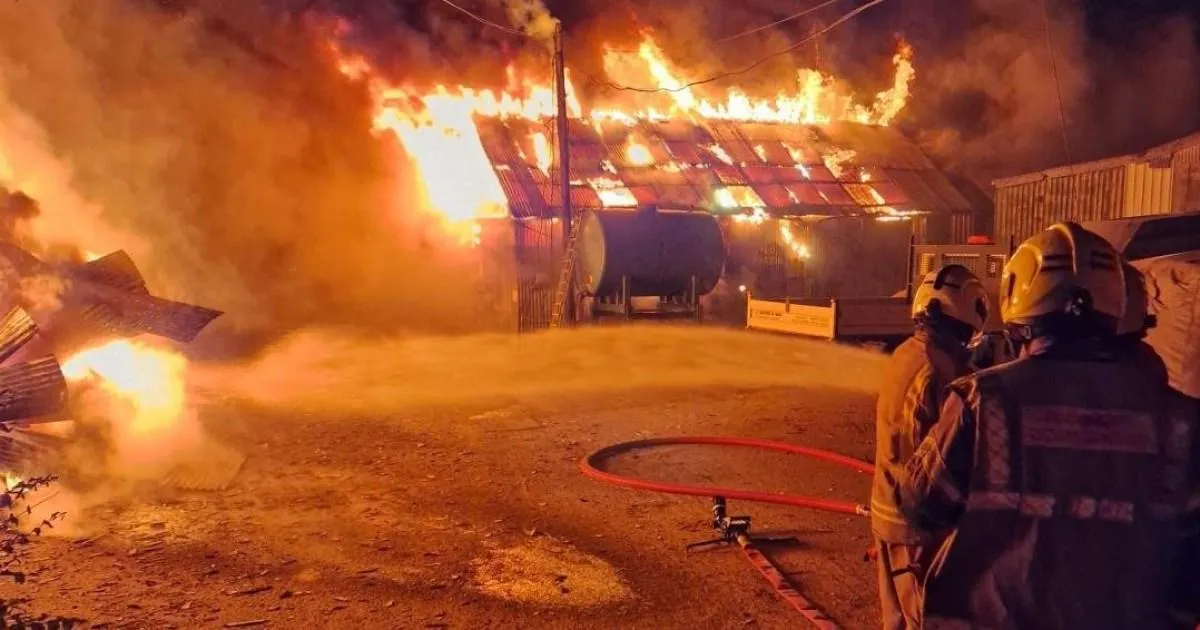
Late last night, the quiet of High Ongar was shattered as a massive blaze tore through an industrial site on Woolmongers Lane. Around 11:00 p.m., emergency services were alerted to a fire that had rapidly engulfed a large barn, putting neighboring vehicles and mobile homes at significant risk. As twelve crews arrived on the scene, they were met with a daunting sight: flames leaping into the night sky and thick, suffocating smoke spreading toward local residential areas. The intensity of the inferno was exacerbated by the presence of industrial and farming cylinders inside the structure, which posed a constant threat of explosion and added a dangerous, unpredictable element to the firefight.
The logistical challenges faced by the Essex County Fire and Rescue Service were immense from the very start. Battling such a large-scale fire is always demanding, but the crews were forced to operate with a notably limited water supply, forcing them to be strategic and methodical in their approach. Station Manager Scott Fretton praised the resilience of his team, who worked tirelessly through the night to surround the fire and prevent it from jumping to other nearby buildings. By the early hours of the morning, they had finally gained enough control to begin scaling down the operation, though firefighters remained on-site to monitor hot spots and manage the ongoing hazards.
Safety remained the top priority as the sun began to rise over the scorched facility. With smoke continuing to drift into the surrounding neighborhoods, authorities issued an urgent warning to local residents: keep your windows and doors tightly shut. This precaution was not merely about the visible smoke, but also the loud, jarring bangs echoing from the wreckage. These explosions were the result of the trapped gas cylinders succumbing to the heat, creating a nerve-wracking environment that served as a stark reminder of the volatile materials being consumed by the flames.
To make matters worse, the crews found themselves fighting the fire under the grueling conditions of a persistent, intense heatwave. With temperatures in the area expected to climb toward 30C, the physical toll on the firefighters—already exhausted from a long, dangerous night—was extreme. The region has been locked in a dry, sweltering weather pattern for a full week, parching the landscape and leaving virtually no hope for rain to assist in dampening the affected areas. This combination of scorching, unrelenting heat and dry conditions has turned what might have been a routine incident into a test of physical endurance for the responding units.
The incident in High Ongar comes amidst a broader, concerning backdrop of fire-related emergencies nationwide. Just a day prior, an iconic Victorian building in Edinburgh, formerly home to a Debenhams department store, was left gutted by a catastrophic fire that destroyed its roof and charred its historical facade. Whether it is a commercial blaze in an industrial yard or the unfortunate destruction of a city center landmark, these events have been exacerbated by the current environmental conditions, highlighting the increased risk of fire in a country struggling to cope with record-breaking heat and dry, tinder-like conditions.
As the situation in High Ongar slowly stabilizes, the focus has shifted toward the long road of recovery for the affected site and the relief of the nearby community. While the fire is being managed down to eight crews, the smoke and the lingering risk of cylinder pops mean that life in the immediate vicinity will remain disrupted for several hours. It is a sobering reminder of how quickly an industrial site can become a site of danger, and how much we owe to the dedicated first responders who step directly into the fire’s path when the rest of the world is asleep, all while facing the punishing elements of an unforgiving summer.