


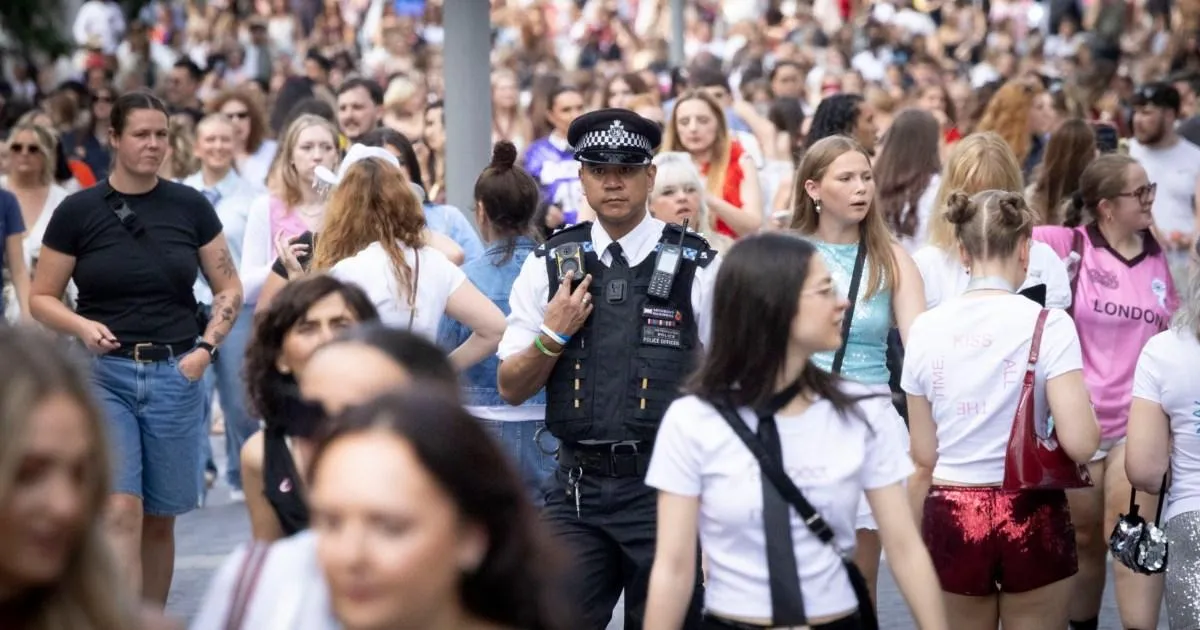
The scene at Wembley’s Boxpark captures a uniquely chaotic overlap of modern British culture. On one side, England football fans are huddled around screens fully immersed in the intensity of the World Cup, while a sea of sparkling, sequin-clad teenagers and young women stream past, heading toward the stadium for the penultimate night of Harry Styles’ record-breaking residency. While the atmosphere is electric and celebratory, there is an invisible, protective layer woven into the crowd. Hidden among the fans are plainclothes officers—men and women dressed in cowboy hats, glitter, and concert attire—tasked with a critical mission: keeping women and girls safe from predatory behavior in environments where they should be free to simply enjoy the music.
Despite the jovial vibe, the reality of the situation is sobering. The police presence isn’t a precautionary fluke; it is a direct response to a rise in targeted incidents at large-scale events. Already, the summer had seen seven arrests related to violence against women and girls at concerts, including a harrowing case at a separate event where a man was charged with upskirting. Hidden beneath the fun aesthetic of concert-going, these officers carry handcuffs and walkie-talkies, transforming from unsuspecting concert-goers into a line of defense the moment they spot a predator. They are the eyes and ears of a city that refuses to tolerate the normalization of harassment, ensuring that young fans aren’t targeted under the cover of a dense crowd.
Identifying potential offenders requires a refined, almost intuitive skill set. These officers aren’t just watching from the sidelines; they are scanning the social topography of the stadium, looking for minute behavioral anomalies. While the vast majority of the crowd is focused on the stage or taking genuine photos with friends, the officers are flagging individuals whose movements don’t match the flow of the event. A tell-tale sign might be a man wandering aimlessly through the perimeter—not engaging with the concert, but constantly repositioning to get closer to groups of women. For an outside observer, these individuals might seem harmless, but for officers trained in behavioral analysis, the patterns of a predator are remarkably consistent.
The tactical response is often remarkably understated but highly effective: disruption through presence. Instead of an immediate, aggressive tackle, an officer will often simply approach the person whose behavior has triggered their alarms. By striking up a casual conversation, the officer makes it explicitly clear that the individual is being watched. This “seed of doubt” strategy is designed to kill a criminal impulse before it manifests into action. By humanizing the police presence and refusing to hover in the shadows, these officers successfully dismantle the predator’s sense of anonymity, effectively turning the stadium from a hunting ground into a space where they feel constantly monitored.
Acting Inspector Vincent Maningas and Detective Superintendent Andrew Wadey emphasize that this isn’t about ruining anyone’s fun, but about creating accountability. They are hyper-aware that not every man standing alone is a threat, yet they maintain a policy of “better safe than sorry” when it comes to the safety of young fans. With around 50 officers deployed throughout the venue, the message to potential offenders is clear: you never know who is standing next to you. Whether it is unwanted catcalling, inappropriate physical contact, or more severe acts of harassment, the police are actively curating a safer concert experience. They are there to prove that unacceptable behavior will be met with immediate, decisive action.
Ultimately, this undercover operation serves as a necessary intervention in an era where the safety of women at public events has finally moved to the forefront of police prioritization. By integrating themselves into the crowd, these officers are not just stopping crimes; they are reclaiming the concert experience for the people who deserve it most. As the music reaches its peak and the fans head home from Wembley, the legacy of this operation lies in the peace of mind it provides. It is a reminder that while society faces ongoing challenges regarding personal safety, there is a dedicated force working behind the glitter to ensure that no one is left vulnerable in the crowd.