

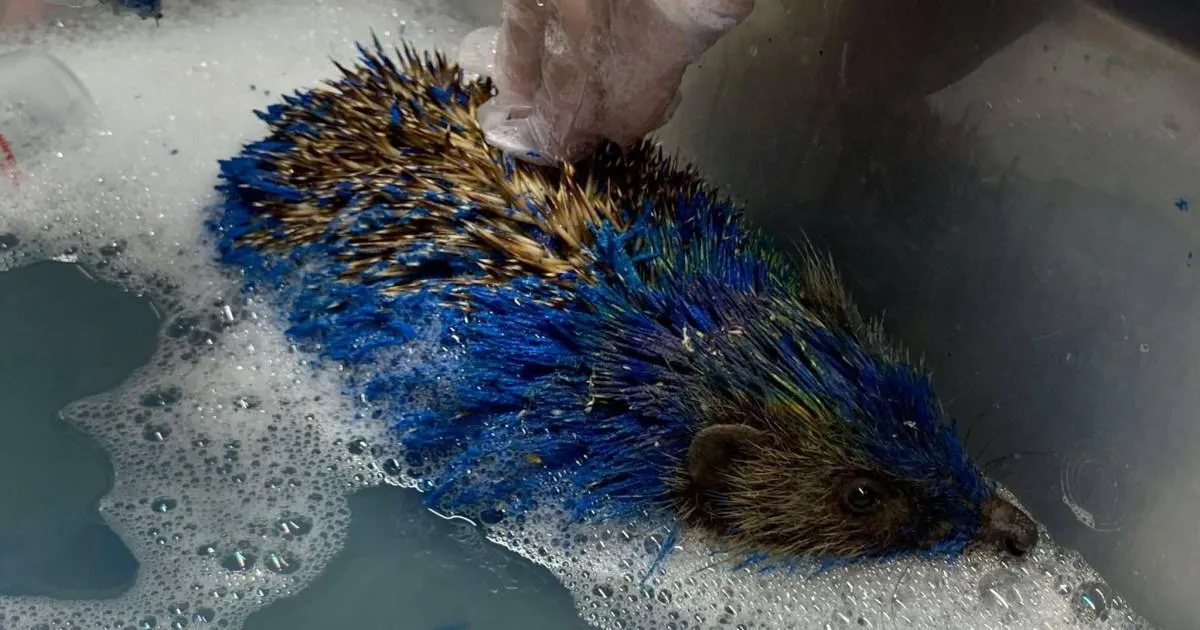
In a deeply distressing incident in Yeadon, Leeds, a defenseless hedgehog was discovered in a private garden, heartlessly coated in thick blue and yellow paint. The poor creature, now thought to be the victim of a cruel prank—possibly intended to resemble the team colors of Leeds United or the fictional character Sonic the Hedgehog—was found in a state of physical agony. The substance used was not merely a light dusting but a heavy, oil-based paint that matted the animal’s natural defenses, leaving her struggling to draw breath amidst toxic fumes while unable to carry out her most basic biological needs.
The rescue team at Prickly Pigs Hedgehog Rescue, led by the dedicated Diane Cook, stepped in to provide urgent care for the suffering mammal. Upon arrival at the shelter, the staff faced the grueling task of meticulously cleaning each individual spine, an arduous process that required immense patience and specialized care. As they worked, it became painfully clear that this was no accident; the precision and total coverage of the paint indicated a deliberate, malicious act that took considerable time to inflict, leaving the hedgehog isolated from any chance of self-defense or natural comfort.
Beyond the immediate trauma of the paint itself, the hedgehog’s survival hung by a thread. Because hedgehogs rely on curling into a tight, spiked ball to protect their soft bellies from predators, the thick, glue-like substance had effectively locked her spines together, rendering her completely vulnerable. Furthermore, the rescue team suspects that in a desperate bid to clean herself, the hedgehog likely ingested some of the toxic chemicals, posing a severe risk of internal poisoning. Diane Cook rightly branded the act “disgusting,” emphasizing that the creature’s vulnerability is particularly tragic given that British hedgehogs are an endangered species currently facing a rapid decline.
The emotional weight of this incident has resonated far beyond the rescue center, highlighting the callousness of treating a living creature as a prop for a twisted joke. Diane noted that had the homeowner not chanced upon the hedgehog in her backyard, the animal likely would have perished from suffocation, starvation, or an inability to fend off threats. The transformation of a gentle, wild animal into a “toy” for human entertainment reflects a lack of empathy that is as alarming as it is unacceptable, especially considering the already fragile state of hedgehog populations in urban landscapes.
Local authorities have since become involved, with West Yorkshire Police calling for witnesses to step forward. Recognizing this as a clear case of unnecessary animal suffering, investigators are treating the event as a crime, urging anyone with information to contact them immediately. This intervention serves as a necessary reminder that wildlife—vulnerable and protected as it is—is not there for our amusement. The incident serves as a grim reflection of the wider challenges facing British wildlife, where habitat loss is already taking a heavy toll; such human-inflicted cruelty only acts to accelerate that tragic decline.
As the hedgehog continues her recovery under the watchful, compassionate eyes of the Prickly Pigs team, the goal remains clear: to return her to the wild, paint-free and microchipped. The shelter, operating out of a converted garage, continues to pour its resources into her rehabilitation, vowing to do everything possible to ensure she thrives once more. It is a story of human depravity met by human kindness, a reminder that while some individuals may choose to inflict pain for a momentary laugh, dedicated others will always be there to clean up the mess and fight for those who cannot fight for themselves.