


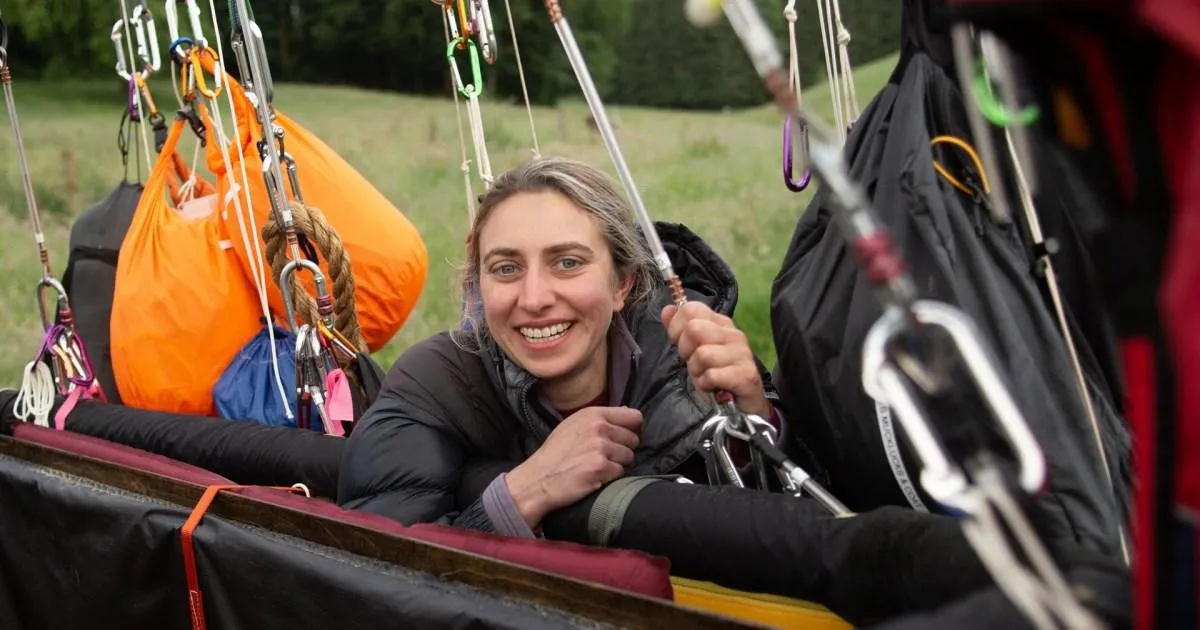
The spirit of exploration has always relied on a unique blend of grit, curiosity, and the courage to face the unknown. Recently, that spirit soared to new heights when British adventurer Alicia Hempleman-Adams etched her name into the history books. Alongside her experienced teammates, Bert Padelt and Peter Cuneo, Hempleman-Adams successfully navigated a hydrogen-powered balloon across the vast expanse of the Atlantic Ocean. When their craft finally touched down in Bastendorf, Luxembourg, at the crack of dawn on a Sunday morning, it marked the conclusion of a 70-hour odyssey that transformed a daring experiment into an extraordinary accomplishment. By becoming the first British woman, and only the second woman in history, to brave the Atlantic in a gas balloon, Hempleman-Adams proved once again that the most significant frontiers are often those we push within ourselves.
The journey began on a Thursday morning in Presque Isle, Maine, setting the stage for a test of endurance that few could truly fathom. Floating at an average altitude of 14,000 feet, the trio was not nestled in the protection of a high-tech cabin; instead, they were exposed to the biting, raw realities of the elements in an open basket. Subjected to freezing temperatures and immense atmospheric pressure, they traveled over 5,200 kilometers at speeds reaching 62 mph. This was not a flight for the faint of heart, but rather a calculated risk driven by the goal of achieving the first successful manned transoceanic crossing powered entirely by hydrogen gas—a feat that required absolute focus and precision from takeoff to landing.
As the team ventured beyond Newfoundland, the mission shifted from a high-altitude expedition to a high-stakes survival challenge. Beyond the Canadian coastline, the safety net effectively vanished, leaving the crew with nothing but the endless, churning expanse of the Atlantic beneath them. There were no secondary options or convenient landing zones; the success of their journey relied entirely on their ability to navigate fluctuating winds and weather patterns by constantly adjusting their altitude. This constant game of cat-and-mouse with the atmosphere was the only way to maintain the correct trajectory. Every decision made in that small, swaying basket was a line drawn between a successful landing and the perils of the sea.
The reality of the flight was perhaps best captured by Hempleman-Adams herself, who spoke with refreshing candor after the adrenaline had subsided. She described moments where the mission hung in the balance, particularly when rain began to cause ice to accumulate on the balloon’s surface. This added a layer of grave danger, threatening the stability and lift of the craft. Yet, rather than focusing solely on the adversity, she pivoted to the power of human connection, emphasizing that their survival was rooted in a collaborative effort. Her humility in acknowledging the expertise of her veteran pilots, Padelt and Cuneo, reflects the true character of an explorer: one who respects the mountain—or in this case, the ocean—and values the team that helps them stand atop it.
It is fitting that such an accomplishment belongs to Alicia, who has been a lifelong advocate for the wonders of ballooning, recently receiving an MBE for her contributions to the field. However, her success also highlights the importance of legacy. As she stepped onto the solid ground of Luxembourg, she was met by her father, the renowned adventurer Sir David Hempleman-Adams. Having completed the exact same Atlantic crossing solo in an open basket years prior, he understood better than anyone the sheer physical and mental toll his daughter had just endured. His pride was not just that of a father for a child, but that of one pioneer recognizing the arrival of another, witnessing his daughter surpass the constraints of convention in the same treacherous skies he once navigated.
Ultimately, this record-breaking flight serves as a powerful reminder of the relentless human drive to innovate and explore. It is a story that bridges generations, proving that while technology changes, the fundamental requirements for discovery—bravery, preparation, and the willingness to face the elements—remain timeless. Alicia Hempleman-Adams did not just cross an ocean; she crossed a threshold. By pushing through the biting cold and the uncertainty of a hydrogen-powered horizon, she has inspired a new generation to look upward. Her achievement is a testament to what is possible when we stop looking for safety nets and start embracing the wind, carving out our own path across the largest, most indifferent canvases on Earth.