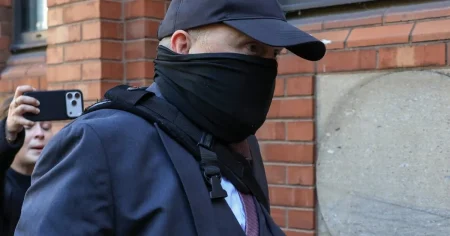



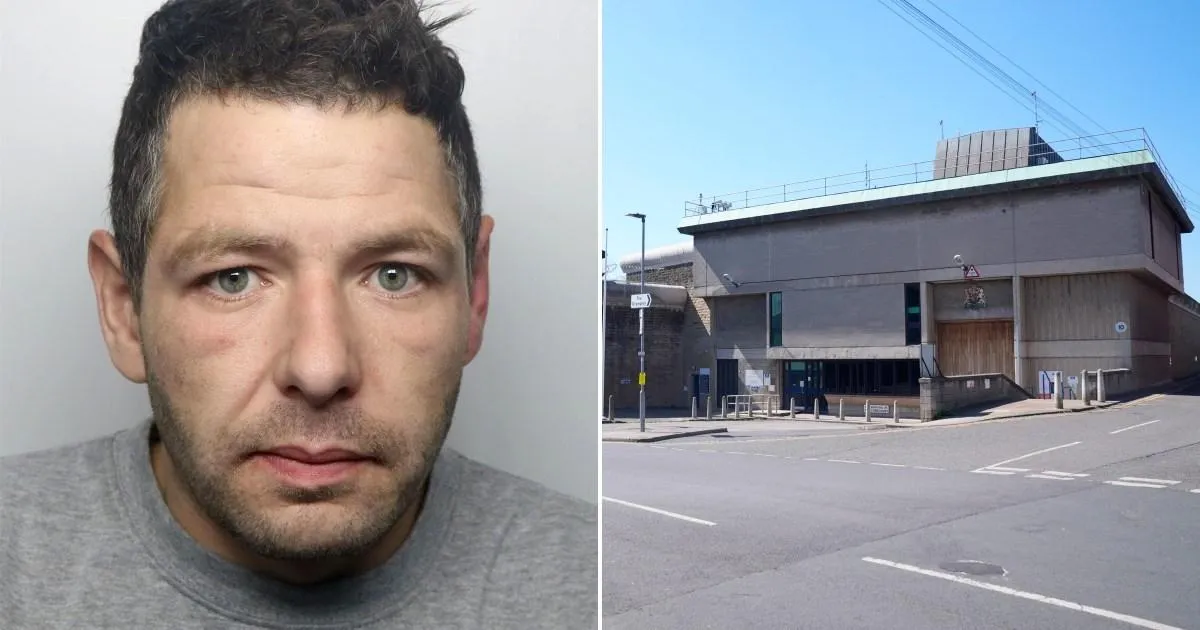
The grim reality of life behind bars at HMP Wakefield has been laid bare in a harrowing murder trial that delves into the brutal reality of prison politics. Mark Fellows, Lee Newell, and David Taylor stand accused of a calculated and cold-blooded attack on a fellow inmate, 33-year-old Kyle Bevan. The incident, which occurred on November 4 of last year, ended in a scene of absolute carnage within the confines of a high-security cell. Bevan, who was himself serving a life sentence for the horrific murder of his step-child, was discovered the morning after the attack, having succumbed to 25 separate stab wounds that ravaged his vital organs.
The prosecution’s narrative, presented by Jason Pitter KC, paints a chilling picture of clinical efficiency. During the trial, jurors were shown CCTV footage capturing the moments leading up to the tragedy. The video shows Bevan entering his cell, closely followed by the three defendants. In a display of what the prosecution described as a “satisfied, job-done mood,” the three men emerged from the cell less than five minutes later, leaving their victim behind. Following the assault, the attackers allegedly placed Bevan in his bed, leaving him to bleed out in silence as his life slipped away unnoticed throughout the night.
The forensic details of the attack underscore the intensity and premeditation involved in the assault. The victim’s injuries were catastrophic; the wounds inflicted by the attackers penetrated his jugular vein, his aorta, and his heart. Beyond these primary strikes, evidence suggests that a variety of improvised implements were used to carry out the violence. Investigators later recovered a folded piece of sharp metal, fashioned from a component of a television, stained with Bevan’s blood. This makeshift weapon stands as a stark reminder of the dangerous inventiveness that arises in environments where lethal intent meets restricted access.
Central to this case is the controversial environment of HMP Wakefield, a high-security facility that carries a complex reputation. At the time of the killing, roughly 77% of the prison’s population was categorized as “vulnerable prisoners”—a group that historically includes those convicted of particularly reviled crimes, such as child murder. The prosecution noted that unlike many other correctional institutions, Wakefield operated under a policy that did not strictly segregate these vulnerable individuals from the general population, often referred to as “main prisoners.” This “open door” policy, intended to facilitate routine interaction, instead created a volatile pressure cooker.
The trial brings to light the underlying systemic tensions that define daily existence within these prison walls. Mr. Pitter acknowledged to the jury that while the prison’s regime might prompt questions regarding the wisdom of allowing such distinct groups of inmates to mix freely, those policy decisions are not the focus of the current legal proceedings. However, he emphasized that this integration undeniably fueled a deep, palpable friction between the groups. This environment of “obvious tension” implies that for those behind the bars, the prison hierarchy is not merely a social construct, but a matter of daily survival, where past sins are often revisited with lethal consequences.
As the trial continues, the proceedings serve as a somber reflection on the failures of containment and the persistent brutality that can flourish in the shadows of the justice system. While the court must decide the guilt of Fellows, Newell, and Taylor based on the evidence of the singular, violent act, the community is left to contemplate the broader environment that allowed such a confrontation to occur. HMP Wakefield, designed to hold the most dangerous offenders, became the stage for a tragic and violent endgame, forcing a difficult national conversation about how we manage, protect, and punish individuals who have already been permanently removed from society for crimes the public finds unforgivable.