

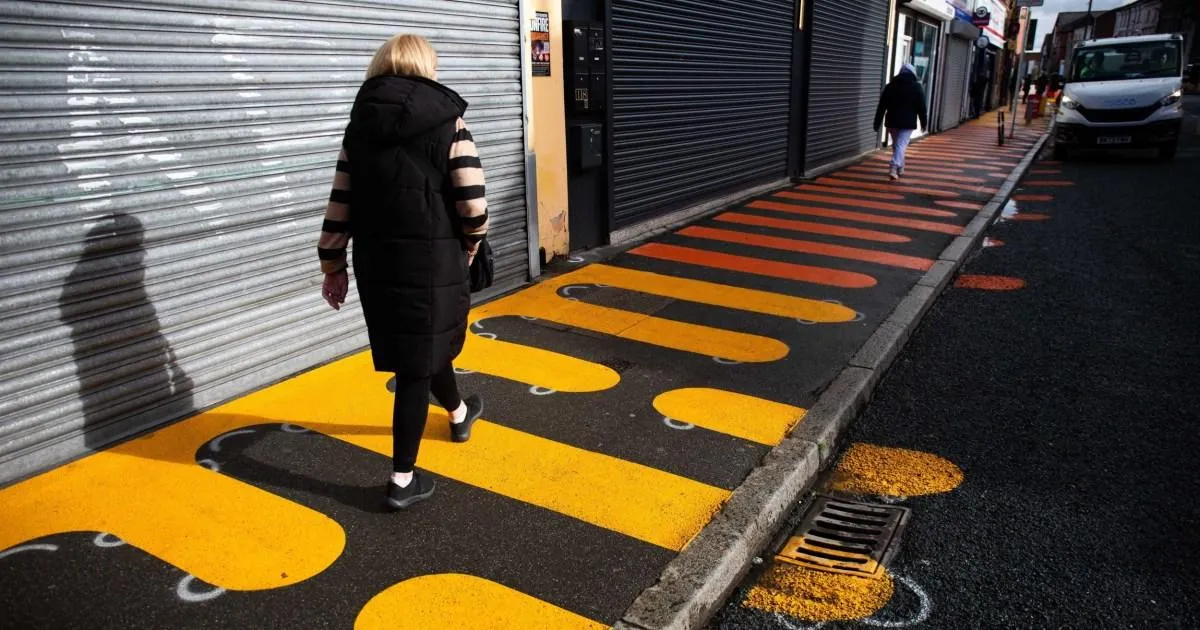
For months, the people of Birkenhead have been looking at a street and wondering whether someone had spilled a giant packet of Cheesy Wotsits across the pavement. The £300,000 road-calming experiment on Grange Road West, a 170-yard stretch running from Charing Cross junction to Clayton Street, was supposed to make the area safer, calmer and more inviting. Instead, it became known as “Wotsit Street,” after the council covered the road and pavement in garish orange-and-yellow designs that many locals thought looked less like traffic management and more like a children’s playground. The makeover, completed last winter, was meant to test a one-way system that would ease congestion and create safer routes into Birkenhead town centre. But while it may have slowed down cars, it also stirred up a hornet’s nest of public fury. Residents called the designs “hideous,” business owners described them as “disgusting,” and one man said the whole scheme made the council look like “clowns.” The street, once an ordinary shopping route, had become a punchline, and the people living and working there were not laughing.
The frustration only deepened when the council announced that it would tear the whole thing down. Benches, planters and the infamous coloured surfacing were all set to be removed, with the furniture gone by the end of August and the markings expected to disappear by the end of September. For residents like Brian Kearsley, the news confirmed what they had suspected all along: that the entire project was a farce. He called for council staff to be disciplined, for the consultants to never be hired again, and for the wasted money to be paid back to taxpayers. Another resident, Bernie Cooke, asked whether anyone at the council would actually be held responsible for the mess. Peter Dunn, clearly furious, said the £300,000 scheme had insulted the good people of Birkenhead. Even a local shopkeeper, who has to live with the damage to the street’s reputation, described it all as “disgusting.” But in a twist that perfectly sums up the strange life of Wotsit Street, not everyone was unhappy. One woman, who preferred not to give her name, pointed out that the bizarre new look had attracted more visitors to the road than it had ever seen before. Curiosity, it seems, had become an accidental tourist attraction, with people coming from elsewhere just to see the road that looked like snack food.
The story behind Wotsit Street is a complicated one, full of good intentions, government money, and a classic disconnect between planners and the public. The scheme was a six-month trial designed to test whether a one-way traffic system could create safer and more pleasant routes into Birkenhead town centre. It followed two public consultations held between November 2022 and July 2023, and the scheme was officially approved by the council before the contract was awarded in March 2024. Funding came from the government’s Future High Street Fund, with Wirral receiving a share of £25 million. Graham’s, a construction company, was given £2.9 million to carry out the work, and some of that money paid for the now-infamous orange surfacing and street furniture. At the time, council leaders said the goal was to transform Birkenhead town centre into a pleasant place to shop, free from the clutter and dominance of cars. In theory, it sounded reasonable. In practice, something went badly wrong. The colourful designs were supposed to calm traffic and make the area feel more welcoming, but instead they sparked a wave of criticism that made national news. Council officials later admitted that the temporary features had created “significant concern locally,” and that the feedback from businesses, residents and visitors had made it impossible to ignore.
Now, after months of controversy, the council has finally laid out its next steps, and they are a mix of apology and stubbornness. The one-way traffic system, which officials say has improved the operation of the busy Charing Cross junction, will be kept. But the orange road surfacing, the planters, the benches and the rest of the temporary structures will not be part of the long-term plan. Instead, the council says it will bring back parking along Grange Road West, with additional parking and loading bays designed to support local businesses and make it easier for customers and deliveries to access the street. New images from the area show a barren, stripped-back road, with red-and-white plastic bollards blocking off the spaces where the fixtures once stood. It is a sight that feels almost poetic: a £300,000 experiment reduced to a few plastic barriers and a memory of orange stripes. Wirral Council’s leader, Councillor Paula Basnett, tried to put a positive spin on the situation, saying that the trial had given the council valuable evidence about what works for the area and what needs to change. She acknowledged that residents and businesses had made it clear that parking and loading provision are essential, and said the revised scheme would reflect that. The language was diplomatic, but the message was clear: Wotsit Street, as the world had come to know it, was over.
Councillor Basnett also defended the idea of running a trial in the first place, arguing that the whole purpose of a pilot project is to test changes, gather evidence, and then use that evidence to shape the right long-term solution. She spoke of wanting a scheme that works for everyone who lives, works, shops and trades in the area, while supporting the local business community. And she promised that letters had been sent to businesses on the road, outlining the next phase of changes and new measures to help support local traders. It was a message designed to reassure, but for many residents, it was hard to hear over the sound of £300,000 being flushed down the drain. The council did, however, offer one small consolation: the planters and street furniture that once lined Grange Road West will not be wasted entirely. According to officials, they will be donated to schools and community groups, meaning that somewhere out there, children may soon be sitting on benches that were once part of the most ridiculed road scheme in Merseyside. It is a gentle, almost humorous ending for objects that caused so much public anger, and perhaps a sign that the council is trying to smooth things over with the community it managed to annoy so thoroughly.
Looking back at the whole affair, there is something deeply human about the Wotsit Street saga. It is a story about how even the best-intentioned plans can go wrong when they ignore the feelings and experiences of the people who actually live with them. The council wanted to make Birkenhead a nicer place to visit, and instead it became a national joke. The residents wanted safer streets and better traffic, and instead they got a road that looked like a packet of crisps had exploded. The money, £300,000, was spent in the name of progress, but the result was a lesson in humility. There is also something hopeful in the aftermath. The council listened, eventually, and changed course. It is asking for feedback, bringing back parking, and promising to work with local businesses. The planters will find new homes, the orange paint will fade, and Grange Road West will slowly return to something resembling normal. The residents of Birkenhead, who have shown remarkable patience and a healthy sense of humour throughout the ordeal, will move on. And somewhere, perhaps, the name Wotsit Street will remain as a cautionary tale, a reminder that civic planning cannot be done in a vacuum, and that the people who use a street every day deserve better than to be served a soggy, overpriced, lukewarm bag of nothing. In the end, Birkenhead got its road back, but it also got a story to tell, and a reminder that public money should be spent with care, because someone is always watching, and someone is always ready to point out that the emperor, or the council, has no clothes, just a lot of orange paint.