

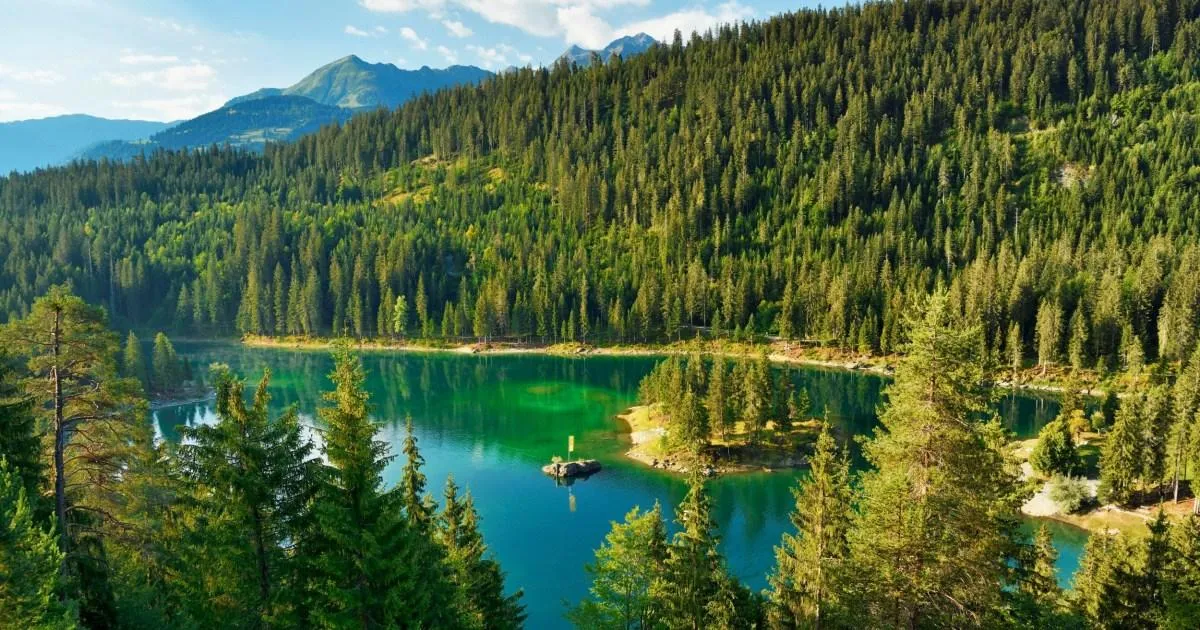
It was supposed to be one of those golden holidays that families remember for the rest of their lives—the kind of trip where the photographs fade but the warmth of the experience stays forever. Lake Cauma, with its impossibly clear turquoise water, its forested slopes, and its peaceful, almost dreamlike setting near the village of Flims, is precisely the sort of place that promises such memories. British families travel there every summer, drawn by the postcard beauty of the Swiss Alps and the promise of quiet evenings, mountain air, and days spent swimming in water so clear it seems to glow. For one British family, however, that promise has been shattered in the most devastating way imaginable. On an otherwise ordinary afternoon, a teenage boy set out from the shore of Lake Cauma, heading toward a small island that sits in the middle of the lake. He was young, healthy, and surrounded by family on a shared adventure. There was no reason to believe that anything was wrong. But somewhere along the stretch of water between the island and the sunbathing area, the ordinary turned to catastrophe. The teenager got into difficulty and went under the surface. At about 5.45pm local time, the serene soundtrack of the lake—laughing children, splashing swimmers, the murmur of holiday conversations—was broken by the unmistakable sound of alarm. Someone was in trouble. A life was slipping away in a place that had been chosen for happiness and relaxation. And in the moments that followed, the beauty of the Swiss landscape became the backdrop for a nightmare that no parent should ever have to endure.
The response from the people around the lake was immediate and, in many ways, remarkable. According to reports from the Swiss newspaper Tages Anzeiger, other beachgoers saw the teenager disappear beneath the surface between the island and the sunbathing area. They understood instinctively that waiting for help to arrive was not an option. Without hesitation, they rushed toward him, some swimming with every ounce of strength they had, others grabbing paddle boards and propelling themselves across the water in a desperate attempt to close the distance. In those terrifying minutes, complete strangers became an improvised rescue crew. They were tourists, locals, families, and friends who had come to Lake Cauma for a pleasant afternoon and found themselves instead fighting against time and the cold, unforgiving water. Some of them may never have performed a rescue before. They may not have been trained lifeguards. But they were human beings who saw someone in need, and they moved. They reached the boy, brought him to the shore, and worked to provide assistance until professional help could arrive. The scene on the beach must have been chaotic and heartbreaking: towels scattered, voices raised, people crying, hands desperately working to keep a young life from slipping away. Those who were there will never forget that afternoon. They did everything that could have been asked of them, and perhaps more. Their courage is a reminder that even in the darkest moments, compassion and bravery can appear without warning, from people whose names we will never know, who gave everything they had to offer.
When the teenager was finally pulled from the water and brought to the shore, there was still a fragile chance that he might be saved. By a stroke of tragic fortune, medical professionals happened to be at the lake that day, and they immediately started resuscitation efforts. Their training and presence meant that the boy did not have to wait for an ambulance or a rescue team to begin receiving emergency care. Right there, among the towels and sandals and scattered lunches, the struggle to bring him back began. They performed chest compressions, administered oxygen, and did everything possible to restart a heart that had been silenced by the lake. At some point, an air ambulance was called, and the teenager was airlifted to the Cantonal Hospital in Chur, in the Graubünden region, about thirteen miles away. For his family, the flight must have felt like an eternity trapped between hope and terror. They were in a foreign country, far from everything familiar, watching their child fight for his life. The hospital took over from the medical professionals at the lake, continuing the battle with the latest technology, the best doctors, and all the resources modern medicine can offer. But drowning is a vicious enemy. The damage it causes, especially to the brain and lungs, is often insurmountable, no matter how hard anyone tries. Despite every effort, despite the dedication of the people who had given him a chance, the teenager died later that same evening. In a quiet hospital room, surrounded by grief, a young life came to an end. The family’s holiday was over. Their world had changed forever.
What the family is going through now is almost impossible to imagine. They came to Switzerland together, full of excitement and anticipation. They woke up that morning looking forward to a day at the lake. They packed their bags, found their spot on the shore, and enjoyed the sunshine filtering through the trees. They watched their son swim toward the island, perhaps not thinking twice about it, perhaps snapping a photo, perhaps planning what they would all do later in the day. Then, without any warning, that beautiful day was torn apart. They saw their child pulled from the water. They watched strangers perform CPR on the sand. They heard the helicopter and followed it to the hospital. And finally, they were told that there was nothing more anyone could do. Grief is hard enough when everything around you is familiar, when you have the support of friends and neighbors and the comfort of your own home. But when it happens on holiday, in a foreign country, the practical realities become another layer of pain. The family must deal with local authorities, with hospitals, with embassies, with the impossible task of arranging to return home without the person who came with them. The Foreign Office has been contacted, and consular officials are likely helping with the process, but no amount of assistance can ease the raw heartbreak. The cantonal police and the public prosecutor’s office have launched an investigation into the circumstances of the incident. That is standard, but it also means questions, statements, and waiting. For the family, every detail will be a reopening of the wound. There is no legal process that can bring their son back, no explanation that can fill the empty space at the dinner table, and no way to undo the fact that they arrived in Switzerland as a whole family and will leave with a hole in their hearts.
Lake Cauma is often described as one of the most beautiful lakes in Switzerland, and it is easy to see why. Its water is so clear and so blue that it looks almost tropical, a jewel hidden in the heart of the Alps. People come from all over the world to swim there, to sunbathe on its grassy banks, and to enjoy the tranquillity of the surrounding forest. It is a place of extraordinary natural beauty, and that beauty is precisely what makes a tragedy like this so difficult to process. Nobody looks at a lake like that and imagines death. Nobody thinks that a confident swimmer, a teenager in the prime of life, could set off from the shore and simply not make it back. But open water is not a swimming pool. It is unpredictable, powerful, and often much colder than it appears. Even on the warmest summer day, the water in an Alpine lake can be chilling enough to cause cold-water shock, a condition that can overwhelm the body within minutes, affecting breathing, heart rate, and the ability to swim. Fatigue, cramp, hidden currents, and sudden drops in depth can all play a part in turning a normal swim into a fatal emergency. The young man was not doing anything reckless, as far as anyone knows. He was simply swimming from an island back to the shore, something that countless people do every day. But the water has its own rules, and those rules can be unforgiving. This tragedy is a reminder, painful and devastating, that beauty can hide danger. It is not a reason to live in fear, but it is a reason to respect the elements, to understand the risks, and to remember that even the strongest swimmers can find themselves in trouble when they are far from the safety of the shore.
In the aftermath of such a tragedy, words often feel empty. We search for meaning, for comfort, for something that can make sense of the senseless. But sometimes all we can do is acknowledge the sorrow and hold those who are grieving in our hearts. For the family, the coming days and months will be an unimaginable journey through pain. They will have to return to England, leave the hospital, pack the belongings of someone who is no longer there, and face the silence that follows a sudden, traumatic loss. They will carry guilt, even though none of this was their fault. They will replay every moment, asking themselves if there was anything they could have done differently, even when the answer is clearly no. They will feel anger, despair, numbness, and waves of grief that come without warning. They will, at some point, have to find a way to live in a world that no longer contains their son. There is no instruction manual for that. There is no recovery, only survival. But perhaps there is some tiny comfort in knowing that their son was not alone when he died. In his final moments, people he had never met fought for him with every ounce of their strength. They did not hesitate. They did not look away. They tried to save him, and in that effort, there was love, even from strangers. The world is full of unexpected kindness, and this was one small, heartbreaking example of it. As the investigation continues and the family prepares to say goodbye, the rest of us can only watch with sympathy and try to remember how fragile life really is. We can hold our children a little closer, think twice before we take the open water for granted, and honor the memory of this young man by being more present, more compassionate, and more aware of how quickly everything can change. May he rest in peace, and may his family find some light in the midst of the darkness.