


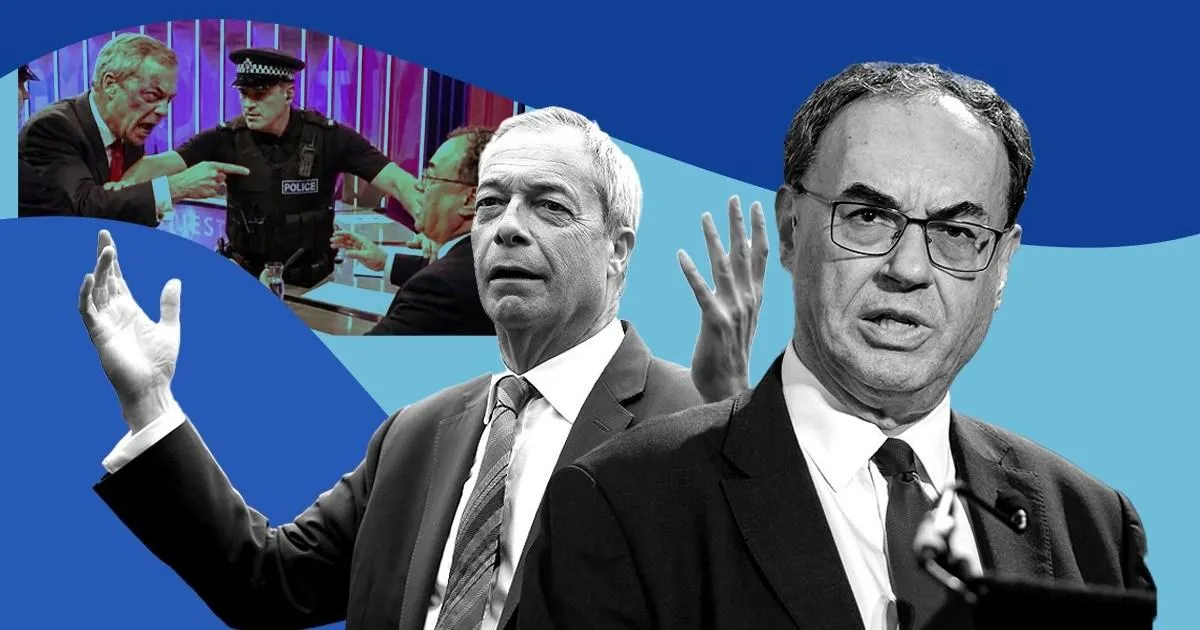
The digital landscape is currently witnessing a bizarre and increasingly dangerous trend: the emergence of AI-generated, deepfake adverts featuring high-profile figures in fabricated, often violent scenarios. A glaring example currently circulating on social media shows Reform UK leader Nigel Farage and Bank of England Governor Andrew Bailey engaged in a physical brawl on the set of the BBC’s Question Time. In these images, the two men are depicted grappling, throwing kicks, and even brandishing a firearm—a scenario that is entirely fictional, as the two have never appeared on the show together. These ads, which feature a deceptive “play” button to trick users into clicking, have proliferated across platforms like X, leaving many observers confused and highlighting the alarming ease with which artificial intelligence can now be weaponized to distort reality.
Beyond the sheer absurdity of the imagery, there is a sinister financial motive driving this phenomenon. These viral posts serve as conduits to fraudulent investment schemes, acting as digital bait to lure unsuspecting users into scams. Andrew Bailey has been quick to condemn the practice, labeling it a “truly online scourge” designed to exploit the public, especially those who are most vulnerable. The Bank of England has confirmed that they are actively reporting these fraudulent advertisements to both the social media platforms hosting them and to the political parties whose images are being hijacked. For the victims, the consequences are rarely just about fake news; they are about losing hard-earned life savings to criminal syndicates masquerading as legitimate financial enterprises.
Nigel Farage, while maintaining his typical public persona, has also addressed the digital impersonations, distancing himself from the violent narratives being spread. He noted with a touch of irony that despite his clear political disagreements with the Governor of the Bank of England, he would certainly never resort to physical violence. However, cybersecurity experts have identified these deepfakes as part of a much larger, global ecosystem of coordinated financial crime. Analysis from firms like Bitdefender suggests that many of these campaigns are linked to sophisticated, Russian-language cybercriminal networks. These groups are constantly evolving their tactics, using the notoriety and perceived authority of well-known public figures to bypass the natural skepticism people should have when presented with “too good to be true” financial opportunities.
The emotional and psychological toll of this digital deception cannot be overstated. High-profile figures like money-saving expert Martin Lewis have spoken out about the devastating real-world impact these scams have on his audience. Lewis recently shared the heart-wrenching story of a viewer who, believing the celebrity had endorsed a specific investment scheme, poured all of her savings—money intended for her housing and support during a period of disability—into a scam. Her story serves as a tragic reminder that behind every “bot” post and AI-generated image is a human victim whose life can be fundamentally upended by the unchecked spread of digital misinformation. When trust is eroded in this manner, it is the most vulnerable who bear the heaviest burden.
The government is now facing mounting pressure to address this “digital rot” that threatens both personal security and the public’s ability to trust what they see online. Tech Secretary Liz Kendall has expressed deep concern regarding the misuse of “digital replicas,” confirming that the government is actively investigating ways to curb the influence of AI-generated misinformation. The fundamental issue at stake is the erosion of truth; if we can no longer distinguish between a genuine broadcast and a malicious, AI-generated fabrication, the very foundation of public discourse is at risk. Legislative action is being framed as an urgent necessity, as the current environment favors the fraudsters, leaving public figures and ordinary citizens alike to play a frantic game of digital whack-a-mole.
Ultimately, the brazen use of deepfakes featuring figures like Farage and Bailey marks a disturbing turning point in how we consume media. While platforms like X are under intense scrutiny to moderate these reports more effectively, the responsibility also falls on the public to remain hyper-vigilant. As technology continues to accelerate, the lines between reality and simulation will only become more blurred, making it imperative that we demand stricter accountability for tech companies and better public education on these threats. This saga is not merely a funny or strange internet curiosity; it is a urgent warning sign that without intervention, the digital world risks becoming a playground for predators who view our shared reality as nothing more than a tool for exploitation.