
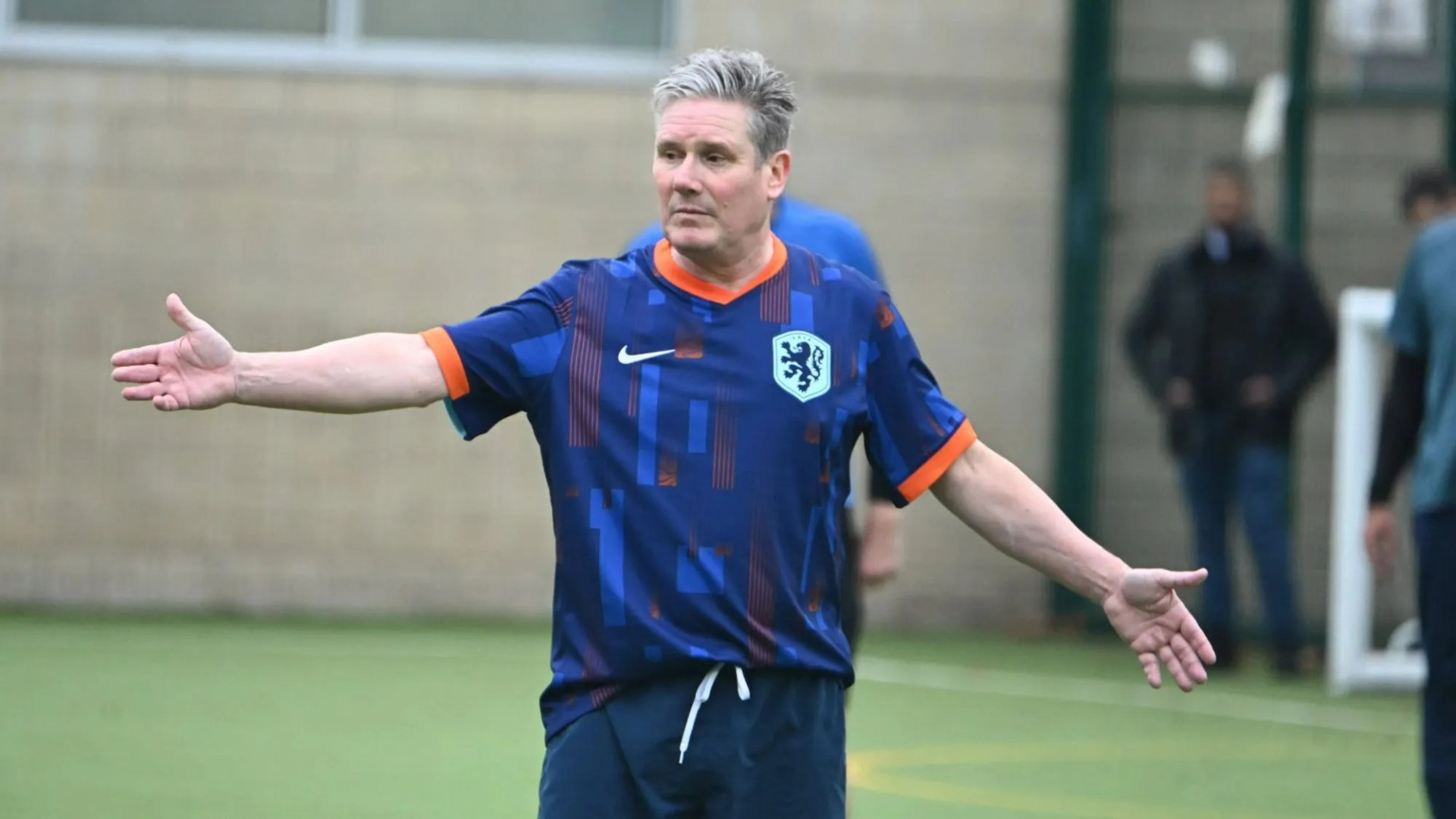
Sir Keir Starmer, the leader of the Labour Party, took to the football pitch for his regular Sunday five-a-side game in North London, demonstrating his continued commitment to the sport despite the pressures of his political career. Eschewing the expected England shirt, Starmer opted instead for the 2024-2025 Netherlands away jersey, a navy blue design accented with varying shades of blue and orange. This choice of attire raised some eyebrows, particularly given England’s recent victory over the Netherlands in the Euros semi-final, a match Starmer himself celebrated. He played with his usual team, demonstrating his long-standing dedication to this recreational activity, which he has previously stated he intends to continue unless prevented by serious injury. Despite wearing a knee support bandage due to a pre-game injury, Starmer participated actively, taking shots, assisting injured players, and engaging with the referee throughout the match, which ended in an 8-8 draw.
Starmer’s presence on the pitch underscores his passion for football, a passion often manifested in his support for Arsenal, the North London club he regularly attends at the Emirates Stadium. This dedication to the beautiful game offers a glimpse into his personal life, revealing a commitment to physical activity and team dynamics that extends beyond the political arena. His choice of the Netherlands shirt, while potentially intriguing given past England-Netherlands football encounters, highlights his comfort in embracing international football aesthetics, perhaps reflecting a broader outlook that transcends national rivalries. His engagement with the game, despite his knee injury, further emphasizes his commitment to his teammates and the camaraderie associated with amateur sport.
The image of a senior political figure actively involved in recreational sport resonates with many, projecting an image of normalcy and relatability. Starmer’s continued participation in his five-a-side games, even amidst the demanding schedule of a political leader, underscores his commitment to maintaining a balance between his professional and personal life. This commitment to regular physical activity and team engagement also reflects positively on his personal discipline and ability to prioritize well-being, traits often admired in leadership figures. His willingness to continue playing despite his knee injury further highlights his resilience and determination, qualities that translate to the political sphere.
However, the seemingly innocuous act of choosing a football jersey can sometimes become entangled in political narratives. Given Starmer’s prominent position and the recent history between the English and Dutch national teams, his choice of the Netherlands shirt could be subject to varied interpretations. While likely a simple personal preference, it could be viewed by some within the context of ongoing political dynamics, potentially fueling existing narratives or even creating new ones. The focus on his attire, while perhaps trivial in the grand scheme of things, illustrates the heightened scrutiny faced by public figures, where even seemingly personal choices can become subject to public commentary and interpretation.
Beyond the football field, Starmer’s activities have also drawn attention in recent times, particularly concerning the acceptance of hospitality tickets. He has defended his use of directors’ boxes at sporting events, citing security concerns as the primary reason. This justification, however, has sparked debate, with some questioning the necessity of such privileged access. The issue of freebies and hospitality for politicians remains a sensitive one, often viewed with suspicion by the public. Starmer’s defense, while seemingly reasonable, highlights the complexities of navigating the ethical gray zones that often arise in public life, where the lines between legitimate perks and undue influence can be blurred.
The confluence of Starmer’s recreational football activity and the ongoing discussion regarding hospitality tickets presents a multifaceted portrait of a political leader navigating the public eye. While his dedication to football offers a glimpse into his personal life and emphasizes his commitment to physical activity and teamwork, the controversy surrounding hospitality tickets raises questions about transparency and accountability. These seemingly disparate elements, however, converge to highlight the constant scrutiny faced by public figures, where even seemingly mundane choices, from a football jersey to a seat in a directors’ box, can become subject to public discussion and political interpretation.