

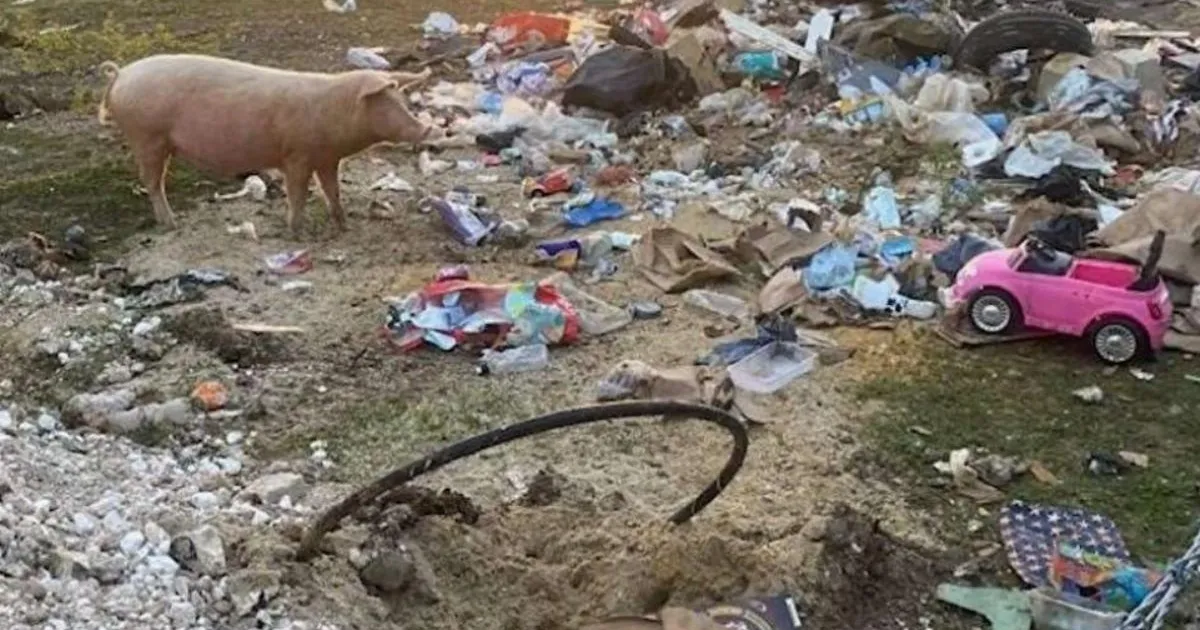
The case of Jamie Broadmore has ignited a firestorm of controversy, exposing what local officials describe as a “fundamentally flawed” justice system. Broadmore, a 41-year-old with a extensive criminal history—including 41 previous offences ranging from fraud to burglary—was recently convicted for his role in operating an industrial-scale fly-tipping site on Kent’s green belt land. Despite the sheer scale of the environmental destruction he facilitated, the legal outcome has left both the authorities and the public reeling, as he walked away from Maidstone Crown Court with a mere six-month suspended sentence.
The severity of Broadmore’s actions went far beyond the illegal dumping of waste. The site became a source of constant public danger, characterized by massive, toxic bonfires that frequently billowed thick smoke across the A2 and the high-speed rail line, causing dangerous traffic disruptions. In a bizarre and chaotic twist, Broadmore even kept pigs on the site, which were at one point released onto the busy A-road, endangering motorists and causing widespread pandemonium. For local residents and firefighters, who frequently had to contend with the aggressive behavior of those running the site, the environmental degradation was matched only by the constant threat to public safety.
The financial fallout of Broadmore’s activities is staggering, yet the responsibility for the damage remains unfairly shifted onto the public. While National Highways spent a massive £150,000 to clear the site and Gravesham Council invested thousands more in a grueling investigation, the court ordered Broadmore to pay a symbolic £1,000 in compensation. In a ruling that has baffled local leaders, no further costs were awarded to recoup the public funds spent on the cleanup. This means that, effectively, the taxpayers of Kent are footing the bill for the criminal enterprise of a repeat offender, leaving many to wonder how justice can be served when the victim—the community—is left to pay for the crime.
Labour leader John Burden has become a vocal critic of the sentencing, arguing that current guidelines are completely detached from the reality of organized environmental crime. Burden pointed out the demoralizing nature of the court’s decision, noting that it is nearly impossible to explain to constituents why their hard-earned council tax is being drained by the cleanup costs of a criminal who faces no real-world consequences for his actions. He described the situation as “beyond belief,” emphasizing that the current judicial approach provides zero incentive for criminals to stop their destructive behavior when the financial and personal penalties are so negligible.
The call for legislative reform is now gaining momentum, with local officials and politicians joining forces to demand a shift in how fly-tipping is treated under the law. Gravesham MP Lauren Sullivan has championed this cause, stressing that fly-tipping is far from a victimless crime. She argues that environmental damage of this magnitude puts public safety at risk and degrades the very communities that residents call home. Together with local council members, she is lobbying the government to overhaul existing sentencing guidelines, aiming to transform them into a “true deterrent” that reflects the gravity of these crimes and forces perpetrators to take financial responsibility.
Ultimately, the Broadmore case serves as a grim reflection of a legal system struggling to keep pace with the growing “epidemic” of industrial fly-tipping. As the council looks for ways to address the injustice of the ruling, the case has become a rallying cry for those who believe that the environment and the public purse deserve better protection. Until the law catches up with the reality of such crimes—implementing penalties that actually sting and ensuring that the financial burden of restoration falls on the guilty rather than the taxpayer—local leaders fear that sites like this will continue to be a regular occurrence rather than an shocking exception.