



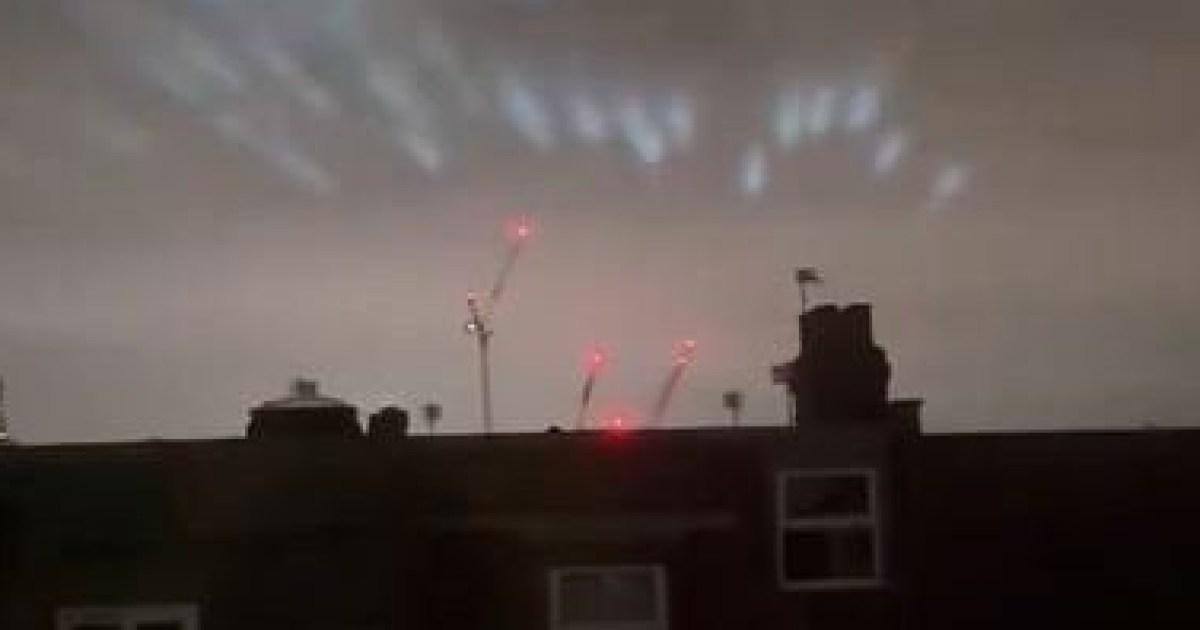
On Sunday night, Londoners were treated to an unexpected spectacle: beams of light streaking across the night sky, forming intriguing patterns and clusters. The mysterious display sparked a wave of speculation on social media, with theories ranging from alien visitations to elaborate movie premieres. Comedian Dara Ó Briain, a former host of BBC’s Mock The Week, captured the phenomenon on video and shared it on X (formerly Twitter), asking his followers for an explanation. The video quickly went viral, garnering millions of views and thousands of replies, highlighting the widespread intrigue surrounding the unusual lights.
The video footage showed distinct lines of light moving across the sky, seemingly converging towards central London from the west. Witnesses described the lights as appearing in columns and clusters, creating an otherworldly atmosphere. Some social media users jokingly suggested an extraterrestrial origin, while others proposed more down-to-earth explanations, such as a promotional event or a light show connected to a sporting event. The timing of the event, shortly after 1 a.m., added to the mystery, prompting many to wonder about the source of the unusual illumination.
Amid the flurry of speculation, a more plausible explanation emerged from the numerous replies to Ó Briain’s post. Several users suggested that the lights were a test run for London’s New Year’s Eve fireworks display. This theory gained traction when another user shared a video showcasing flashing lights on the London Eye, further supporting the idea of a New Year’s Eve rehearsal. The lights in the video matched the descriptions provided by those who witnessed the aerial display, lending credence to this explanation.
The New Year’s Eve rehearsal theory seemed to resonate with Ó Briain, who acknowledged it as the most sensible explanation offered. However, he also playfully noted his amusement at the various outlandish theories circulating online, including suggestions that he had doctored the footage. The incident underscores the power of social media in both amplifying unusual events and fostering a collaborative effort to decipher their meaning. While the light show initially baffled many, the online community ultimately played a key role in uncovering its likely purpose.
The incident highlights the inherent human curiosity towards unexplained phenomena. The rapid spread of information through social media platforms like X allows for real-time discussion and speculation, transforming isolated observations into collective investigations. In this case, the mystery of the London lights captivated a large audience, demonstrating the power of shared experience and the human tendency to seek explanations for the unknown. The viral video and the ensuing discussions served as a reminder of the speed and reach of social media in disseminating information and sparking conversations about unusual occurrences.
This seemingly minor event also underscores the importance of critical thinking and information verification in the age of social media. While the initial reactions ranged from humorous speculation to genuine concern, the collective wisdom of the online community ultimately helped to identify the most likely explanation. The incident serves as a valuable lesson in the power of crowdsourced information and the importance of considering multiple perspectives before drawing conclusions. It also emphasizes the role of traditional media outlets in verifying information and providing context to events that unfold rapidly on social media platforms.