

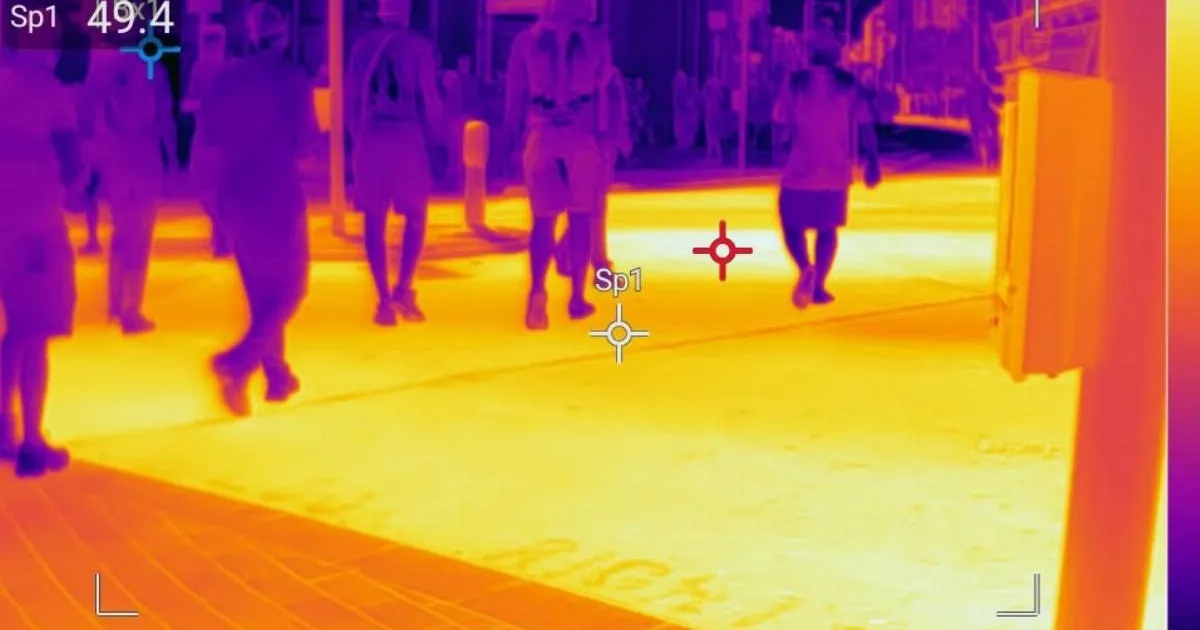
As London swelters through an unprecedented heatwave, the city’s concrete landscape has transformed into a dangerous radiator. While air temperatures have been hovering in the mid-30s, the ground beneath our feet is reaching near-lethal levels. Recent thermal imaging investigations conducted by Greenpeace reveal a shocking reality: while we may feel the heat in the air, surfaces like pavements, station platforms, and roads are cooking to temperatures as high as 65°C. This invisible crisis poses a severe threat to the most vulnerable among us—including our pets, who are often forced to traverse these furnace-like surfaces during their daily walks.
The guidance for dog owners is simple yet urgent: the “five-second rule.” If you cannot comfortably keep the back of your hand pressed against the pavement for five seconds, it is far too hot for your dog’s sensitive paws. Despite clear warnings from animal charities and veterinarians, observers have continued to spot owners walking their pets during the peak heat of the day. Images of dogs walking across 60°C stones at parks serve as a stark reminder that what feels like a typical walk to a human can result in painful burns and lasting trauma for a dog, whose paws are not built to withstand the searing temperatures of modern urban infrastructure.
The data captured by Greenpeace paints a grim portrait of a city unprepared for such extremes. From the 62°C platform at Highbury and Islington to the 56°C sidewalks of Oxford Circus, London has essentially become a “sizzling cauldron.” Even public infrastructure like the Victoria Line has seen carriage temperatures hit 40°C, leaving commuters and city dwellers struggling to find any respite. This isn’t merely a temporary spell of hot weather; it is a symptom of a larger, systemic breakdown as the city faces the immediate consequences of a rapidly changing climate that its infrastructure was never designed to handle.
Experts are now calling this a public health emergency, and the frustration is palpable. Environmental advocates argue that these record-breaking temperatures are the direct result of fossil fuel dependency, pointing to the responsibility of energy giants in accelerating the planet’s warming. Critics argue that the government has been caught off guard, scrambling to react to a crisis that has become increasingly predictable. The message from organizations like Greenpeace is clear: we can no longer afford to “wing it.” The capital requires a comprehensive, long-term strategy that prioritizes the health of its citizens over short-term inaction.
This sentiment is echoed by the scientific community and local leadership. Met Office Chief Scientist Professor Stephen Belcher has described these events as sobering, noting that human-induced climate change has made such intense heatwaves significantly more likely. Even Mayor Sadiq Khan has candidly admitted that London is currently ill-equipped to deal with the frequency and ferocity of these extreme thermal events. The recent unveiling of the city’s heat plan is a start, but it highlights a massive gap between the city’s current capabilities and the escalating environmental reality of the 21st century.
Moving forward, the challenge for London is twofold: adaptation and accountability. Policy leaders are being urged to implement better shade coverage, expand green spaces, and mandate cooling measures for homes, schools, and workplaces. However, the advocates argue that adaptation is only a bandage; the true solution requires holding fossil fuel companies accountable for their role in the climate crisis. As Londoners navigate this humid, stifling week, the conversation has shifted from simply “staying cool” to a deeper, more urgent question about the future of our urban environments and the collective responsibility to protect those who cannot protect themselves.