

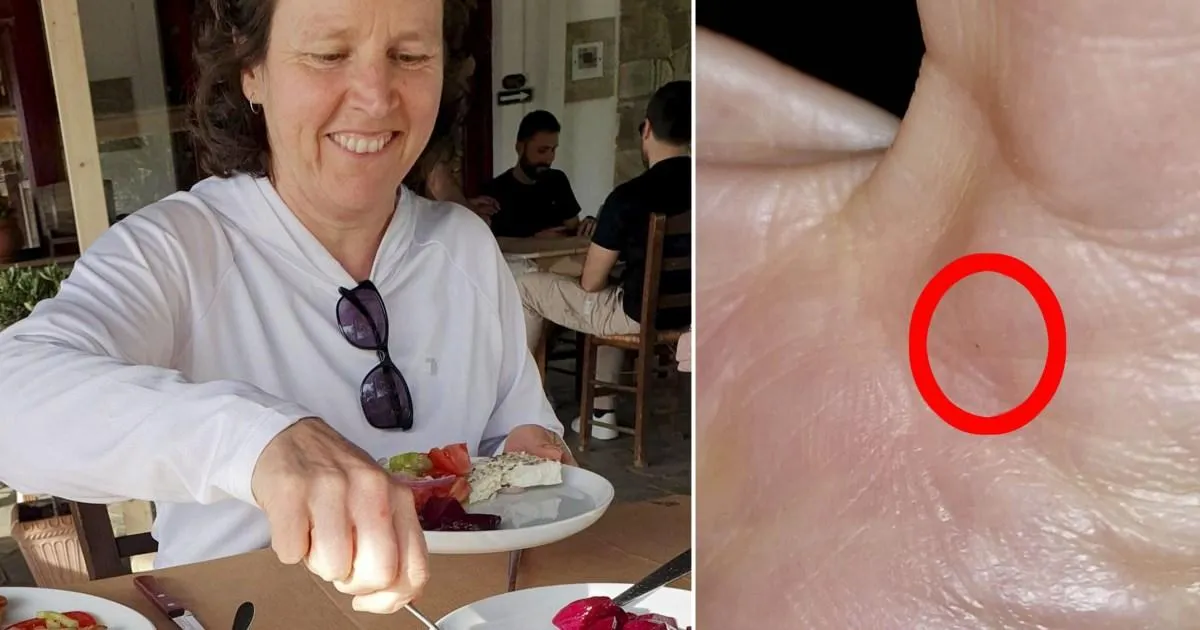
Here is a summary and humanized retelling of Laura’s experience, expanded into a narrative format.
For 53-year-old personal trainer Laura Horton, what began as a serene birthday getaway in Lesbos, Greece, quickly transformed into a medical emergency that would reshape her perspective on wildlife forever. While enjoying the sun at a friend’s apartment complex, Laura spotted a small, struggling bat in the swimming pool. Driven by nothing more than pure, instinctual empathy, she reached into the water and plucked the creature to safety. As the bat sat on her hand for ten minutes to dry off, Laura and her friends marveled at how “cute” it looked, blissfully unaware of the silent, life-threatening danger that was unfolding in those quiet moments.
The turning point came when Laura, curious about her new little companion, decided to identify the species. She snapped a photo of the bat and uploaded it to Google Lens, expecting a simple trivia answer. Instead, the AI technology acted as an unlikely guardian; while it correctly identified the creature as a pipistrelle bat, the interface immediately flagged a grave warning about the risk of rabies. Skeptical at first, Laura held her hand up for a closer look and was shocked to discover two tiny, pin-prick bite marks—wounds so delicate that she hadn’t even felt them being made.
This realization sent Laura into a flurry of action. Following the digital warning, she contacted her insurance provider, who urged her to seek immediate professional medical care. Her arrival at the Hospital of Mytilene was complicated by a significant language barrier, leading to initial confusion where staff almost dismissed the situation as a minor issue requiring only antibiotics. It wasn’t until she reached a dedicated travel clinic that a nurse, correctly alarmed by the potential severity of a bat bite, helped steer her toward the hospital’s infectious disease department, where she finally began a critical series of rabies post-exposure prophylaxis vaccinations.
The ordeal didn’t end when she stepped off the plane back home. Because rabies is a notoriously lethal condition once symptoms appear, the treatment required a rigorous, multi-dose schedule. Laura spent the remainder of her Greek holiday checking in for vaccinations, and upon her return to Liverpool, she continued the process. Even her local GP was initially uncertain about how to manage the protocol, leading Laura to utilize the specialized resources of the School of Tropical Medicine in Liverpool. She later realized there was a dedicated national hotline that could have streamlined the entire process, a detail she now shares to help others navigate similar crises.
Looking back, Laura acknowledges the chilling reality of what could have been if not for that serendipitous search. She frequently thinks of tragic historical cases where people, unaware of the risks, succumbed to the virus after seemingly minor encounters with bats. Her story isn’t just about a close call; it is a profound lesson on the hidden dangers of the natural world. She maintains that most people, like her, harbor a misplaced sense of affection for wild animals, failing to recognize that even the smallest, most vulnerable-looking creatures can carry diseases that are nearly one hundred percent fatal.
Ultimately, Laura hopes that by sharing her story, she can bridge the gap in public awareness regarding wild animal interactions. She stresses that empathy shouldn’t override caution, especially when dealing with creatures that can carry life-ending pathogens. Her takeaway is simple but vital: modern technology might have saved her life, but it’s global awareness that will save others. By turning her frightening experience into a cautionary tale, Laura is transforming a near-tragedy into a catalyst for education, hoping that the next person who sees a struggling bat in a pool will reach for a net—or sound the alarm—rather than their bare hands.