


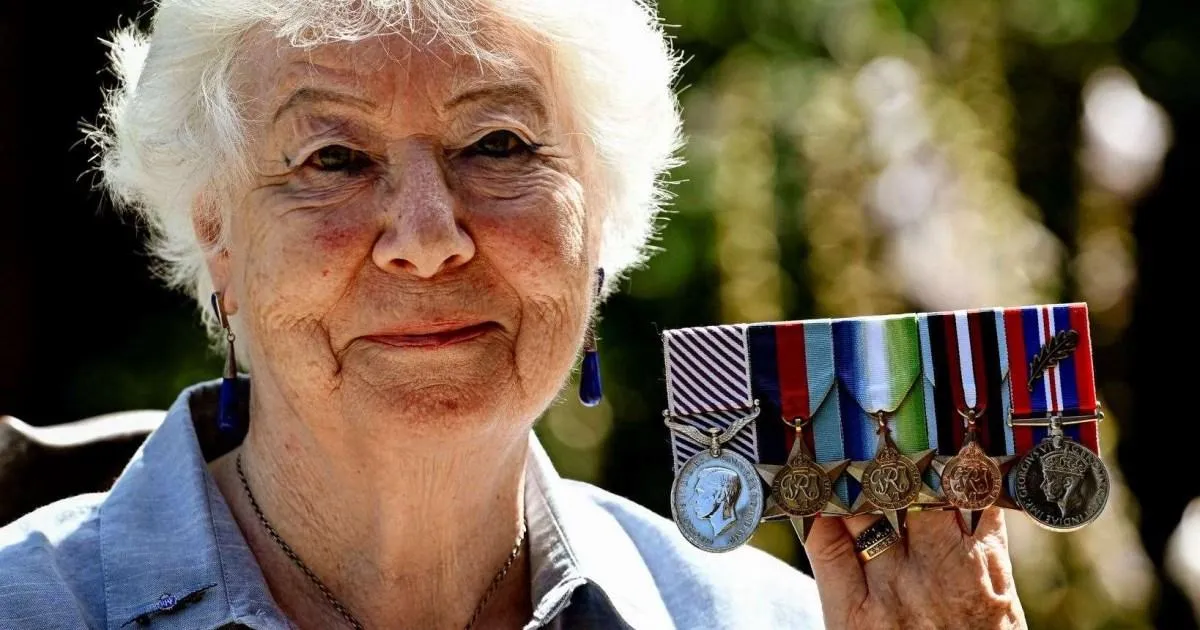
The story of Carol Lockwood is a poignant testament to how the echoes of history can shape a life decades later. Carol never knew her father, Flight Lieutenant Alfred “Ginge” Culver, who disappeared over the icy waters of Iceland in September 1942, just eight weeks after her birth. For most of her life, his existence was a narrative of tragic mystery—a loss that left her mother, Olive, a widow at a young age who chose to remain alone, holding fast to the memory of the man she loved. It wasn’t until 1992, upon her mother’s passing, that Carol finally bridged the gap between her reality and her origins by uncovering a vast, hidden archive of wartime letters left behind in her mother’s home.
These letters did more than just recount his service; they humanized a man who had become a fading photograph. Ginge was a talented aviator who survived near-death experiences—most notably being saved by a chin strap after his aircraft nearly plummeted into the sea—yet he remained a man driven by humor and deep, abiding affection for his family. Among the correspondence was a heartwarming note from August 1942, where he expressed his excitement to meet his newborn daughter, Carol. He jokingly wrote that she would likely inherit his better qualities, and with a father’s grace, shared a touching wish for her future: that she might find a partner who loved her with the same intensity he held for her mother.
This wish proved prophetic. In 1959, young Carol met Derek at a sailing club in Maidstone. Their courtship was humble and honest, characterized by small, persistent efforts to be near one another, eventually leading to a marriage that would span 65 years. Life took them across the country, building a legacy of six granddaughters and a bond that grew stronger through the mundane and the major challenges of life. Their partnership, which they humorously credit to a rule of “never wanting a divorce on the same day,” became the very realization of the hope Ginge cherished in his final days at war.
The tragic mystery of the 1942 flight remains unsolved to this day. The rescue mission, which drew in the famous artist Eric Ravilious and the crew of Ginge’s plane, vanished into the North Atlantic without a single signal or shred of wreckage, leaving the families with nothing but questions. For decades, the sheer emptiness of that loss haunted those left behind, but for Carol, the letters provided a vital sense of closure. They allowed her to know her father as a person—a man who valued beauty, humor, and, above all, the importance of a lasting partnership.
In 2014, the closure became physical. Carol and Derek traveled to Iceland to visit a waterfall Ginge had written of in his letters, planning to one day share it with his wife. Standing in that remote landscape, the weight of history became visceral for Carol. Looking out over the vast, gray sea, she recognized the final resting place of her father, accepting that while his life was cut short just weeks before he was set to return home, his legacy had thrived. She had lived the life he wanted for her, proving that while a father may be lost in the tides of history, the influence of his love can endure through generations.
Today, the story of Carol and Ginge sits at the intersection of tragedy and triumph. It reflects the resilience of those who survived the heartache of war and the enduring power of human connection. Through the mundane acts of daily life—the sailing, the dog fostering, and the enduring marriage—Carol has lived out the promise her father made in his final letters. It is a reminder that even when we are shaped by ghosts, we have the agency to turn their hopes into our realities, finding light, love, and a lasting peace in the wake of the deepest of losses.