


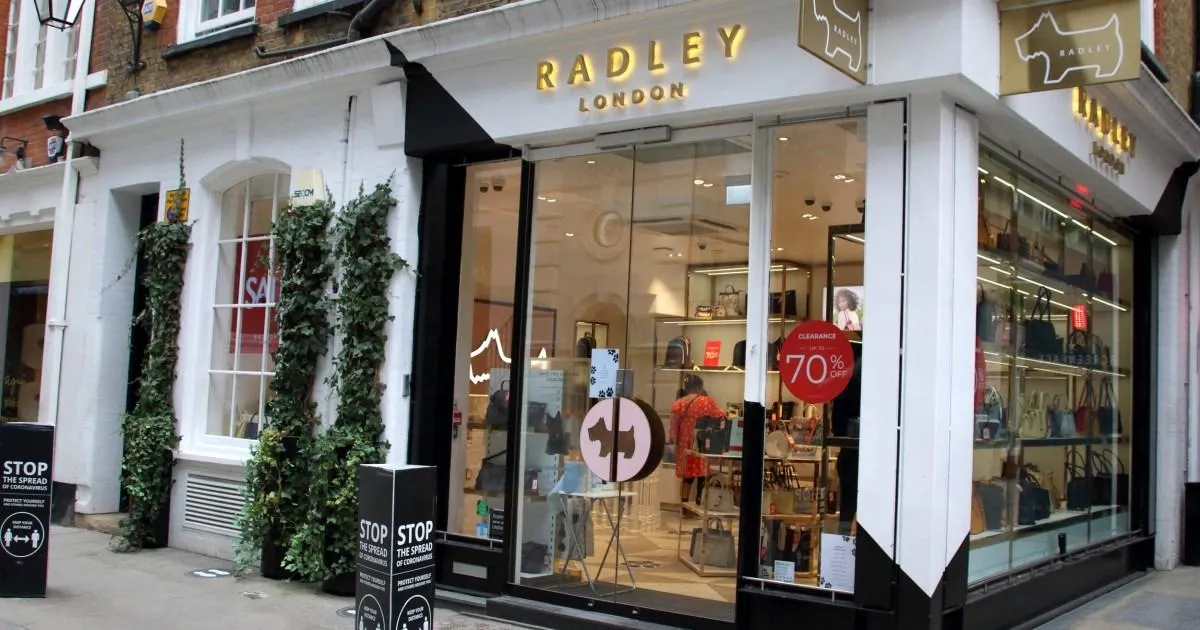
It’s the kind of news that makes you stop and do a double-take, especially if you’ve ever owned a little leather handbag with a jaunty Scottie dog swinging from the clasp. Radley, the beloved British accessories brand that has been a fixture of shopping centres and high streets for decades, is quietly closing its doors for good. The company’s website went dark at 11:59 last night, and by the end of the month, every single Radley shop in the United Kingdom will be shuttered. The brand, which was bought out of administration in May by Gordon Brothers, the investment firm behind Poundland, will no longer have a physical retail presence on these shores. At the time of the rescue deal, 42 employees were made redundant with immediate effect, and the coming weeks are expected to bring further job losses as the remaining stores wind down. For anyone who has ever treated themselves to a Radley bag, or gifted one to a friend, the news feels less like a corporate announcement and more like the end of a small, reassuring chapter of British retail history. The closedown sales have already begun, with prices slashed by up to 70 percent, but even the discounts carry a bittersweet edge: these are the final days of a brand that once felt like it had found a permanent home on our streets.
The scale of the collapse is stark when you look at the list of locations. Radley’s two flagship stores, one in London’s Covent Garden and the other in Glasgow, will close alongside 19 outlet concessions scattered across the country. The roll call of doomed sites reads like a melancholy map of British shopping: Ashford, Banbridge, Braintree, Bridgend, Cannock, Castleford, Cheshire Oaks, the Cotswolds, Dalton Park, Doncaster, Gretna, Gunwharf Quays, Livingston, Mansfield, the O2 in London, Springfield, Somerset, Swindon and York. Some of these are destination retail villages where shoppers go to hunt for a bargain on a rainy Saturday; others are smaller outlets where Radley bags sat behind glass, waiting for birthday money or a payday treat. Each one will be gone by the end of the month, with stores remaining open only while limited stock lasts. The atmosphere in those final days is likely to be a strange mix of frenzy and nostalgia. Loyal customers will be rummaging through bins of reduced leather goods, hoping to snag a classic bag at a fraction of its original price, while staff who have spent years helping people find the perfect accessory face the grim task of selling off the fixtures around them before handing in their uniforms. Radley may be a business, but to the people who worked there and the shoppers who loved it, it was never just a company.
To understand what makes this closure so poignant, you have to go back to the beginning. Radley was founded by Lowell Harder, an Australian designer with a dream, who set up a stall in Camden Market in London during the 1990s. It was a classic British retail origin story: a small, quirky start in the middle of a bustling market, a little bit of creativity, and a whole lot of hustle. Harder’s designs were distinctive, playful and unmistakably British, and none more so than the cheeky Scottie dog face that became the brand’s hallmark. Over the years, the label grew from that humble market stall into a household name, with handbags sold in department stores, dedicated boutiques and outlet villages across the country. It became a go-to for women who wanted a bit of style without screaming luxury, and for teenagers saving up for their first “proper” handbag. The brand was later owned by private equity firm Freshstream, before being sold to Gordon Brothers. But the threads that held the business together were already fraying. In May, administrators were called in, and FTI Consulting was appointed to handle the fallout. A spokesperson for FTI said at the time: “The administration appointments follow a sustained period of challenging economic conditions for the retail environment, including declining customer demand and increasing operating costs, all of which have had a negative impact on trading.” Those words are painfully familiar in modern Britain, but they do not make the reality any less harsh for the people affected.
Behind the corporate language, there are real lives and real memories. For the employees, this is not just a job loss; it is the loss of a place that may have felt like a second home. Handbag retail is deeply personal work. It is about listening to a customer talk about a new job, a wedding, a first holiday without the kids, or a quiet act of self-care after a hard year. It is about understanding that a handbag is never just a bag; it is a repository for phone, keys, dreams, secrets and cardigan receipts stuck in a side pocket. Radley staff often formed genuine bonds with their regulars, celebrating with them when they picked up a new bag and sympathising when they returned one that simply did not feel right. Now those relationships are being dissolved in a matter of weeks. The redundancy process is beginning, and while FTI says it will “guide and support affected team members” through the claims procedure, that support can feel cold when you are clearing out your locker and handing back your name badge. For shoppers, the disappearance of Radley from the high street removes another familiar signpost from our daily routines. We have already lost so many names we took for granted, and each one makes the remaining shops feel a little more fragile. The fact that Radley’s website closed overnight, with no long farewell tour, only adds to the sense of suddenness. There was no time to say goodbye properly, just a flash sale and a closing notice taped to the window.
Radley’s closure is not happening in isolation, of course. It is part of a broader wave of contraction sweeping across British retail and hospitality, and the timing is particularly brutal. Around the same date that Radley’s remaining doors are due to shut, Beefeater and Brewers Fayre restaurants will close 200 locations nationwide, leaving large holes in high streets and retail parks that were already struggling. Morrisons has announced plans to close 100 of its Daily convenience stores this year, a further blow to neighbourhood shopping habits. And the British Heart Foundation, a charity that has become a familiar fixture of every town centre, has confirmed it will close 87 of its stores, with plans to shut dozens more by 2028. The cumulative effect is devastating. Every closure means not just lost shops but lost meeting points, lost jobs, lost reasons to leave the house and wander aimlessly around a town centre. The rise of online shopping, soaring energy bills, rising wages costs, business rates, and the squeeze on household budgets have all combined into a perfect storm that is reshaping the geography of Britain. Streets that once had a post office, a bank, a café, a bookshop, and a friendly place to buy a handbag are becoming rows of boarded-up units and charity donation bins. Radley’s name will join the long litany of brands that have disappeared from our high streets, leaving behind only memories and a few second-hand bags in charity shops.
Yet perhaps this is not quite the end of the story. Radley as a brand may not vanish entirely; Gordon Brothers, which specialises in buying and licensing distressed retail names, has acquired ownership of the brand itself, even though it has not taken on the retail operating business. That means we might still see Radley bags in other retailers, or online through licensed partners, in the years to come. The little Scottie dog may survive in some form, perhaps sold through department stores or e-commerce platforms, stripped of the physical shops that once gave it a neighbourhood presence. But something will undoubtedly be lost. A brand that began as a market stall and grew through the experience of browsing, touching, trying on and walking out of a shop with a carrier bag swinging from your wrist cannot be fully replicated by a website and a wholesale contract. The high street is not just a collection of transactions; it is where we test the cultural weather, where we see what the world looks like beyond our screens, and where we find unexpected moments of joy in a well-designed display. Radley was part of that texture, its stores offering a small splash of colour in cities that were increasingly filling up with vape shops and betting offices. Its departure is a reminder that nothing on the high street is permanent, but that the things we lose often mattered more than we realised while they were there. As the last bags are sold and the shutters come down, the best we can do is remember the brand fondly, hold on to our favourite Radley bags, and perhaps think twice before we complain about the state of the high street, because the next time we look, another familiar name may already be gone.