
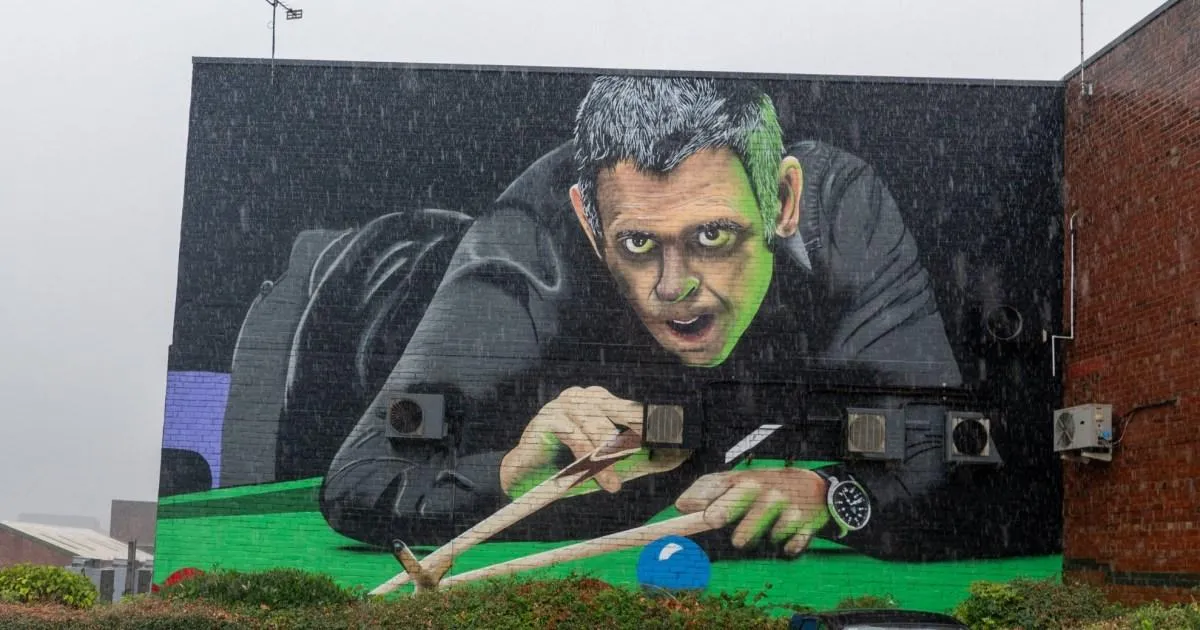
In the heart of Sheffield, a city that transforms into the epicenter of the sporting world every spring, something unexpected has appeared on the brickwork of a local snooker club. Close to the hallowed grounds of the Crucible Theatre, where every dramatic frame of the World Snooker Championship has been played out for decades, a colossal 30-foot mural now towers over the street. The intention was clear: to pay homage to Ronnie O’Sullivan, the undisputed maestro of the green baize, a man whose name is synonymous with genius, flair, and sheer dominance. The artist, Chris Ashmore, spent over six painstaking weeks on scaffolding, layering paint, refining details, and pouring his artistic soul into creating a tribute worthy of “The Rocket.” The owner of Spot On Snooker & Pool Club, Dan Kirkland, envisioned a striking landmark that would greet visitors with the intimidating visage of a sporting immortal. However, when the paint finally dried and the scaffolding came down, the reality of the mural did not quite evoke the reverence that was intended. Instead of wowing passersby with an uncanny likeness to the snooker legend, it has sent fans into absolute fits of hysterics, with the grand tribute being mercilessly compared to a zombie, a weary war veteran, and even something that emerged from a particularly bizarre fever dream.
The internet, as it always does, responded with an unprecedented level of ruthless and creative mockery that spread across social media platforms like wildfire. The criticism was not merely a gentle ribbing; it was a full-scale roast of epic proportions. The facial features depicted in the mural, which were meant to capture O’Sullivan’s intense focus and charisma, were instead dubbed “terrifying” and looking “like the corpse” of the seven-time World Champion. One particularly amusing quip saw a user asking, “Didn’t know zombie snooker was a thing,” perfectly capturing the surreal horror-movie aesthetic of the piece. Another user, thoroughly unimpressed, declared, “That’s absolutely horrendous, just looks like the corpse of Ronnie O’Sullivan.” The comparisons did not stop at the undead; the mural was also hilariously nicknamed “Monkey O’Sullivan,” a pun that highlighted how the artist’s interpretation of the player’s facial structure seemed to veer into primate territory. Someone else joked about the depiction looking like “he’s just returned from war,” conjuring an image of a shell-shocked, battle-worn snooker pro facing down a cue ball amidst the trauma of battle. The laughter reached a fever pitch when one fan connected the dots to pop culture history, noting, “Best worst tribute to a sports star since the Ronaldo bust statue,” referencing the infamous statue of Cristiano Ronaldo that went viral for its tragically comical likeness. The consensus was clear—this was a masterpiece of unintentional comedy rather than a sober tribute to athletic greatness.
Yet, amidst the cacophony of online jeering, the creators of the mural are taking the entire debacle in remarkable stride, offering a refreshing dose of perspective while defending their work. Dan Kirkland, the club owner, has firmly stated that he absolutely “loves” the artwork, revealing a deep affection for both the piece and the artist who created it. He praised Chris Ashmore as a fantastic talent who has previously adorned the interior of the club with stunning recreations of the Crucible Theatre itself, alongside portraits of cultural icons like John Lennon, Freddie Mercury, and the game show legend Bullseye. Rather than being offended, Kirkland has embraced the viral nature of the criticism, admitting, “We think some of the online comments are hilarious.” Crucially, he dropped a major caveat that might soften the harsh judgment of the critics: the artwork is not yet entirely finished. He stressed that the piece “will look a little different by the time it is all done,” suggesting that the current, somewhat haggard appearance of “The Rocket” is merely an intermediary stage of a larger creative process. In a triumphant defense of artistic endeavor, Kirkland articulated the true purpose of public art, stating, “We love the painting so far; it’s unique and is a talking point, but then all good art should provoke discussion.” It is a sentiment that elevates the mural from a simple failure of likeness to a successful piece of public engagement, regardless of whether the reactions are positive or negative.
This controversial mural serves as a visceral reminder of the paradoxical nature of Ronnie O’Sullivan himself, the man who sits at the center of this artistic storm. He is widely regarded as the most naturally talented player to ever lift a cue, a prodigy who turned professional at the tender age of just sixteen, terrorizing seasoned professionals with a brand of snooker that seemed to belong to a different universe. His list of accolades is almost absurdly comprehensive: seven World Championships, a record eight Masters titles, and eight UK Championship titles, culminating in an unprecedented 23 Triple Crown titles—the most achieved by any player in the history of the sport. But O’Sullivan is not merely a cold, calculating statistics machine; he is a tortured genius, a volatile soul who has openly struggled with the mental pressures of the game, depression, and the weight of expectations over the years. He has expressed boredom during matches, has famously played left-handed against lesser opponents, and has occasionally threatened to walk away from the sport altogether. In this context, a mural that captures the bleary-eyed, intense, and slightly unhinged glare of O’Sullivan arguably captures a true facet of his personality, even if that facet looks like a hungry zombie. The “corpse-like” appearance inadvertently taps into the extreme exhaustion and mental gauntlet he has endured through endless frames of tactical warfare, making it a strangely authentic, if unintentionally brutal, depiction of a warrior who has weathered decades of psychological storms.
The story of this mural is ultimately a deeply human tale about the inherent vulnerability of public creation and the beautiful messiness of community spirit. Painting on a canvas in a quiet studio is a private act; painting a 30-foot mural on the side of a building in a bustling city is an act of public offering, laying one’s talent bare for the entire world to judge. The artist, Chris Ashmore, placed his credibility on the line, investing hundreds of hours of labor into a project that he undoubtedly hoped would be met with applause, only to be greeted with a deluge of laughter. Likewise, Dan Kirkland staked the visual appeal of his business on this gamble, hoping to create a landmark that would draw tourists and snooker fans alike. But as the reactions poured in, a fascinating shift occurred—the mockery became a form of affection. In an era where digital outrage often turns toxic, this particular controversy has remained remarkably good-natured, with fans making jokes about the “banana shot” for a maximum 147 break. The mural has accomplished exactly what Kirkland hoped: it has put Spot On Snooker & Pool Club on the map, sparking a global conversation. It has become a pilgrimage site of sorts, where locals and visitors alike are compelled to stop, take a selfie, and share a laugh. In a country obsessed with the polished and the perfected, there is something incredibly endearing about an imperfect tribute that wears its flaws so openly, inviting everyone to participate in the communal act of interpretation.
Ultimately, the giant mural of Ronnie O’Sullivan has transcended its original purpose as a piece of sporting memorabilia to become something far more valuable: a genuine cultural phenomenon and a testament to the resilience of local pride in the face of viral scrutiny. As the joke continues to circulate, the mural is likely to become a permanent fixture in the folklore of Sheffield, a story that will be told to future generations of snooker fans who venture to the Crucible to witness the World Championships. Whether it undergoes significant changes as the artist applies the finishing touches or remains in its current, gloriously bizarre state, it has already secured its legacy. Tourists will not just come to see the snooker; they will come to see the “zombie” Ronnie that broke the internet. This mural is a reflection of the sport’s gritty, working-class roots in Sheffield—a city that values authenticity over pretension, and substance over style. The image of O’Sullivan looking like a war-weary combatant is perhaps accidentally profound, symbolizing the psychological battles that define the sport. By embracing the humor instead of resorting to defensiveness, the owner has turned a potential PR disaster into a beloved local oddity. It reminds us that art does not need to be flawless to be impactful; sometimes, the most memorable creations are the ones that make us laugh, gasp, and scratch our heads in disbelief. In a world that often takes itself too seriously, a slightly terrifying, possibly monkey-like, undead version of a living legend is a joyful, humanizing reminder that perfection is overrated, and that a good laugh will always be the best measure of success.