
The streets of Northern Ireland have descended into a state of volatile unrest following a harrowing act of violence that has left an entire community on edge. The catalyst for this sudden eruption of disorder was a brutal knife attack that occurred on Kinnaird Road in north Belfast late Monday night. A man, currently fighting for his life, was left with life-threatening injuries after being viciously assaulted in an incident so graphic it was captured on video and circulated across social media platforms. The footage, which has understandably fueled public outrage, shows the victim being stabbed in the head and neck while bystanders, including one wielding a sports stick, desperately attempted to intervene and halt the carnage. As the victim remains in serious condition, local authorities have arrested one individual, who now faces a charge of attempted murder and is slated to appear in court. However, the arrest has done little to soothe the boiling frustrations on the ground.
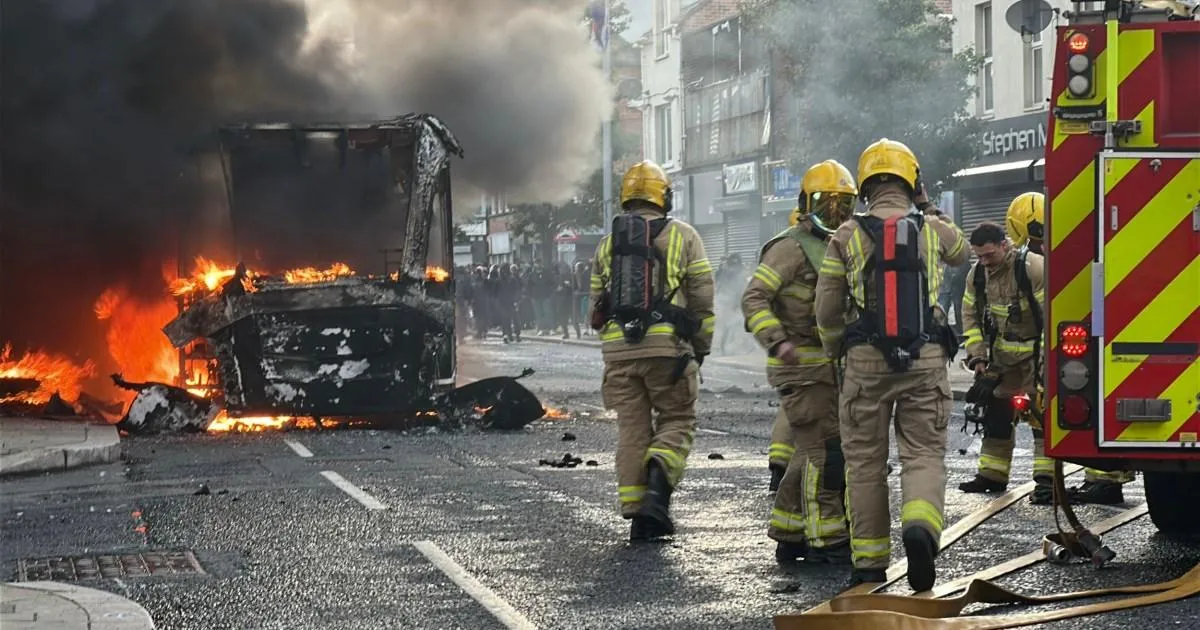
In the hours following the assault, the peace of Belfast was shattered as pockets of violence began to spread throughout the city. What started as a focused reaction to a specific crime quickly morphed into widespread civil disorder, characterized by the sight of burning vehicles and the sound of shouting through the night. A bus was set ablaze, serving as a grim focal point for the chaos, while other cars were torched in various neighborhoods. The tension, unfortunately, did not remain confined to North Belfast; reports soon confirmed that similar scenes of unrest were unfolding in other parts of the region, turning once-quiet residential areas into theaters of confrontation. This rapid escalation speaks to a deep, underlying unease that can quickly ignite when a shocking incident pierces the fragile stability of the community.
The scenes on the ground are stark and unsettling: groups of youths and protesters have gathered at critical intersections, such as the Newtownards Road in the east and near the Crumlin Road roundabout, creating makeshift barricades that have been set on fire. These gatherings have led to direct confrontations between members of the public and the Police Service of Northern Ireland (PSNI). The imagery coming from these locations—young people silhouetted against the orange glow of burning debris—is a stark reminder of how quickly law and order can slip away when emotions reach a breaking point. For those living in these areas, the night has been one of anxiety and noise, as the divide between the police and the restless crowds continues to widen with every passing hour.
The official response from law enforcement has been one of urgent de-escalation and caution. Assistant Chief Constable Ryan Henderson of the PSNI spoke to the media, clearly identifying the situation as a series of “sporadic pockets of disorder” rather than a singular, organized movement. His message was a plea for sanity: he urged the public to remain calm, to act with a sense of personal and communal responsibility, and to step back from activities that place lives at risk. The police are now tasked with the difficult job of managing these volatile crowds while navigating a climate of intense hostility. Yet, the very fact that the chief constable felt compelled to issue such a public, desperate appeal underscores the severity of the situation and the genuine fear held by authorities that the violence could spiral further out of control.
At its core, this situation is not just about the legal proceedings regarding the attempted murder charge; it is about the trauma and frustration that ripples through a city after such a harrowing act of violence. When a graphic video of a stabbing becomes the spark for a city-wide disturbance, it highlights a community where social cohesion is currently strained to the limit. The presence of bystanders trying to use hurling sticks to stop the stabbing illustrates the frantic, split-second nature of the initial attack, while the subsequent burning of buses and blockades reflects a much slower, deeper burn of resentment and anger. People are not just reacting to the crime itself, but to the environment that allows such violence to take place in their streets, prompting a reflexive, albeit destructive, form of collective defiance.
As the region faces the coming days, the challenge will be to restore a sense of normalcy and safety to the affected neighborhoods. The legal system will deal with the perpetrator, but the community must now grapple with the aftermath of the rioting and the psychological toll of the unrest. While officials talk of “sporadic” incidents, the reality for the residents of Belfast is a pervasive sense of instability that is difficult to shake. The hope, as shared by the police and local leaders, is that the anger does not solidify into a longer-term breakdown of public order. For now, the city remains in a state of watchful waiting, underscored by the burnt metal of abandoned vehicles and the echo of the recent violence, praying that the fires are extinguished before the situation reaches a point of no return.