


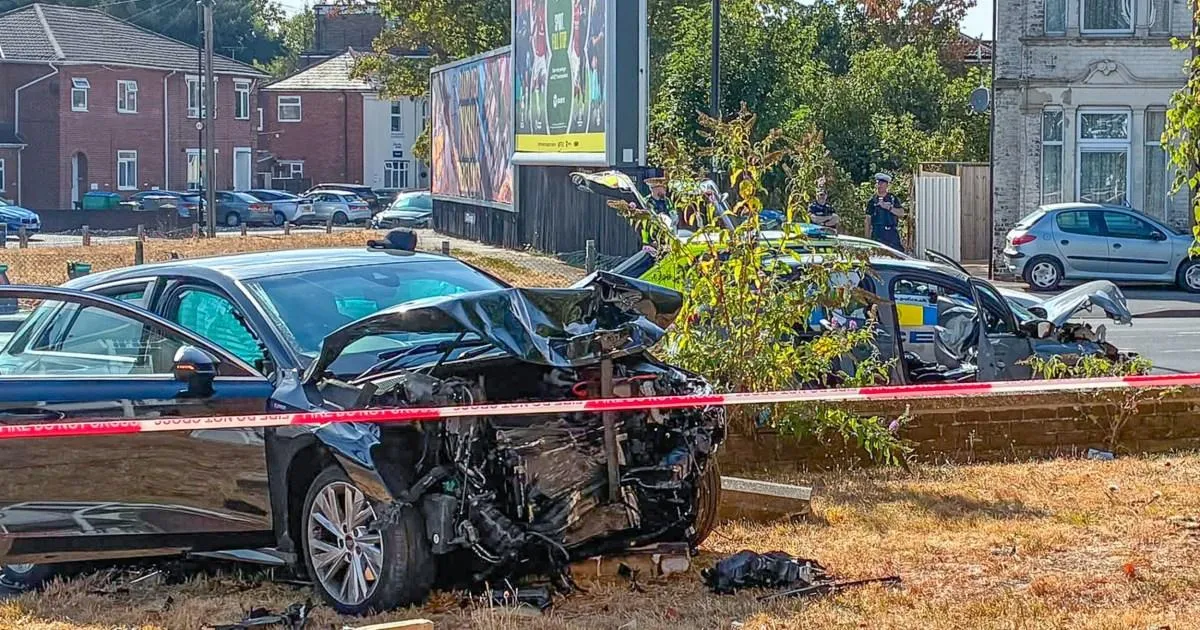
It began, for most motorists, as an unremarkable Wednesday afternoon in Southampton. Traffic moved steadily through the familiar junction where Shirley Road meets Roberts Road and Waterloo Road, with drivers waiting at the lights and easing forward when the signals allowed. Dashcam footage from the scene shows an ordinary city street, the kind of everyday setting where nothing out of the ordinary is expected. Then, in a heartbeat, that calm was shattered. A black Audi A3 appeared suddenly, tearing along the wrong side of the road, flying through the junction and into oncoming traffic before smashing head-on into a Vauxhall Corsa. The impact was violent, the two vehicles left crumpled and wrecked, with debris scattered across the tarmac. Two people were injured in the crash, and the aftermath left local residents and passing motorists in a state of shock. What had been a routine drive for one person became a life-changing moment in seconds. For the driver and passenger of the Audi, the day ended in handcuffs and hospital beds. For the innocent driver of the Corsa, it brought serious physical harm and the kind of trauma that can linger long after the sirens have faded. The footage, raw and unnerving, has since served as a stark reminder of how quickly road safety can be undone by reckless behaviour, and how the consequences of a single decision ripple far beyond the mangled metal left behind.
The chain of events that led to the collision began shortly before the crash, when police officers in the area spotted the Audi and ran a check that revealed it had previously been linked to drug offences in the locality. It was around 2.20pm when officers decided to pull the vehicle over on Blechynden Terrace. According to Hampshire and Isle of Wight Constabulary, the officers got out of their patrol vehicle and approached the Audi, but the driver had other intentions. Without warning, the Audi took off, accelerating away from the scene with little regard for anyone in its path. Officers immediately turned on their blue lights and began a pursuit, following the vehicle through the streets of Southampton in the hope of stopping it before anyone got hurt. That hope was short-lived. The pursuit came to a jarring conclusion when officers next came across the Audi at the junction of Shirley Road, Roberts Road and Waterloo Road—not because they had managed to box it in, but because it had already collided with a Vauxhall Corsa. The Audi had veered into oncoming traffic, and the front-end crash that followed was the kind of moment every officer dreads during a chase. The driver of the Corsa sustained serious but not life-threatening injuries, according to police, leaving them in need of medical treatment but fortunate to survive the impact.
The human cost of the incident was felt immediately, not only by the injured Corsa driver but also by the two occupants of the Audi, both of whom were arrested at the scene. A 33-year-old man from London was taken into custody on suspicion of dangerous driving, causing serious injury by dangerous driving, and failing to stop. He was later taken to hospital, where he remained with minor injuries—a reminder that even those who cause chaos on the roads are not immune to the physical consequences of their actions. A 27-year-old man from Essex was also arrested on suspicion of dangerous driving and causing serious injury by dangerous driving. Unlike the 33-year-old, he was released on bail until November 26 while the investigation continued. The arrests marked the beginning of what will likely be a lengthy legal process, with questions to be answered about the choices made in those moments before the crash. The officers involved, too, would have had to process the experience of initiating a pursuit that ended in injury, knowing that every decision they made would come under scrutiny. Police pursuits are inherently unpredictable and high-risk, and even when officers follow protocol, the behaviour of a fleeing driver can turn a routine stop into a tragedy. Fortunately, the injuries in this case were not fatal, but the emotional and psychological toll on everyone involved—witnesses, emergency responders, and families—should not be underestimated.
In the aftermath, Hampshire Constabulary referred itself to the Independent Office for Police Conduct, otherwise known as the IOPC. This referral is standard practice whenever an incident involves a police pursuit, reflecting the need for transparency and accountability when officers are engaged in high-speed chases. The IOPC considered the circumstances of the case and ultimately returned the matter to the force, determining that there was no need for the watchdog to carry out an investigation. That decision suggests the officers involved had acted in a manner that did not warrant independent scrutiny, and that the root cause of the crash lay with the driver who chose to flee rather than stop. Still, the referral highlights the delicate balance that police must strike in such situations. On one hand, they have a duty to apprehend suspects and prevent crime; on the other, they must weigh the risk that a pursuit could lead to serious injury or death. Every chased vehicle has the potential to become a weapon, and the decision to engage in a pursuit is never taken lightly. For the officers who watched the Audi speed away, the outcome of the crash would have been a heavy burden to carry, even if the IOPC found no fault with their actions. The system, at least, moved to ensure that every detail would be examined, and that the public could have confidence in the integrity of the investigation.
This Southampton crash did not happen in a vacuum. It came during a period when wrong-way driving and police pursuits had already claimed lives and shaken communities across the UK and Ireland. Just days earlier, a devastating collision on the A66 in Middlesbrough had killed five young men and two police officers in the early hours of a Saturday morning. A VW Passat carrying the young men had been driven the wrong way down the dual carriageway, seconds after a police chase had been called off, before smashing into another patrol vehicle. The officers killed in that crash, PC Matthew Blades and PC Tom Clough, were remembered as dedicated public servants who lost their lives in the line of duty. The tragedy sent shockwaves through the policing community and beyond, prompting renewed calls for the stricter regulation of pursuits and for a rethink of how police handle dangerous drivers. Then, a week before the A66 tragedy, five teenagers died in a head-on crash on the M9 in County Kildare, Ireland, while driving on the wrong side of the motorway. That collision, too, was met with an outpouring of grief, as families mourned young lives cut short in a moment of catastrophic misjudgement. Together with the Southampton incident, these crashes form a troubling pattern, one that underscores the devastating consequences of reckless driving and the split-second decisions that can change everything.
For those who witnessed the Southampton crash, or who have since seen the dashcam footage, the images are haunting in their familiarity. There is something deeply human about watching ordinary drivers navigate a city street, unaware that they are seconds away from being caught up in another person’s reckless choice. The driver of the Corsa, in particular, becomes a symbol of the innocent people who share the roads with those who choose to break the law at any cost. They were not speeding, not driving dangerously, not doing anything wrong—they were simply in the wrong place at the wrong time, and their life was turned upside down by someone else’s decision. In the days ahead, the focus will rightly remain on the legal proceedings against the two arrested men, on the recovery of the injured, and on the broader lessons that must be learned. But there is also a quieter, more personal dimension to consider: the trauma carried by everyone who was there, the anxiety felt by family members who received phone calls about the crash, and the fragile nature of lives that are so easily disrupted. As communities across the UK and Ireland mourn recent losses and recover from these alarming incidents, the hope must be that greater awareness, stricter enforcement, and a renewed commitment to road safety will prevent future tragedies. Because in the end, a police chase is not just a matter of catching a suspect; it is a chain of human decisions, each one capable of saving a life or ending one. The road to safety is paved not only with laws and punishments, but with compassion, responsibility, and a collective understanding that every driver’s choices matter.