
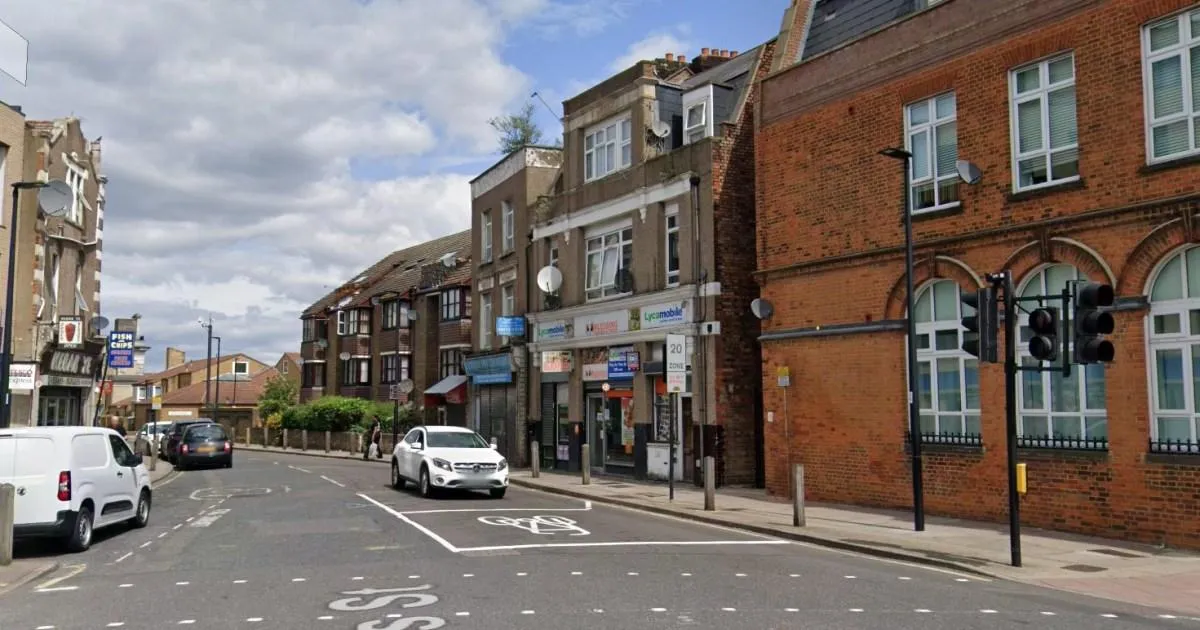
In the quiet, residential streets of Woolwich, southeast London, a district steeped in centuries of military history and known more for its historic barracks than for modern-day violence, September’s dusk was shattered by a sound that has become far too familiar in the capital’s urban sprawl: the sharp, decisive crack of a gunshot. It was just after eight o’clock on the evening of October 22nd when the ordinary flow of traffic along Frances Street turned into a scene of explosive, deadly conflict. At the center of this chaos stood Terry Dearsley, a 32-year-old father of three, a man whose only crime on that fateful night was an overwhelming impulse to intervene in a volatile road rage altercation erupting between strangers. Drifting through the neighborhood on his own business, Dearsley witnessed the escalating fury—the shouting, the aggressive posturing, the simmering anger that threatened to boil over. Motivated by a profound sense of civic duty and the compassionate instincts of a devoted parent, he made the split-second decision to step out of his own vehicle and attempt to act as a peacemaker. His intention was to de-escalate, to use calm words to quell the rising tempers—a noble act of heroism that tragically made him the target of unspeakable violence, transforming his car from a mode of transport into a sanctuary of last resort where he would bleed and wait for salvation.
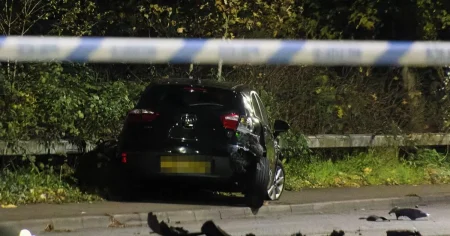
The ensuing chaos unfolded within moments. What began as a dispute over driving etiquette quickly spiraled into a lethal confrontation when one of the parties resorted to a firearm. In the blur of panic and adrenaline, Dearsley was shot, struck by a single, devastating bullet that would ultimately prove fatal. Despite the searing pain and the rush of blood, he managed to retreat to his own parked vehicle, a space where he likely sought refuge, hoping to shield himself from further harm until help could arrive. It was there, in the driver’s seat of his car, that responding Metropolitan Police officers found him—a critically injured, deeply human soul, slumped and gasping for life. The emergency response was immediate and massive: armed police units and specialist detectives converged on the scene near the Royal Artillery Barracks, sealing off the area while paramedics frantically fought to stabilize him. He was treated on the pavement, the glow of sirens illuminating his pale face, before being rushed at high speed to a major trauma hospital. For the next thirteen days, Dearsley lay in a critical condition, his body hooked to a web of life-sustaining machines, suspended between this world and the next. His family kept a vigil, holding onto hope, praying for a miracle. But the medical team’s relentless efforts were futile; the internal damage wrought by the bullet was too extensive, too catastrophic. On Wednesday, November 4th, the heart that had beaten for his three children finally gave out, and the journey from a random act of violence to a full-scale murder investigation was heartbreakingly completed.
As the Dearsley family began to navigate the unfathomable depths of their grief, the machinery of justice grinded forward with grim determination. Detectives spent the subsequent week meticulously piecing together the events of that night, collecting ballistics evidence, interviewing witnesses, and analyzing CCTV footage from surrounding properties. Their investigation quickly converged on a suspect: a 48-year-old man named Paul Rosser-Davies. A week after the shooting, Rosser-Davies was arrested, and following intense questioning and forensic analysis, he was formally charged last Sunday. The initial charges leveled against him were attempted murder and possession of a firearm with intent to endanger life—a legal framework that reflected the horrific reality that Dearsley was still clinging to life in a hospital bed. Now, with the victim’s tragic passing, the pendulum of justice has swung toward more severe consequences; while the murder investigation is officially underway, the charges will inevitably be revisited and likely upgraded to reflect the irreversible outcome of Dearsley’s death. Rosser-Davies was brought before Wimbledon Magistrates’ Court on Monday, appearing in the dock where he was officially remanded into custody. The judge set a subsequent hearing date at the Central Criminal Court, more commonly known as the Old Bailey, where the case will be heard with the full weight of the British legal system. The upcoming trial promises to be a harrowing examination of how a simple disagreement over driving behavior could escalate into such permanent devastation, placing the court at the heart of a community grappling with a senseless loss.
Behind the stark legal terminology, the police statements, and the press releases, there lies a profoundly human catastrophe that reaches far beyond the cruelties of the criminal justice system. Terry Dearsley was not a faceless statistic that will be reduced to a number in London’s gun crime records; he was a devoted father whose three children will now grow up carrying the heavy burden of his absence. He was a son, a sibling, a friend—a man who loved deeply and believed, perhaps innocently, that humanity could be reasoned with. The cruelest irony of this tragedy is that Dearsley was never a willing combatant in the violent dispute. He was a peacemaker, a Good Samaritan who saw two people descending into madness and made the selfless choice to interject his own safety into the fray. His final moments were not spent in rage or aggression, but in the hope of resolving a conflict that was never his own. His family now faces an agonizing future filled with funeral arrangements, police meetings, and the hollow echo of his laughter in their home. They are being propped up by specially trained family liaison officers, professionals who are equipped to guide them through the labyrinth of legal procedures while offering a shoulder for their tears. For his children, the questions will be endless and unanswerable—why was their daddy so brave? Why would someone take him away from them? The community of Woolwich has also rallied around the family, leaving floral tributes and heartfelt notes at the scene of the shooting, a silent testament to the impact this father had on those around him.
This senseless act of violence also forces a broader, uncomfortable reflection on the state of modern society, particularly the epidemic of road rage that has become a powder keg on Britain’s roads. A minor traffic incident—a tight overtake, a misjudged indicator, a sharp horn blast—can ignite a fuse of primal anger that quickly spirals beyond control. In this instance, what should have been a fleeting moment of peevish exchange escalated with terrifying speed into the unlawful discharge of a firearm on a public street. The prevalence of illegal guns in London remains a stubborn and deeply concerning undercurrent of violence, a societal ill that the police fight on a daily basis, often with mixed results. While statistics on firearm discharges fluctuate, incidents like this one shatter the illusion that gun crime is confined to specific, high-risk gang territories; rather, it can erupt anywhere, in any neighborhood, at any time, victimizing even those who are simply trying to do the right thing. Woolwich, with its rich tapestry of cultures and its proud heritage, now bears the unhappy distinction of hosting this tragedy. The case also highlights the precarious nature of civic duty; we often teach our children to stand up against injustice, yet this event chillingly demonstrates the potential fatal cost of such action. Dearsley’s instincts were pure, his courage admirable, but they were met with a callous disregard for human life that is emblematic of a society struggling to manage anger and conflict without resorting to lethal force.
Looking ahead, the quest for justice for Terry Dearsley will continue to unfold within the austere corridors of the Old Bailey. The trial will serve as a somber reminder of the fragility of life, as jurors are subjected to harrowing testimony, forensic evidence, and the emotional weight of a family left shattered. The charge of possession of a firearm with intent to endanger life carries heavy penalties, and if the murder charge is formally upgraded—as it almost certainly will be given the victim’s death—it will demand a mandatory life sentence under English law. While the courts deliberate, the Dearsley family must find the strength to rebuild their lives from the rubble of their tragedy. They must learn to remember Terry not solely as a victim of a heinous crime, but as a hero who embodied the very best of humanity—a man who valued peace over personal safety, compassion over convenience. His children will be raised on stories of his bravery, taught that their father was a man who stood up for others when others might have looked away. The Metropolitan Police continue to appeal for any further witnesses to come forward, urging anyone with information to assist the investigation in bringing full closure. As the sun sets over the streets of Woolwich, the memory of Terry Dearsley lingers like a poignant ghost, a stark reminder of the devastating cost of unchecked rage and the price of unyielding courage. His family demands answers; the law must rise to meet them. And in the quiet moments, when the traffic flows peacefully again, one hopes that his sacrifice will encourage a little more patience, a little more kindness, and a steadfast refusal to let anger transform our streets into battlefields.