



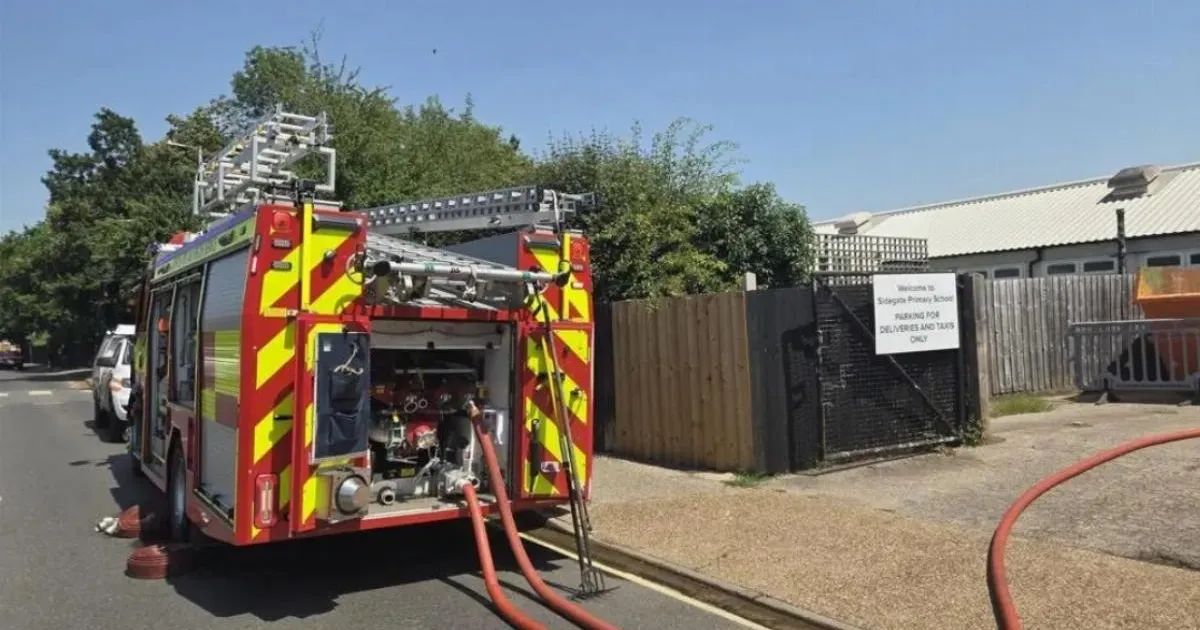
Across the UK, a cloud of anxiety is forming over school rooftops. Recently, parents and local communities have been rattled by a string of fire incidents linked to solar panel installations at primary schools. From Suffolk to Northumberland, a recurring pattern has emerged: when a fire breaks out, investigators are pointing toward the solar technology perched above classrooms. In response, local authorities have taken decisive, precautionary action, disconnecting dozens of school systems as they scramble to ensure that the very technology intended to foster a greener future doesn’t compromise the safety of the children sitting beneath it today.
The alarm bells began ringing in earnest following an incident at Sidegate Lane Primary School in Ipswich, where staff were forced to evacuate the building after the smell of smoke drifted through the hallways. Suffolk Fire and Rescue offered a sobering conclusion: it was confirmed beyond reasonable doubt that the source of the blaze was a roof-mounted solar panel. This was not an ancient, crumbling system, but one installed in 2012, well within its expected operational lifespan. This event prompted Suffolk County Council to temporarily shutter 80 school systems that were installed between 2011 and 2016, effectively pressing “pause” on their renewable energy output while they investigate the integrity of these installations.
This is not an isolated phenomenon confined to a single county. Similar reports have surfaced in Shropshire, Nottinghamshire, London, and Northumberland, where 81 systems were disconnected after a fire broke out last summer. While many of these investigations remain inconclusive or point to “undetermined” causes, the repeated proximity of these fires to solar equipment has sparked a nationwide debate. Critics and worried parents are now questioning the government’s ambitious push to outfit over 250 schools with solar panels under a 10-year decarbonization plan. The goal is noble—to save millions in energy costs and fight climate change—but for parents waiting at the school gates, the priority is the immediate safety of their children.
Government officials and environmental advocates remain firm that the risks are statistically minute, often noting that solar systems are significantly safer than common household appliances like electric cookers. They argue that the transition to clean energy is more vital than ever, especially in a world where climate-driven wildfires are becoming a regular summer occurrence. The Green Party and other proponents of the scheme argue that abandoning solar energy would be a “serious own goal.” They maintain that the path forward isn’t to retreat from renewable energy, but to ensure that the transition is executed with rigorous standards, focusing on the quality of installation rather than the technology itself.
Experts in the field are trying to demystify the fear by pointing the finger at infrastructure rather than the panels themselves. Tony Slade, an energy expert, has clarified that solar panels—consisting mostly of glass and inert materials—rarely catch fire on their own. Instead, the danger likely lurks in the electrical “balance of system”: incorrectly sized wiring, corroded connections, or faulty inverters that convert the sun’s energy into usable power. His perspective suggests that the fires are not a symptom of flaws in renewable energy, but rather an issue of electrical engineering, maintenance, and the aging of early-generation components that may not have been serviced with the rigor they require.
Ultimately, the situation underscores a balancing act between urgent climate action and the necessity of child safety. While the National Education Union and local councils acknowledge that these fires are statistically rare, they agree that “rare” is not “acceptable” when it involves a school setting. The current pause in Suffolk and other regions is being treated as a vital period of due diligence. As the government continues its drive toward net-zero, these incidents are serving as a necessary, if difficult, reminder: the transition to a greener future must be built on a bedrock of meticulous installation and exhaustive, ongoing maintenance to ensure that our schools remain safe havens for the next generation.