



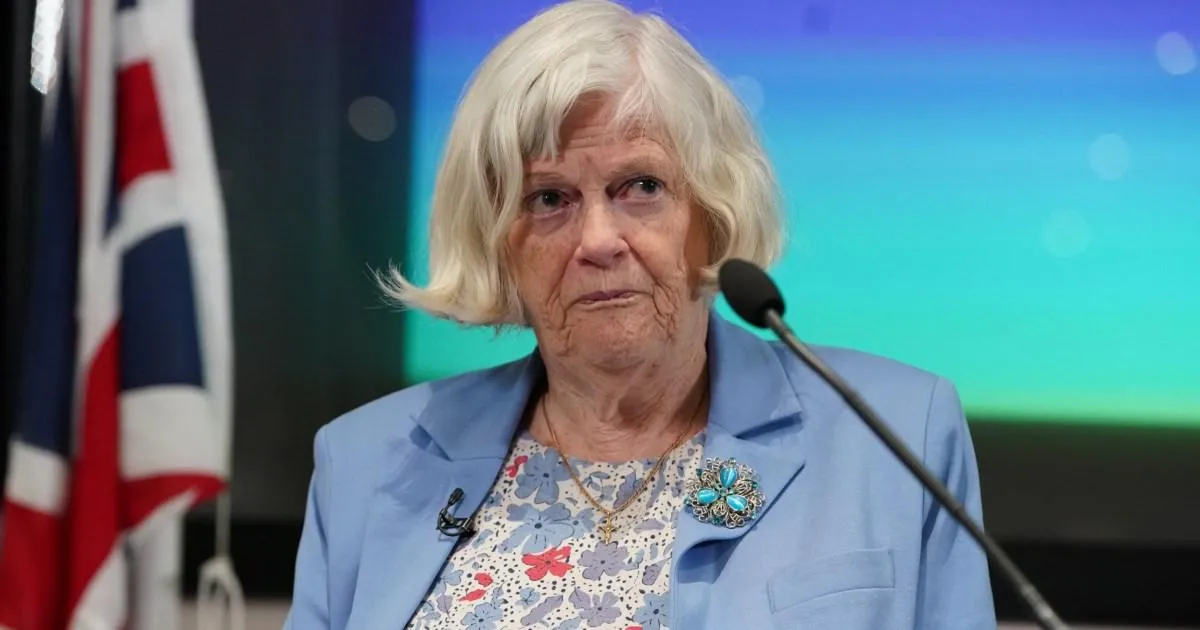
The tragic death of Ann Widdecombe—a prominent former Conservative minister and television personality—has sent a profound shockwave through the United Kingdom. Found deceased in her Dartmoor residence, the 78-year-old’s life was abruptly cut short in what authorities are now describing as a targeted attack. As forensic teams process the scene at her isolated bungalow and the nation attempts to grapple with the loss of such a polarizing yet steadfast public figure, the situation has been further inflamed by a vicious digital fallout that highlights the dark, uncensored nature of modern political discourse.
Following the news of the murder, a firestorm erupted on social media after a post, allegedly authored by Heather Herbert, a web developer at the University of Aberdeen, surfaced. The post brazenly described the assassination as “good news,” accompanied by inflammatory remarks wishing the deceased had suffered in agony. While the post was eventually deleted, its reach remains a focal point of public outrage. Police Scotland have confirmed they are investigating the incident, and the University of Aberdeen has publicly distanced itself from the comments, emphasizing that they do not reflect the institution’s values and are being treated as a matter of urgent priority.
The controversy has sparked a fierce debate about the boundaries of free speech versus the cruelty of internet toxicity. When approached for comment, Ms. Herbert—who claimed to have received death threats in the wake of her post—remained obstinate. She defended her stance by invoking a 2019 speech given by Miss Widdecombe at the Oxford Union, in which the late politician argued that people do not have a “right” to be protected from offense or hurt feelings in a functioning society. By framing her commentary as an act of retaliation against the politician’s past rhetoric, Herbert highlighted the deep, lingering animosity that Miss Widdecombe’s long and often controversial political career had inspired in certain quarters.
The animosity mentioned by critics often traces back to Miss Widdecombe’s tenure as Prisons Minister in the 1990s, particularly her controversial defense of the policy that saw pregnant inmates shackled during childbirth. She had argued at the time that such restraints were a necessary precaution against escape—a stance that many viewed as inhumane and that clearly left a lasting scar on the memories of her detractors. In her defense of her online comment, Ms. Herbert specifically cited these historical policies, attempting to draw a moral equivalence between the politician’s past legislative actions and the violence she suffered at the end of her life.
Beyond the online vitriol, the official investigation into the murder continues to move at a rapid pace under the guidance of counter-terrorism detectives. A 28-year-old male suspect was apprehended in Rotherham and is currently facing charges related to both murder and the potential instigation of terrorism. Authorities are meticulously piecing together the timeline, including whether Miss Widdecombe’s final media appearance on the morning of her death acted as a catalyst for the perpetrator. The intensity of the inquiry underscores the police’s belief that this was not a random act of violence, but a calculated, politically motivated strike against a woman who had spent decades in the public eye.
As this investigation unfolds, the death of Ann Widdecombe serves as a grim reflection of a society increasingly divided by political vitriol. Whether one supported her conservative politics or found her policies deeply objectionable, the nature of her death—and the callousness with which some have reacted—reminds us of the fragility of civil discourse. As the legal system works to bring the culprit to justice, the broader challenge remains for the public to reckon with how political passion can devolve into dehumanization, leaving a nation to mourn a life that, regardless of ideology, deserved a far more dignified end.