


Paragraph 1: The Weight of the Verdict
The small, utilitarian courtroom at Leeds Crown Court fell silent as the judge lifted his head from the dense legal papers. On the stand stood Connor Charlton, a man whose name was once chanted from the terraces of grassroots football grounds across Yorkshire. At 32 years old, he was a familiar figure in the Northern Counties East League, a semi-professional center forward for Nostell Miners Welfare, known for his physical presence, his work rate, and his knack for scoring crucial goals. He was a local lad from Hunslet, a working-class district of Leeds where football isn’t just a sport but a lifeline, a source of identity, and a communal heartbeat. Yet, on that fateful morning, the football boots were replaced by handcuffs, and the green pitch was replaced by the cold, grey dock. The judge’s verdict echoed through the chamber with a finality that was both stark and shocking: four years in prison for a litany of appalling driving offenses, paired with a driving ban extending four years and seven months. For Charlton, the dream of a quiet life of sport, local celebrity, and community was over, replaced by the grim reality of a prison cell. The stark contrast between the athletic hero he was on the pitch—clapping fans, celebrating goals, inspiring children in the local youth teams—and the reckless menace he had become on the road left onlookers and, indeed, his supporters in a state of deep disbelief. This was a stark reminder that talent, good standing, and community respect can be obliterated in a split second of catastrophic judgment, leaving a trail of shattered careers and broken trust behind.
Paragraph 2: The Horrifying Visual Evidence
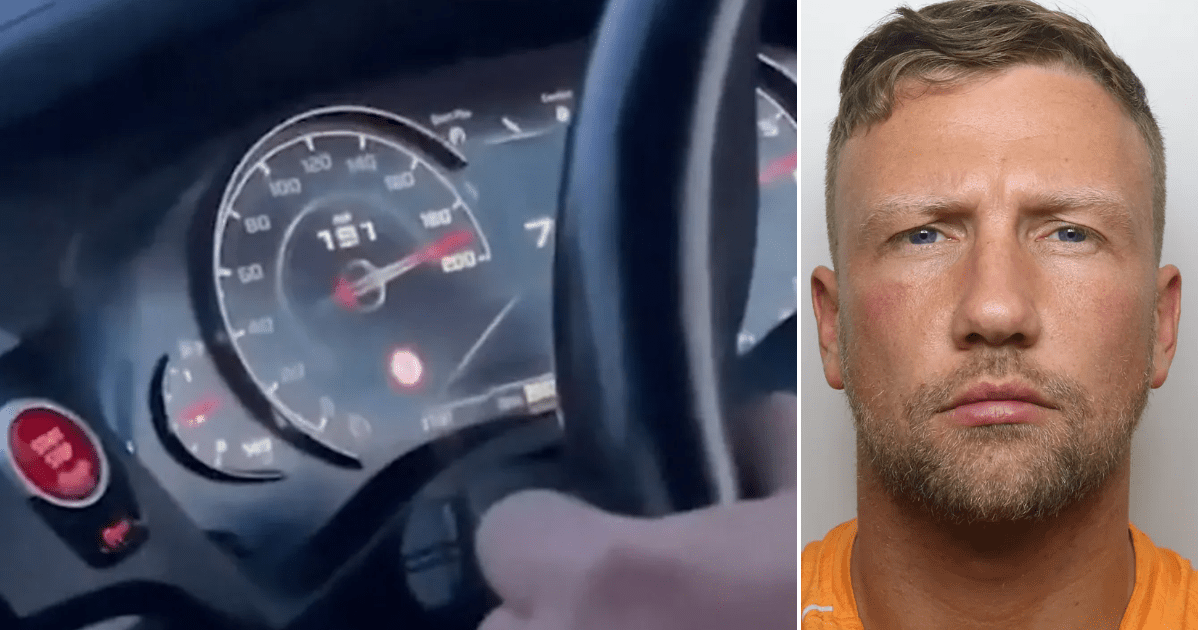
The evidence that sealed his fate was not buried in dusty case files or suppressed by legal technicalities; rather, it was displayed in horrifyingly vivid video footage released by the Crown Prosecution Service, a move designed to ensure the public saw exactly what the courts saw. In one painful clip, Charlton is seen behind the wheel of his powerful BMW, treating a public roundabout as if it were his personal drift track, a scene ripped from a street-racing video game. The screams of the tires are deafening—a high-pitched shriek of torture as the car slides sideways, thick smoke billowing into the air and obscuring the view of other motorists. His passengers, seeming emboldened by the thrill, whoop and laugh, egging him on, oblivious to the chaos he is sowing on ordinary roads used by families, commuters, and delivery drivers. At one terrifying, heart-stopping moment, the car lurches violently towards an innocent, unsuspecting van, missing it by mere inches—a collision that could have easily, and instantly, turned into a multi-vehicle catastrophe or a funeral. But this near-miss was not his worst offense. Another video, filmed by a passenger on a motorway in the West Yorkshire area, shows the speedometer needle climbing relentlessly, mercilessly, until it hits a staggering 191mph—a velocity so extreme that it numbs the mind. To put that into perspective, that is over three times the legal limit, faster than many commercial airplanes take off. At that speed, a car is essentially a high-velocity missile encased in a thin shell of metal, and a single pothole, a gust of crosswind, a tire blowout, or a driver merging lanes would result in instant, guaranteed death for Charlton, his passengers, and all those unfortunate enough to be sharing the tarmac with him. This was not driving; this was a blatant, calculated death wish, carried out with an arrogance that defied all comprehension.
Paragraph 3: The Deep Web of Deceit
Yet, the dangerous driving, appalling and unforgivable as it was, only told half of this sordid story. Charlton’s downfall was compounded by a calculated and cynical scheme that struck at the very heart of the British justice system, a system designed to keep roads safe and drivers accountable. He admitted to four offenses of perverting the course of justice—a serious, indictable crime that carries its own severe penalties in addition to the primary driving charges. The details that emerged during the trial revealed a sordid and disturbing side to his character, one that went far beyond the reckless abandon of a speeding thrill-seeker. Facing multiple speeding fines and accumulating penalty points on his license—points that would soon trigger an automatic ban—Charlton did not slow down or change his behavior. He didn’t take a defensive driving course or sell the sports car. Instead, he arranged for other people, likely friends, acquaintances, or vulnerable individuals desperate for easy cash, to be paid to take the penalty points for his offenses. This is a dangerous betrayal of the entire legal framework. He effectively bought their names and their clean records to protect his own driving record, ensuring he could continue to drive at lethal speeds with complete impunity while others bore the legal burden, the insurance penalties, and the long-term ramifications. The individuals who took those points were not just committing a minor infraction; they were actively colluding in his ongoing deceit, allowing a dangerously incompetent and narcissistic thrill-seeker to remain legally on the road behind the wheel of a high-powered car. This fraud undermined the sanctity of the driving license system, which is a contractual agreement of trust between the state and the driver, and showed a complete, calculated disregard for law, order, and the safety of the public he so recklessly endangered.
Paragraph 4: The Fall of the Local Hero
To truly understand the magnitude of Charlton’s fall, one must first appreciate the unglamorous world he inhabited. Semi-professional football is not the glamorous, financially bloated realm of the Premier League. It is a raw, gritty world of muddy pitches, blustery northern winds, early morning training sessions squeezed in before a full day of physical labor, tin roofs resting on small, intimate clubhouses, and the passionate, unwavering loyalty of a tight-knit local community. Players like Charlton play for the sheer, unadulterated love of the game, for the camaraderie, and for the pride of representing their town. They juggle full-time jobs with the demanding physical regime of the sport, often traveling long distances in cramped minibuses just to secure a few minutes of game time. For Nostell Miners Welfare, a club steeped in the proud mining heritage of the region—a club built on grit, solidarity, and the sweat of working men—Charlton was a key player, a spearhead of their attack, the focal point of their ambitions. His goals brought joy and brief, glorious respite to the club’s supporters from the drudgery of daily life. However, this driving shame has indelibly tarnished his name and, by extension, the reputation of the club he represented. The headlines will follow him for years, a grim asterisk next to his career stats: “Jailed.” His teammates now have to field awkward questions from opponents and fans; his past goals will be viewed retrospectively through the dark lens of his imprisonment, and the club has had to actively distance itself from the scandal to preserve its own integrity. The shame extends exponentially to his family and friends in Hunslet, who now face the public stigma of his crimes, the whispered gossip, and the palpable disappointment. His promising, though modest, sporting career is now conclusively over. No credible club in the country will touch a 32-year-old convicted criminal who put lives at risk, and the support network of teammates that once defined his Saturday afternoons is gone forever.
Paragraph 5: A Chilling Cautionary Tale
The case of Connor Charlton serves as a chilling, sobering cautionary tale for every motorist across the UK, transcending the niche world of local football. It highlights the inherent, festering danger of the “boy racer” culture that glorifies high speeds and reckless maneuvers as feats of masculine skill. The videos released by the CPS were not meant as entertainment to be laughed at; they are grim educational tools designed to expose the grotesque reality of such behavior. At 191mph, Charlton had zero control. He didn’t have the skill to drive like that—no one does on public roads. The laws of physics become immutable dictators at that speed. The fact that he survived is purely down to blind luck, sheer, unadulterated luck that no one was crossing the motorway in the outside lane, no lorry was changing lanes, no tire blew out, and no rain cloud had just slickened the asphalt. The police and the CPS are clearly sending a message through their handling of this case: this behavior will not be tolerated, and the courts are willing to throw away the key. The judge’s harsh sentence of four years, alongside the extensive driving ban, reflects the gravity and severity with which the judiciary now views such conduct. If Charlton had hit a family’s car at that speed, he would have been facing multiple counts of manslaughter and would likely be looking at a decade or more in prison, burdened with the blood of innocents. Instead, he sits in a prison cell, while the families he very nearly destroyed—the drivers of that van, the commuters on that motorway—can only imagine the horrific tragedy they were spared by a fraction of a second. His actions were not just illegal; they were profoundly immoral, prioritizing a few fleeting seconds of adrenaline and ego over the lives of his fellow citizens.
Paragraph 6: The Long Road to Ruin
As Charlton begins his four-year sentence, the silence of the football terraces will soon be replaced by the clang of prison doors and the sterile monotony of institutional life. The road ahead is brutal and unforgiving: four years of lost freedom, followed by a four-year and seven-month driving ban once he is eventually released on license. By the time he is legally allowed to sit behind the wheel of a car again, he will be in his early forties. His football career will be long dead, his physical peak a distant memory, his reputation permanently scarred and relegated to the annals of criminal history. His journey from grassroots hero to convicted felon is a profoundly human tragedy, but one wholly and undeniably of his own making. He had every single chance to slow down, to take responsibility, to respect the law, to value his own life and the lives of others. Instead, he chose arrogance, reckless abandon, and cold, calculating deceit. In that moment of sentencing, he lost more than his freedom; he lost his identity as an athlete, his standing in his cherished community, the trust of his family, and the respect of everyone who once looked up to him. This story is a stark, definitive reminder that the privilege of holding a driver’s license is a profound responsibility, not a right to be abused for cheap thrills. Every time we get behind the wheel, we are entrusted with the lives of our friends, our family, and complete strangers. Connor Charlton proved himself incapable of maintaining that trust, and for that profound failure, he will pay the ultimate price. His story is a sobering testament to the fragility of a good name and the permanence of bad choices, leaving a permanent warning etched into the history of Leeds Crown Court and the Northern Counties East League.