


A New Year’s Eve Spectacle: The Northern Lights Grace the UK Skies
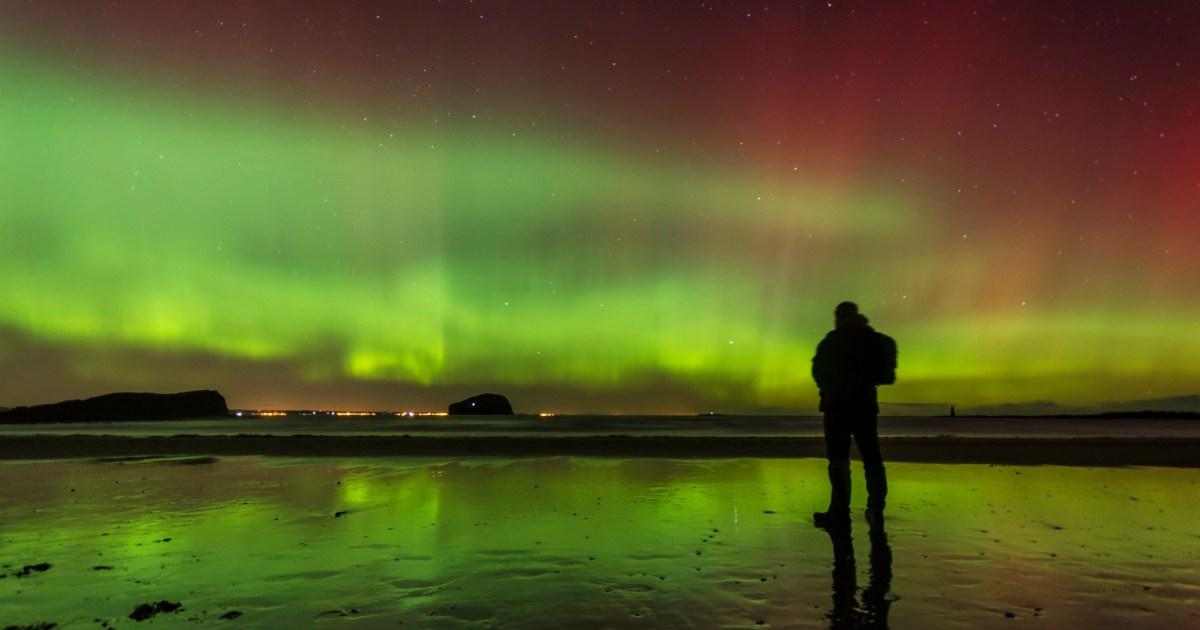
As millions across the UK prepare to ring in the New Year, a celestial spectacle is set to enhance the festivities. A powerful solar flare has triggered a coronal mass ejection (CME), increasing the likelihood of witnessing the mesmerizing aurora borealis, or Northern Lights, across a significant portion of the country. This rare occurrence is a result of the Sun’s heightened activity during its solar maximum, the peak of its 11-year cycle. During this period, the Sun is more prone to releasing potent flares that interact with Earth’s atmosphere, creating breathtaking auroral displays.
The aurora borealis is typically confined to the auroral oval, a ring of light encircling the polar caps. However, the intensity of the current solar maximum has expanded the visibility of these captivating lights. The Met Office has predicted a G1-G2/Minor-Moderate geomagnetic storm, resulting from the CME’s impact on Earth, which will potentially bring the aurora borealis to the skies of Scotland, Northern Ireland, and parts of northern England. This presents a unique opportunity for residents of these regions to witness a natural wonder often reserved for higher latitudes.
The CME, a massive expulsion of plasma and magnetic fields from the Sun’s corona, is expected to arrive at Earth on New Year’s Eve. While most recent CMEs have been deemed "far-sided," posing no threat to Earth, this particular CME is directed towards our planet. This fortunate alignment creates the potential for a spectacular New Year’s Eve display, with the Northern Lights potentially sharing the night sky with celebratory fireworks. The Met Office forecasts the peak viewing time around 9 PM, with visibility potentially extending until 3 AM the following morning.
The origin of this Earth-bound CME can be traced to a filament eruption, an arc of plasma observed near a sunspot region in the Sun’s southeast quadrant. This eruption generated a partial halo CME, identified as potentially Earth-directed, with an anticipated arrival on December 31st. This forecast has generated considerable excitement among skywatchers, particularly in northern England, Scotland, and Northern Ireland, the regions most likely to witness this celestial event. However, weather conditions, including heavy rain and strong winds predicted for these areas, could potentially obstruct the view.
For those hoping to catch a glimpse of the aurora borealis, the Met Office advises seeking out dark skies away from city lights, allowing ample time for the eyes to adjust to the darkness. Smartphone cameras can also be helpful in detecting subtle hints of the aurora that might not be immediately visible to the naked eye. This rare opportunity to witness the Northern Lights adds a magical element to New Year’s Eve celebrations, providing a unique and memorable start to 2024.
The concurrence of the Northern Lights with New Year’s Eve festivities presents a remarkable opportunity for millions to witness a natural spectacle typically reserved for higher latitudes. The heightened solar activity, responsible for this expanded visibility, offers a reminder of the dynamic nature of our solar system and the interconnectedness of Earth with its celestial surroundings. While weather conditions may pose a challenge, the potential for a dazzling display alongside celebratory fireworks makes this New Year’s Eve a truly special occasion for skywatchers across the UK.