


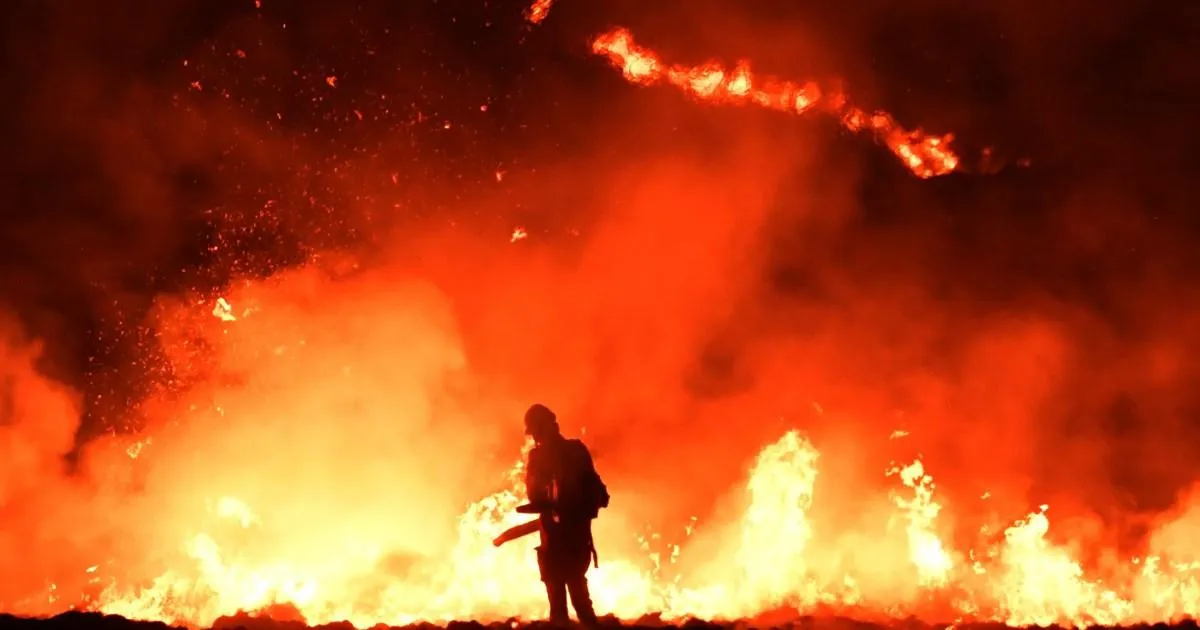
The United Kingdom is currently facing a dual crisis: a punishing heatwave and what experts are calling a “firewave.” As of recent reports, at least 19 wildfires were actively burning across the country, with some moorlands enduring flames for weeks. These infernos are not just expanding in size; they are actively threatening local communities, destroying fragile ecosystems, and degrading the air quality for thousands of people. While the term “firewave” might sound like a singular event, it describes a volatile intersection of urban danger and extreme environmental conditions, transforming the British landscape into a tinderbox.
At its core, a wildfire requires only two components: fuel and a spark. Unfortunately, the UK is currently suffering from a dangerous surplus of both. Successive heatwaves throughout the summer have parched the land, killing trees and turning once-vibrant forest floors into carpets of dry, flammable kindling. With near-zero rainfall for weeks, even the wind has become a malevolent force, whipping up embers and driving flames across larger territories. While human error—such as an abandoned campfire or a carelessly flicked cigarette—is the most common spark, the tinder-dry conditions have made even the smallest accident capable of mushrooming into a disaster.
Scientists, such as Dr. Theo Keeping of Imperial College London, clarify that a “firewave” is best understood as a period of “extreme fire weather.” Each day that a heatwave persists, the dangerous conditions compound; as the edge of a fire grows longer, it spreads faster and with greater intensity. Although these extreme weather windows occur on only about 4% of days annually, they account for roughly half of the most catastrophic forest fires. It is a terrifying feedback loop where the climate itself becomes the engine for destruction, making it increasingly difficult for firefighters to gain the upper hand.
The reach of this threat is surprisingly broad. Maps provided by Natural England indicate that almost the entirety of England and Wales is at a “very high” risk of wildfire, marked by urgent warning labels. Experts like Thomas Smith, an associate professor at the London School of Economics, emphasize that no part of the UK is immune. Whether it is a small patch of grass near a railway track or a sprawling local park, the current atmospheric conditions mean that ignition can happen anywhere. Consequently, officials like the Mayor of London are pleading with residents to take proactive measures, including creating firebreaks, clearing garden waste, and thinning out shrubs near homes.
Looking ahead, meteorologists warn that relief is not immediate. While there is a sliver of hope for cooler, wetter weather arriving toward the end of July via an Atlantic low-pressure system, the long-term outlook remains grim. Climate change is fundamentally altering the landscape, causing fire seasons to arrive earlier, stay longer, and burn hotter. In just the last two decades, the frequency and intensity of these events have more than doubled. Much of Europe is currently trapped under a “heat dome”—a weather phenomenon acting like a lid on a pot—which continues to push temperatures to fatal levels, as seen in the tragic loss of life in Spain’s recent wildfires.
The reality of this new climate era is that our emergency services are facing a shift in their core mission. In the past, the expectation was that every wildfire could be quickly suppressed; however, during a firewave, that is no longer a certainty. Fire and rescue services are now being forced to make difficult, strategic decisions about which incidents to prioritize, focusing primarily on protecting human life and critical infrastructure. This evolution in emergency management serves as a sobering reminder that as our winters get shorter and our summers grow more hostile, the UK must adapt to a future where fire is an ever-present, dangerous inhabitant of our changing environment.