

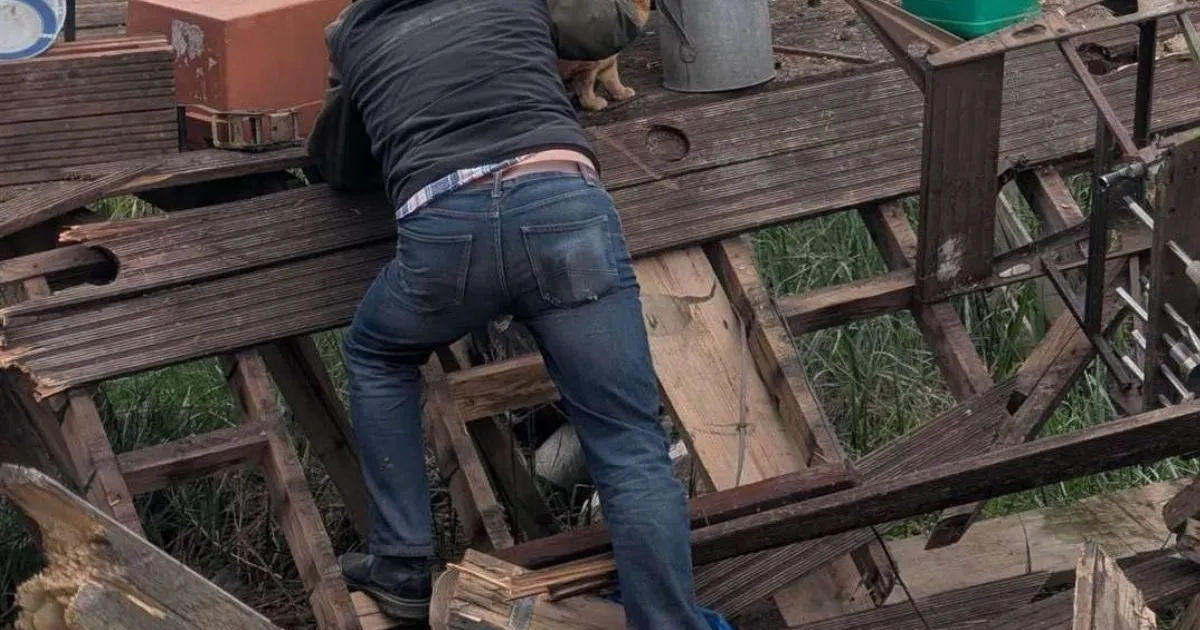
Some lives are built quietly, and they can be destroyed in the time it takes to run a simple errand. Bob Thwaites is 79 years old, a father, a grandfather, and for more than three decades a man who made his home in a creekside caravan on the Swanscombe Peninsula in north Kent. His off-grid existence began in 1991, after his marriage came to an end, and over the years the caravan became not just a shelter but a repository of everything that mattered to him: photographs, letters, everyday possessions, and the ashes of his late son. On May 6, Bob left that caravan for a short shopping trip. When he returned, he found a scene of total devastation. A digger had flattened his home. The place where he had slept, cooked, and grieved was now a heap of splintered wood and crushed metal. The ashes of his son were somewhere in that wreckage. Bob later described the feeling as being “absolutely dead” inside. He was not merely homeless; he was bereft of the physical reminders of an entire lifetime. The developers who carried out the demolition were connected to Land Logical, the company that had acquired Swanscombe Development LLP, the legal owner of the land. But no amount of paper ownership could justify, in the eyes of Bob’s supporters, what happened that afternoon. The loss was not just legal or material; it was profoundly human. A man who had asked for very little from the world had been erased from the landscape, not through a court order, not through legal due process, but through what his lawyers would later call an unlawful act of self-help.
To understand why Bob’s case has struck such a nerve, it helps to understand how he came to be there. The Swanscombe Peninsula is a place of marsh, water, and open sky, and in 1991 Bob found a spot beside Broadness Creek where no landowner seemed to exist. He put down roots of a sort, establishing a caravan that would remain in exactly the same position for decades. Aerial evidence later shown in court demonstrated that the caravan appeared in exactly the same spot from 1999 all the way through to 2025, while photographs from various points in between showed the life of a man who had made this eccentric dwelling a genuine home. He raised his children and welcomed grandchildren; he kept a cat named Rusty who stayed by him amid the debris; he became a familiar figure to the Broadness Cruising Club and other locals who passed along the creek. For many years, Bob even had a key to the gate leading onto the peninsula. That key would become important later, because his lawyers would argue that it amounted to a recognition of his residence. He did not live entirely alone—he had a partner and a daughter, and he would visit them—but the caravan was his base, the place he returned to, the place where he could be himself. He paid no council tax and had no planning permission, but in his view he had something more important: 35 years of undisputed presence. During all that time, he later recalled, there were no problems, no complaints, no attempts to move him on. Then Land Logical took over, and the life he had built in that quiet corner of Kent was destroyed in a single day.
The legal fight that followed has been framed by Bob’s team as a test of whether the rule of law still means anything. Ed John, a partner at Keystone Law who has spent 30 years practising property law, said he was left “open-mouthed” when he received the call on May 6. “I couldn’t believe anyone could do such a thing,” he said. The proper route for any landowner who believes someone is occupying their land without permission is well established: they must apply to court for a possession order. If the occupant refuses to leave, the matter returns to court and a warrant is issued, so that county court enforcement officers can carry out the eviction lawfully. None of that happened in Bob’s case. Instead, the company with the paper title took matters into its own hands. Bob’s legal team argued that, contrary to the label of “squatter,” Bob had acquired rights through adverse possession. Under English law, a person who occupies land openly and continuously for more than 12 years may, in certain circumstances, acquire an interest in that land. Because Bob had been living there since 1991—a period of more than three decades—his lawyers suggested those rights crystallised as an “overriding interest” when the land was registered. That meant Bob’s rights could in fact take precedence over the paper title now held by Swanscombe Development LLP. Lawyers stressed that the injunction hearing was not the final decision on who owned what; it was a preliminary question about whether Bob should be allowed to return with a replacement caravan while the wider case was resolved. But the implications were enormous. If a developer can simply bulldoze a man’s home without a court order, regardless of how weak or strong his legal claim may be, then the rule of law itself is under threat.
At Dartford County Court on September 30, the human weight of the case was impossible to ignore. David Forsdick KC, representing Bob, told Judge Catherine Brown that the destruction was “a trespass against my client” and that it was unlawful “in every event.” He drew attention to a news article in which Land Logical’s chief executive Nicholas Katz had described Bob as “squatting.” Those words, Forsdick argued, were devastatingly revealing. Under the law, even a squatter cannot simply be removed by force; the landowner must first go to court and obtain a possession order. By calling Bob a squatter, Katz was effectively acknowledging that he knew Bob had no contract and no permission—and that he should have sought a court order to remove him. “If he was squatting there, it can only be under licence or adverse possession,” Forsdick said. The court also heard that the caravan was unmistakably Bob’s home. Evidence included aerial photographs showing the caravan in the same position over the years, family photographs capturing gatherings and everyday moments, and testimony about the key to the gate. Forsdick dismissed the suggestion that Bob lived in three other places, explaining that while he visited his partner and his daughter on occasion, he did not live with them. The old man’s emotional state was described as “traumatised, dislocated and very stressed.” He had lost not only his home but the ashes of his son, and every attempt to salvage something from the wreckage was a small trauma in itself. His family had been photographed amid the remains of the caravan, picking through bent frames and torn fabric, looking for objects that could be recovered. The case had moved beyond legalities into the most basic questions of what it means to lose everything.
The developers’ response was to paint a very different picture. Howard Smith, the barrister representing Swanscombe Development LLP, argued that Bob had no contract entitling him to remain on the land. He accepted that the evidence suggested Bob spent time at Broadness Creek, but questioned whether his occupation had really been constant and uninterrupted for all those years. The lack of planning permission, the absence of council tax payments, and the general “under the radar” nature of the arrangement were all raised as indications that Bob was not a conventional resident. Smith also argued that when the Broadness Cruising Club’s access to the peninsula was revoked, any rights flowing from that arrangement were terminated. The defendant maintained that Bob had given inconsistent accounts of how long he had occupied the site, and warned that granting an injunction would lead to higher insurance premiums and the need for security restrictions. These technical arguments, however reasonable in a courtroom, could not address the core moral outrage of the case: Bob had lived in peace for 35 years, and he had been removed by machinery rather than by law. The demolition itself came after a broader dispute between the Broadness Cruising Club and Land Logical over access to the land. In the aftermath, Katz publicly repeated his claim that Bob had no “occupational right” to reside there. But the larger issue, as Bob’s supporters kept pointing out, was that the company should have asked a judge to decide that question. By acting unilaterally, they treated Bob as less than a citizen, as someone whose possessions and memories could simply be discarded along with the caravan.
Now the next chapter belongs to Judge Catherine Brown, who adjourned the application for an interim injunction until 11am on Thursday, October 15. If she grants the injunction, Bob will be allowed to return to the land with a replacement caravan and regain access to the site while the wider legal case continues. It is not a final victory. It is a temporary door back into a life that was violently interrupted. But for Bob, it could mean the difference between sleeping in the open air of a familiar place and remaining permanently adrift in a world that no longer has a spot for him. The MP for Dartford, Jim Dickson, has publicly backed Bob’s fight for justice. “Bob lived peacefully off-grid for over 30 years and his life was changed beyond recognition when his home and belongings were bulldozed in May,” he said. “This is no way to treat anyone. Proper processes are there for a reason and should be followed. Bob’s whole way of life has been destroyed.” Those words have resonated far beyond the court. Across England, people who live in caravans, boats, and other unconventional homes have watched Bob’s case with anxiety, recognising that it could set a precedent about how easily a human being can be erased from a landscape. And it has resonated with anyone who has ever loved a place, not because they owned it in the legal sense, but because it held their memories and their sorrows. Bob Thwaites may lose his legal battle. He may never get his old life back. But the story of a 79-year-old man returning from the shops to find his son’s ashes buried under rubble has already served as a powerful reminder that the law exists to protect the weak as well as the strong, and that a just society does not simply bulldoze the inconvenient. Whatever the judge decides, Bob’s dignity, in the face of cruelty, is not something that can be taken from him.