

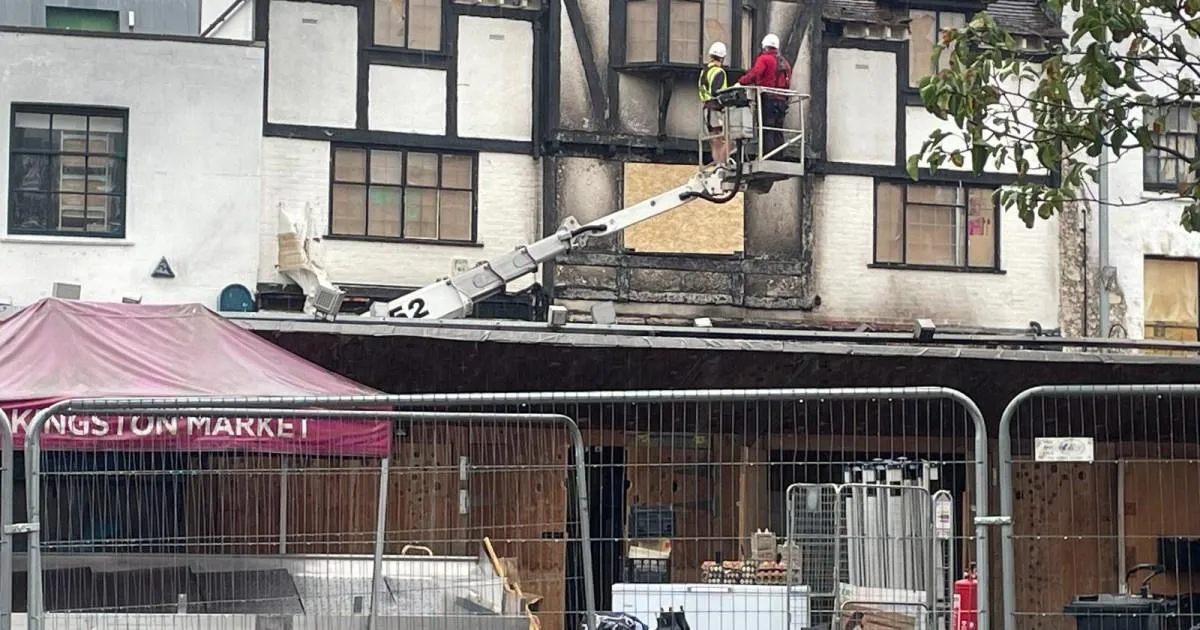
For more than eight centuries, Kingston upon Thames’ Ancient Market has been far more than a collection of stalls selling fish, bread, fruit and flowers. It has been the living, breathing heart of a town, a place where generations have gathered to trade, to chat, to celebrate and to mourn. The market was granted its Royal charter in 1208, and since that time it has stood as a symbol of continuity in a world that constantly changes. On Tuesday morning, that symbol was dealt a devastating blow. A ferocious fire ripped through the historic market in the early hours, tearing through wooden stands, awnings and stock, and leaving behind a scene of charred wreckage that smelled of smoke and loss. By the time dawn broke, the marketplace was cordoned off, with investigators and structural engineers picking through the debris while gas teams stood by. For the traders who have built their lives and livelihoods around these stalls, the sight was utterly heartbreaking. The blaze did not just destroy produce and property; it threatened to erase a tradition that has survived wars, recessions and pandemics. Locals spoke of feeling as though the town’s soul had been torn out. Yet even amid the ashes, there was a fierce determination to rebuild. The race is now on to see whether the market can be restored by Christmas, a crucial time of year for the small businesses that depend on the festive season. For now, the site remains unsafe, and traders cannot even get close enough to salvage what remains. But the promise from those who have lost everything is simple: they will fight back. The market, they insist, is not just a place to shop. It is the identity of Kingston itself.
Among those hardest hit is Tim Meads, known to generations of customers as “Tim the Fish”. For 42 years, he has run his fishmonger stall at the market, building a reputation for fresh produce, warm greetings and a deep commitment to the local community. He has also become one of the biggest local supporters of the Kingston Food Bank, quietly helping to feed vulnerable families in the area. On Tuesday, he stood among the ashes and tried to take in the scale of his loss. Thousands of pounds worth of stock had gone, along with the equipment and infrastructure of a business he had spent more than four decades nurturing. “It’s taken everything away from me,” he told BBC London. “Devastating, at the moment I have lost everything. Hopefully we can rebuild again, the town needs us.” His words captured the mood of a community that refuses to give up. Another trader, too upset to give their name, echoed the same sentiment: “We are heartbroken, just gutted. But we will fight back. We have lost everything, but we are determined to reopen. We are the soul of Kingston. We will rebuild and get back, but at the moment, we cannot even get on the site because it’s not safe.” The determination is not just about money, though the financial blow is severe. It is about identity, pride and a way of life. For many traders, the market is a family inheritance, a daily ritual, a place where faces are known and hands are shaken. To lose it would be to lose a part of themselves. The promise to rebuild is therefore not just a business plan; it is a pledge to the community that has supported them through the years.
The grief is not confined to the traders themselves. When Metro visited the scene, the marketplace was still cordoned off, with the smell of smoke hanging heavy in the air. Investigators were combing through the charred remains, while structural experts worked to make the area safe. But the barriers could not keep people away. Residents gathered at the edges, staring at the wreckage, offering words of comfort to traders and sharing memories of a place that has been a constant in their lives. Sandra Waites, a 54-year-old shopper, spoke for many when she said: “It’s so sad; it’s like the heart has been ripped out of Kingston. It’s more than just a market, it’s our history. In this day and age of malls and arcades, it’s a point of difference Kingston has, and we are very proud of it.” Her words highlight a truth about modern Britain: as shopping centres and online retailers multiply, traditional markets have become rare and precious. They offer something that cannot be replicated by algorithms or chain stores: human connection, local character, and a sense of belonging. Jason Eades, who works in a nearby cafe, described the market as “the hub of the town”. He said it was heartbreaking to see, but added: “I’m sure the community will pull together to help rebuild in any way we can.” That community spirit was visible in the faces of the people who stood in the cold morning air, not because they had anywhere to be, but because they wanted to show that they cared. The market has survived for over 800 years, and the people of Kingston seem determined to make sure it survives this.
The fire itself was terrifying in its speed and intensity. The London Fire Brigade received the first of six calls at 04.33, and crews from Kingston, Surbiton, New Malden and surrounding stations rushed to the scene. Flames were already shooting into the air, and the intense heat could be felt from a distance. There were genuine fears that the fire could spread to the many historic buildings that surround the market, turning a local tragedy into a catastrophe for the whole town centre. Carl Driver, who had just finished a night shift and was walking home through the market, witnessed the blaze take hold. He told Metro: “There were flames shooting in the air and an intense heat. There are a lot of historic buildings around; it looked like the whole town centre could have gone up in flames.” Fortunately, no injuries were reported, and by 06.08 the fire had been extinguished. But the damage was extensive. The fire engulfed not only the market stalls but also a Greggs, a branch of the soap shop Lush, a shoe shop and a bureau de change, all of which remained closed in the aftermath. The area was sealed off as police and fire investigators began the painstaking task of trying to identify the “seat of the fire” — the exact point where the blaze started. Gas teams were also deployed to the scene as a precaution. In a statement, the Metropolitan Police said officers attended alongside the London Fire Brigade and Ambulance Service, and confirmed that no injuries were reported. Crucially, the police added that the fire is not being treated as suspicious. That may come as a small comfort to traders, even as they face the enormous challenge of rebuilding their businesses from almost nothing.
In the aftermath, official responses have reflected the seriousness of the situation. Kingston Council leader Andreas Kirsch said: “The Ancient Market sits in the heart of the community and my thoughts are with traders, business owners and residents who have been impacted.” His words were echoed by the London Fire Brigade, whose spokesperson confirmed that control officers took the first of six calls at 04.33 and mobilised crews from several stations. The cause of the fire remains under investigation, and it may be some time before traders know exactly what happened. For now, the focus is on safety and recovery. Investigators have been combing through the charred remains, looking for clues, while structural experts assess whether any part of the site can be salvaged. The emotional toll is immense. For traders like Tim Meads, the market is not just a job; it is a calling. The fact that he has also been a major supporter of the Kingston Food Bank shows the kind of person the market has always attracted — people who believe in giving back, who know their customers by name, and who understand that a community is only as strong as its most vulnerable members. The fire has tested that community in the most brutal way. But it has also revealed the depth of feeling that exists for the market. From the council leaders to the shoppers standing in the cold, there is a shared understanding that Kingston without its Ancient Market would be a poorer place — not just economically, but culturally and spiritually. The investigation will continue in the coming days, but the bigger question is what happens next. Can the market be rebuilt by Christmas? Can the traders recover their losses? Can the spirit of a place that has stood since the 13th century survive the flames? The early signs suggest that the answer may be yes, because the people of Kingston are not willing to let it go.
Yet even in tragedy, there is a glimmer of hope for the future. Before the fire, the area housing the market had been earmarked for a potential revamp featuring new stalls and a piazza with a restaurant, bar and roof terrace. Between the Bridges, the team behind a legendary venue in Waterloo, had submitted an application to Kingston Council for the scheme. No decision had been made before the fire broke out, but the destruction may now accelerate the conversation about the market’s future. Some will see this as an opportunity to build back better, to create a market that honours its ancient heritage while embracing the needs of a modern town. Others will simply want to see the familiar stalls rise again, as quickly as possible, with the same traders, the same banter, the same smell of fresh bread, fish and flowers. The traders themselves have made their intentions clear. They will rebuild. They will reopen. They will not let a fire destroy what centuries of history have built. As Tim Meads said, “the town needs us” — and he is right. Kingston needs its market, not just for the produce it sells, but for the connection it provides. In an age of online shopping and faceless transactions, the Ancient Market is a reminder that commerce can be personal, that community can be built around a stall, and that some things are worth fighting for. The road ahead will not be easy. There will be insurance claims, planning permissions, fundraising efforts and long days of clearing debris. But the people who stood in the smoke on Tuesday morning, staring at the ruins of a beloved institution, did not look defeated. They looked determined. The market has served the community since the 13th century, and if the people of Kingston have anything to do with it, it will serve them for centuries more. The flames may have ripped through the stalls, but they could not extinguish the spirit of the town.