

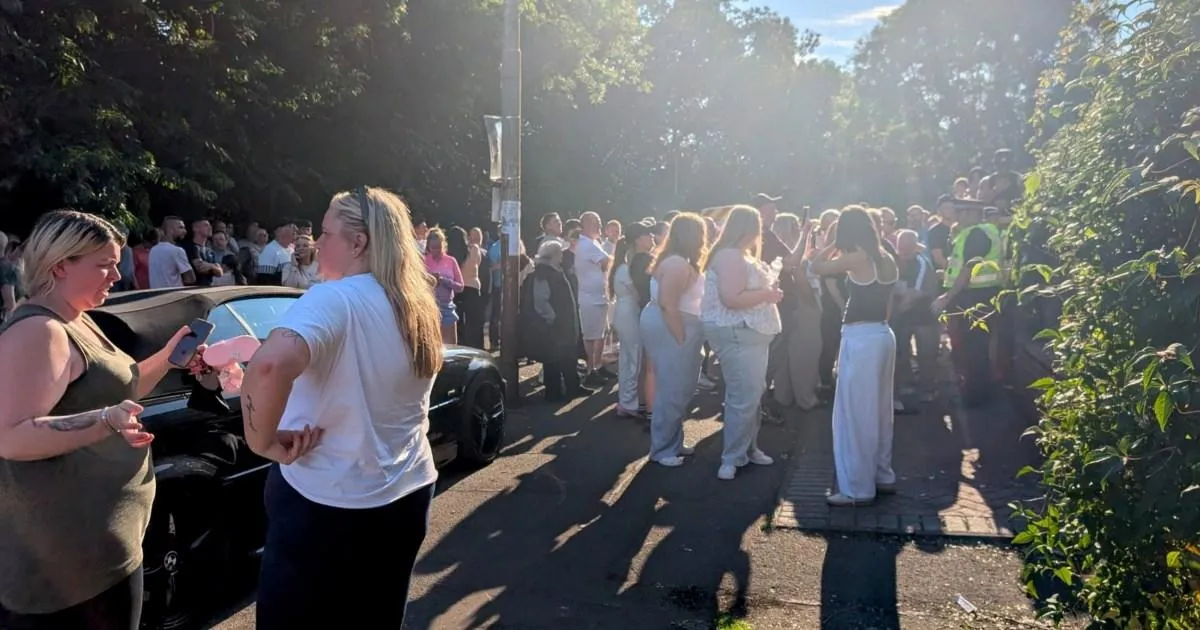
The quiet streets of Glasgow’s Castlemilk district were transformed into a scene of volatile unrest last night as hundreds of residents gathered in a tense stand-off outside a local block of flats. Driven by outrage over allegations of a serious sexual assault in the city, the crowd descended upon Tormusk Road, transforming the residential area into a flashpoint of public anger. Throughout the evening, the air was thick with shouting and the sound of objects striking glass, as protesters made their feelings clear, demanding that the suspect be removed from their community. The atmosphere was one of raw emotion and desperation, with many onlookers filming the chaos and broadcasting the intensity of the scene to thousands of followers via social media livestreams.
Police presence was immediate and significant, with officers forming a defensive line at the entrance of the flats to prevent the surging crowd from storming the building. The chants of “no peace for a beast” echoed through the neighborhood, a stark reflection of the community’s refusal to tolerate the presence of an alleged offender in their midst. As the situation grew increasingly precarious, the internal pressure reached a tipping point when several individuals attempted to force their way into the high-rise. Fearing for the safety of everyone involved—including innocent residents caught in the crossfire—authorities made the calculated decision to evacuate the building by 8 p.m., turning the structure into a fortified police perimeter.
This localized eruption of vigilante-style justice is not an isolated event but rather a worrying escalation of similar tensions seen across Glasgow this week. Just days prior, the Cranhill area experienced a parallel uprising following reports regarding two men accused of raping a woman in late May. In that incident, the situation devolved into physical confrontation, leading to the arrest of a 50-year-old man on charges of assaulting a police officer. These repeated disturbances highlight a community that feels deeply aggrieved and disillusioned by the legal system, choosing to take their frustrations to the streets rather than waiting for judicial processes to unfold behind closed doors.
The specific legal fallout of the Cranhill incident serves as a backdrop for the ongoing agitation, with the public closely monitoring the cases of 19-year-old Jebril Abdelrahman and 20-year-old Denison Charles. With Abdelrahman being held in custody and Charles released on bail, the difference in their legal pathways appears to have fueled a sense of injustice among those protesting. For many in the crowd, the complexity of legal procedures is secondary to the immediate, visceral desire for security and moral retribution. The fact that two other men involved in the original investigation were released without charge has only further muddied the waters, creating a breeding ground for rumors and public hostility that authorities are struggling to contain.
Police Scotland has been forced to take a firm, cautionary stance, emphasizing that while they respect the right to protest, they will not tolerate the transition from advocacy to violence. A spokesperson for the force was unequivocal in their condemnation of the recent disorder, labeling the acts of vandalism, the hurling of projectiles, and the physical attacks on officers as unacceptable risks to public safety. The authorities are now faced with the delicate task of balancing the need for public order with the necessity of maintaining their historically strong relationship with the Scottish public, a bond that is currently being tested to its limits by these recurring outbursts of community-led confrontation.
Ultimately, these protests serve as a grim indicator of the fragility of peace in neighborhoods where high-stress triggers, such as reports of violent crime, can quickly override institutional authority. As investigations into the vandalism and the specific acts of violence continue, the city finds itself asking difficult questions about how to address rising public fury. When communities feel that the system is not moving fast enough or keeping them safe, the barrier between a functioning society and a chaotic confrontation becomes perilously thin. For now, Glasgow remains on edge, with police on high alert and the conversation around community safety becoming increasingly polarized—a manifestation of a public that is no longer content to stand by in silence.