


A Near Miss in Istanbul: Cargo Ship Capsizes, Crew Escapes
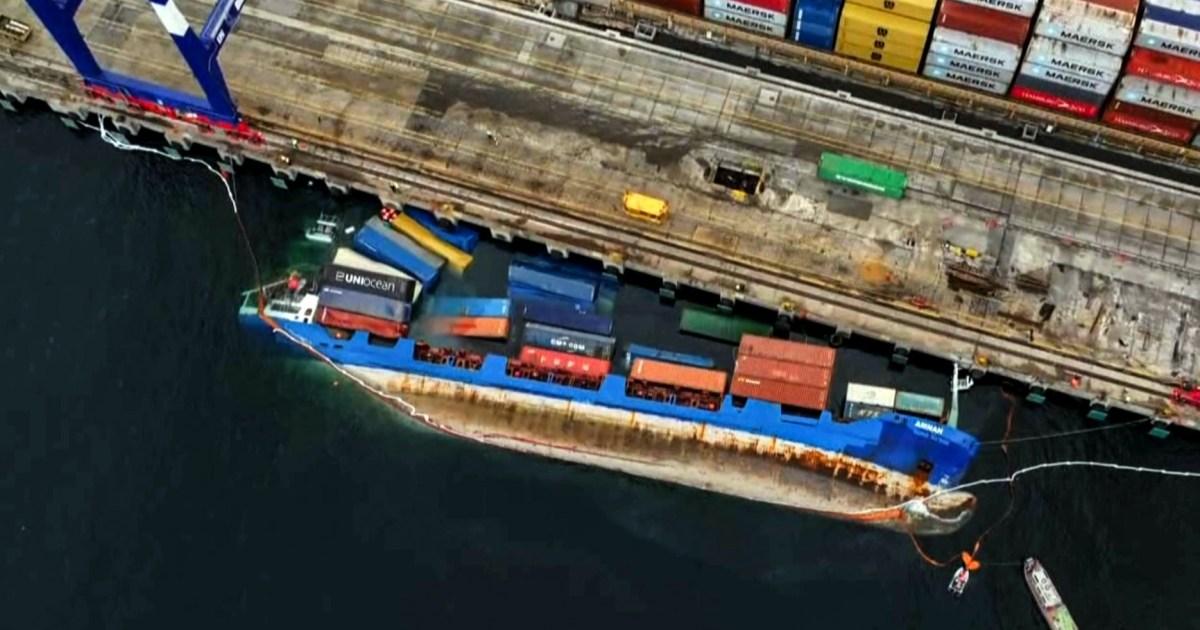
The tranquil waters of Istanbul’s port were shattered in the early hours of a recent day as the towering cargo ship, Amnah, suddenly listed and capsized, narrowly missing its crew. Security cameras captured the dramatic scene as the 5,215-metric-ton vessel, laden with steel containers, began to tilt precariously, its massive weight shifting inexorably to one side. The cause of the mishap was attributed to an uneven load distribution, a critical oversight that nearly led to tragedy. As the ship began its descent, the steel containers stacked on its deck, like a precarious tower of blocks, started sliding towards the edge, foreshadowing the impending chaos.
Fifteen crew members aboard the Amnah found themselves in a desperate fight for survival as their vessel succumbed to the imbalance. Five of them, realizing the imminent danger, leaped into the churning waters, swimming frantically to the safety of the port. Another ten, equally quick-thinking, managed to scramble onto the port itself, fleeing in the opposite direction of the tumbling ship, their lives hanging precariously in the balance. In the ensuing chaos, one crew member sustained minor injuries and was promptly transported to a local hospital for treatment, a fortunate outcome considering the magnitude of the incident.
The capsizing of the Amnah unfolded with a terrifying swiftness, captured in vivid detail by CCTV footage. As the ship listed further, the steel containers on its deck began to cascade into the water like a series of dominoes, creating a chaotic scene of churning water and tumbling metal. After several agonizing swings, the Amnah finally succumbed to gravity, collapsing onto its side and beginning to sink within moments. The quick response of port authorities ensured that the vessel’s perimeter was immediately cordoned off with floating barriers, a critical measure to mitigate the risk of maritime pollution from the sinking ship and its lost cargo.
The Amnah, a veteran of the seas built in 1996, had until recently been operated by the Russian Fesco shipping company. Its primary role was transporting cargo between Russian ports, including St. Petersburg, Petropavlovsk, and Vladivostock, and China, a vital link in the trade network between the two countries. The ship’s service continued until 2024, highlighting its long and active history in maritime commerce. This incident in Istanbul marks a dramatic end to its operational life, raising questions about the circumstances that led to the uneven loading and subsequent capsize.
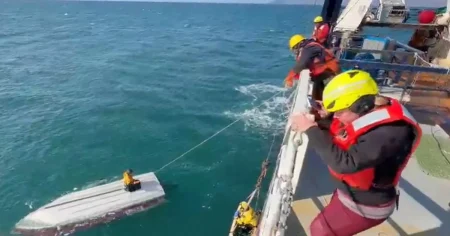
This incident in Istanbul echoes a similar mishap that occurred just a month prior at Mersin, another key commercial port in Turkey. In that incident, an 89-meter cargo ship also capsized, raising concerns about safety procedures and potential systemic issues affecting cargo ship operations in the region. The recurring nature of these incidents underscores the need for a comprehensive review of loading practices and safety protocols to prevent future occurrences and protect the lives of crew members and the surrounding marine environment.
The capsizing of the Amnah serves as a stark reminder of the inherent risks associated with maritime transport, particularly the critical importance of proper loading procedures and weight distribution to maintain vessel stability. The fortunate escape of the crew highlights the importance of quick thinking and decisive action in emergency situations. This incident should prompt a thorough investigation into the specific circumstances that led to the uneven load, as well as a broader review of safety regulations and practices within the shipping industry to prevent future occurrences and ensure the safety of maritime operations.