



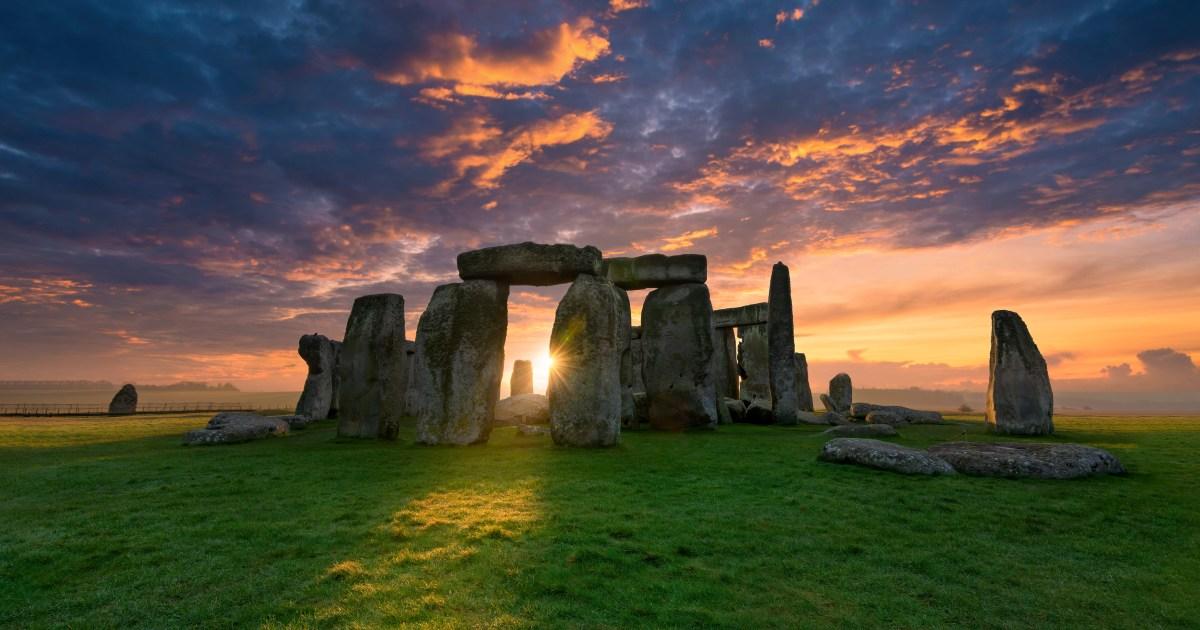
Stonehenge: A Symbol of Prehistoric British Unity
The enigmatic purpose of Stonehenge, a prehistoric monument that has captivated minds for millennia, may finally be revealed. New research suggests that the iconic stone circle, erected on Salisbury Plain in Wiltshire, served not only a religious function but also a political one, acting as a symbol of unity for the disparate peoples of ancient Britain. This groundbreaking theory challenges conventional interpretations and sheds new light on the complex social and political landscape of Neolithic Britain.
The construction of Stonehenge was a monumental undertaking, spanning several centuries between 3000 and 1500 BC. The monument’s unique composition, comprising stones sourced from distant regions across the island, sets it apart from the hundreds of other stone circles found in Britain. While the towering Sarsen stones, the most recognizable feature of Stonehenge, originated from the relatively nearby West Woods in Wiltshire, the smaller "bluestones" tell a different story. These stones, with their characteristic blueish tinge when wet or broken, were primarily sourced from Craig Rhos-y-Felin in the Preseli Hills of southwest Wales. Even more intriguing is the origin of the Altar Stone, a massive six-tonne, five-meter-long bluestone residing at the heart of the monument. Geological analysis has traced the Altar Stone to the Old Red Sandstone of the Orcadian Basin in northeast Scotland, a region encompassing parts of Inverness, Thurso, Shetland, and Orkney. This discovery underscores the vast geographical reach of the Stonehenge project and hints at the complex network of interactions that existed across prehistoric Britain.
The transportation of these massive stones over such vast distances, using only Neolithic technology, represents a remarkable feat of human ingenuity and organization. Researchers theorize that the stones were not merely building materials but symbolic gifts, exchanged between different communities to forge alliances and demonstrate shared cultural identity. The Altar Stone, transported from the far north of Scotland to the south of England, may have been a particularly significant gesture, cementing a powerful political and spiritual bond between these distant regions. The convergence of stones from Wales, Scotland, and Wiltshire at Stonehenge suggests a deliberate effort to create a shared space, a symbolic center for a nascent British identity.
Further evidence supporting this theory of unification comes from archaeological discoveries at Durrington Walls, a Neolithic settlement located near Stonehenge. The floor plans of houses at Durrington Walls bear striking similarities to those found in Orkney, suggesting a close connection between these geographically distant communities. This architectural resemblance points to a shared cultural heritage and strengthens the argument for Stonehenge as a unifying symbol, a place where people from different regions could gather and celebrate their shared ancestry.
Stonehenge’s role as a burial and cremation site also supports the idea of a shared cultural space. Nearly half of the individuals buried at Stonehenge originated from regions outside Salisbury Plain, indicating that the site drew visitors from far and wide. This pilgrimage-like behavior further reinforces the concept of Stonehenge as a central hub, a place of spiritual and social significance for a diverse population.
The alignment of Stonehenge with the solstices, the longest and shortest days of the year, adds another layer of meaning to the monument. The rising sun on the summer solstice aligns perfectly with the Heel Stone, situated in the northeast part of the horizon, while the setting sun on the winter solstice aligns to the southwest of the stone circle. This precise astronomical alignment suggests a deep understanding of the cosmos and its connection to the cycles of life and death. This shared reverence for the celestial bodies further reinforces the idea of Stonehenge as a place of unity, where people from different backgrounds could gather to celebrate the rhythms of nature.
In conclusion, the evidence points to Stonehenge being more than just a religious site; it was a political statement, a symbol of unity for the diverse peoples of ancient Britain. The transportation of stones from distant lands, the shared architectural styles, the burial practices, and the alignment with the solstices all contribute to a narrative of shared identity and purpose. Stonehenge stands as a testament to the ingenuity, organization, and shared cultural values of the people who built it, a symbol of unity in a time long before the concept of nation-states existed. It serves as a reminder of the complex social and political landscapes of prehistoric Britain, and the enduring power of shared symbols to create a sense of belonging and community. The stones of Stonehenge whisper tales of a time when disparate groups came together to create something extraordinary, a monument that continues to inspire awe and wonder millennia later.