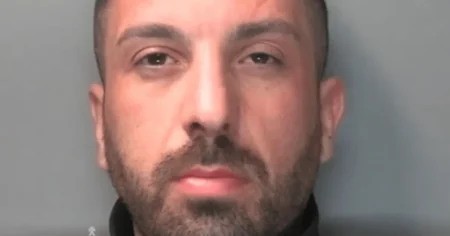




Brian Whitelock, a 57-year-old man with a history of violent crime, was sentenced to a whole-life term for the brutal murder of his 71-year-old neighbor, Wendy Buckney. Whitelock, who had previously been jailed for life in 2001 for murder and manslaughter, was released early on parole, first in 2018 and again in 2020 after a brief return to prison for assaulting a shop worker. This early release, predicated on a “low risk” assessment, ultimately proved tragically inaccurate, culminating in Ms. Buckney’s horrific death less than a year after his second release. The murder took place in August 2022 in Ms. Buckney’s Clydach home, near Swansea, where Whitelock had been employed to do odd jobs. The attack involved a kitchen knife, a broken table leg, and wooden shelving, leaving Ms. Buckney with an uncountable number of injuries. Whitelock’s outburst in court following the guilty verdict further underscored his lack of remorse, as he hurled curses and wished suffering upon the jury members.
The details of the murder paint a picture of unprovoked and extreme violence. Ms. Buckney, who had offered Whitelock a second chance by employing him despite his criminal past, was subjected to a sustained and savage assault. The prosecution presented evidence of multiple stab wounds, sharp force injuries, and blunt force trauma, indicating a prolonged and agonizing ordeal. There was also evidence suggesting sexual assault, though the precise timing in relation to the murder remained unclear. Whitelock’s own admissions to police, both at the scene and during subsequent questioning, confirmed the brutality of the attack, with him using the word “torture” to describe his actions. He was found partially clothed and covered in blood, a stark contrast to his attire when he initially entered Ms. Buckney’s flat.
The sequence of events leading to the discovery of the murder began when a neighbor, alerted by Whitelock’s own pronouncements of guilt, contacted the authorities. Whitelock, found kneeling on the front lawn attempting to wipe blood and dirt off himself, readily confessed to killing Ms. Buckney. His erratic behavior and statements, ranging from expressions of remorse to admissions of torture, highlighted the chaotic and violent nature of the crime. The police arrested him at the scene, where he continued to make incriminating statements, further solidifying his culpability. The judge, Mr. Justice Griffiths, in handing down the whole-life sentence, emphasized the senselessness of the crime, noting Ms. Buckney’s kindness and the lack of any discernible motive on Whitelock’s part.
The case raises serious questions about the effectiveness of the parole system and the risk assessment process that led to Whitelock’s release. Despite his previous life sentence for murder and manslaughter, he was deemed a low risk to the public, a judgment that proved tragically flawed. The Ministry of Justice, while expressing condolences to Ms. Buckney’s family, has declined to comment on any potential disciplinary action against staff involved in Whitelock’s parole hearings. A serious further offence review is currently underway, the findings of which will be shared with the victim’s family. This review is crucial in understanding the systemic failures that allowed a convicted killer to be released back into society, where he committed another heinous act of violence.
The tragedy of Wendy Buckney’s death is compounded by the fact that she had shown compassion towards Whitelock, offering him employment and a chance to reintegrate into society. Her belief in second chances tragically led to her own demise. The court proceedings, including Whitelock’s disruptive behavior and lack of remorse, further highlight the depravity of the crime. The imposition of a whole-life sentence underscores the severity of his actions and the judge’s assessment that he poses a permanent danger to the public. This case serves as a grim reminder of the challenges and potential failures within the parole system and the devastating consequences that can arise when dangerous individuals are prematurely released.
The ongoing review by the Ministry of Justice is of paramount importance. It needs to thoroughly examine the risk assessment process, the decision-making that led to Whitelock’s release, and the monitoring mechanisms in place following his parole. The review’s findings should be made public to ensure transparency and accountability, and to inform future policy and practice within the parole system. Furthermore, the review should consider whether any changes are necessary to prevent similar tragedies from occurring in the future. While the review cannot bring back Ms. Buckney, it can potentially prevent other families from experiencing similar heartbreak. It is a vital step towards ensuring that the parole system effectively protects the public while also providing opportunities for rehabilitation.