
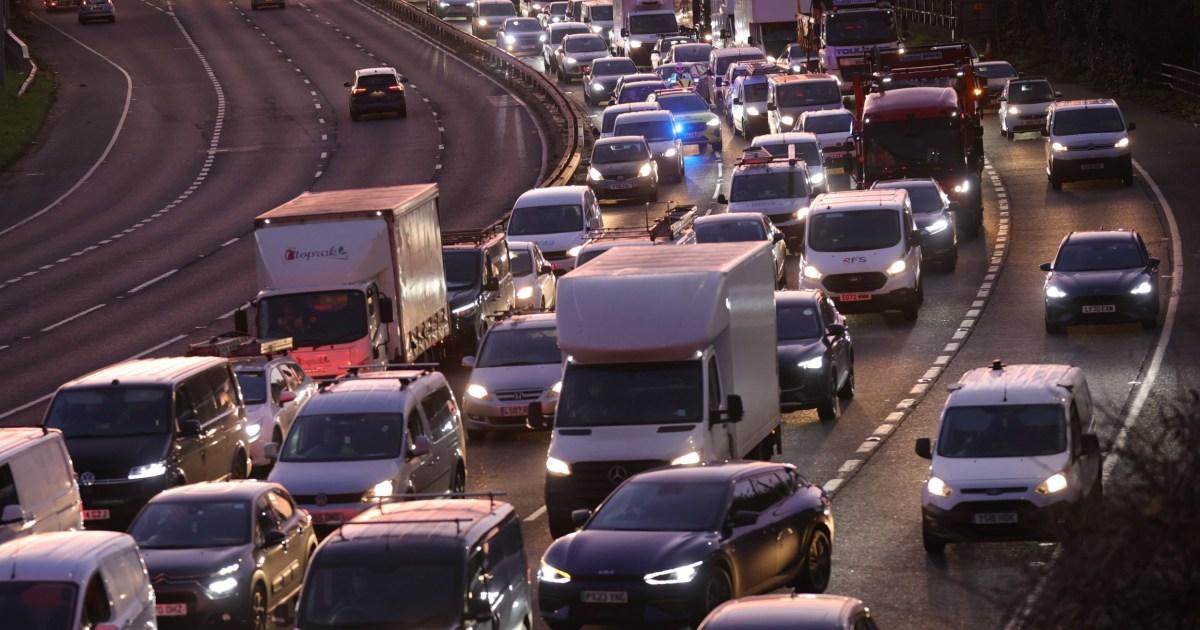
The Christmas season, a time of festive cheer and family reunions, is also notorious for its travel chaos. Millions of people across the country embark on journeys to visit loved ones, transforming roads into potential bottlenecks of holiday traffic. This year is no different, with motoring organizations like the AA and RAC issuing warnings of significant congestion in the lead-up to Christmas Day. The AA has issued an amber warning, signifying a heightened risk of traffic jams, from now until Christmas Eve. This surge in traffic volume, coupled with the usual commuter flows, creates a challenging environment for drivers.
The RAC, in collaboration with transport analytics company INRIX, has pinpointed specific days and times when congestion is expected to be most severe. Friday, December 20th, aptly dubbed “Frantic Friday,” is predicted to witness close to three million individual car trips, adding to the existing commuter traffic. This significant volume of vehicles on the road increases the likelihood of delays and disruptions. Saturday is anticipated to be even busier, with over 3.7 million car trips projected. However, the peak of holiday travel is expected to occur on Christmas Eve, Tuesday, December 24th, with an estimated 3.8 million trips anticipated as people make last-minute dashes to their holiday destinations.
The week leading up to Christmas has already seen a surge in travel, with an estimated 5.7 million trips occurring on Wednesday and Thursday. This mid-week spike is attributed to the fact that Christmas Day falls on a Tuesday, creating an extended period of pre-holiday travel and preparations, which the RAC describes as an “extended period of pre-Christmas panic.” This early rush contributes to the overall congestion and adds pressure to the road network.
The vast majority of these journeys are expected to be relatively short, covering distances less than 50 miles, according to the AA. This suggests that much of the traffic volume is generated by local and regional travel, with people visiting family and friends in relatively close proximity. While these shorter trips may seem less daunting individually, the sheer volume of vehicles on the road collectively contributes to significant congestion and potential delays.
The M25, a major orbital motorway around London, is identified as a particular hotspot for congestion, especially the clockwise section between the M1 near Watford and the M23 towards Gatwick Airport. This section caters to both local traffic and those heading to the airport for holiday flights, creating a convergence point for increased vehicle volume. Other areas of concern include the M3 in Surrey and Hampshire, and the M53 northbound from Chester to Liverpool, which is predicted to experience the worst congestion. These identified hotspots highlight the importance of careful route planning and considering alternative travel times to minimize disruption.
To avoid the worst of the holiday traffic, the RAC and INRIX have provided specific timeframes to avoid traveling. On Friday, December 20th, the period between 2 pm and 7 pm is identified as the worst time to travel. For Saturday, December 21st, the peak congestion window is between 1 pm and 6 pm. On Sunday, December 22nd, it’s advisable to avoid traveling between 8 am and 11 am. For both Monday, December 23rd, and Tuesday, December 24th, the period between 10 am and 4 pm is expected to experience the heaviest traffic. By avoiding these peak travel times, drivers can significantly reduce their chances of encountering lengthy delays and contribute to a smoother flow of traffic for everyone.
These predictions and warnings underscore the importance of careful planning for holiday travel. Checking traffic conditions before setting off, considering alternative routes, and allowing extra travel time are crucial steps to mitigate potential delays. For those with flexible schedules, traveling outside of peak hours can significantly reduce travel time and stress. Utilizing navigation apps that provide real-time traffic updates can also be beneficial in navigating around congested areas. By heeding these advisories and adopting a proactive approach to travel planning, drivers can contribute to a safer and more efficient holiday travel experience for everyone on the road.