



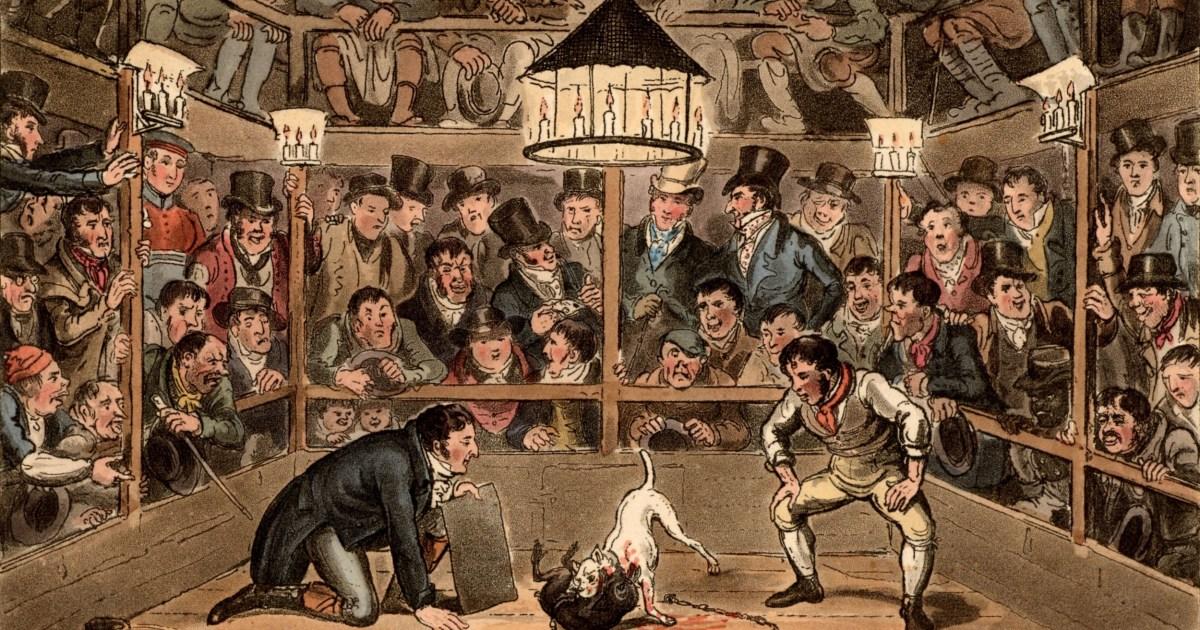
The Victorian era in England, a period of rapid industrialization and societal transformation, witnessed a stark contrast between scientific advancements and a dark underbelly of brutal animal blood sports. While innovations like the telephone and everyday household items emerged, so too did the popularity of staged animal fights held in seedy “pits” across the country. These gladiatorial contests, often resulting in death, captivated audiences from various social strata who wagered on the gruesome spectacle. Animals forced into these brutal engagements rarely achieved notoriety, remaining largely anonymous victims of this cruel entertainment. However, one creature emerged from this brutal arena to achieve a peculiar form of celebrity: Jacco Macacco, the fighting monkey.
Jacco Macacco, whose species remains unknown, arrived in England during the early 19th century, a product of the era’s imperial expansion and exploitative trade in exotic animals. Brought to the country likely from Africa, he was thrust into the cruel world of monkey-baiting, a blood sport pitting monkeys against significantly larger dogs. Jacco, a relatively small primate weighing between 10 and 12 pounds, quickly gained notoriety for his ferocious fighting style, earning the moniker “The Hoxton Ape” following victories in various fighting pits. His reputation grew to the point that challenges were issued on his behalf, inviting any dog in England to face him for substantial sums of money. Between matches, Jacco was confined to a small cage, and during fights, he was tethered to a chain to prevent escape into the audience, highlighting the exploitative nature of his existence.
Contemporary accounts describe Jacco’s fighting prowess with a mixture of awe and revulsion. His strategy involved using his agility and flexibility to evade the dogs’ attacks, positioning himself to seize their vulnerable areas, such as the throat, inflicting devastating bites and claw wounds. Often armed with a stick, Jacco would relentlessly assault his opponents, his small stature belying his ferocity. His matches drew large crowds, particularly after his acquisition by Charles Aistrop, proprietor of the prestigious Westminster Pit, where wealthy and influential spectators placed bets on the duration and outcome of the fights. The multi-tiered structure of the pit, resembling a Victorian theatre, emphasized the theatrical and performative aspect of these brutal spectacles.
Jacco’s fame reached new heights at the Westminster Pit, where he faced a succession of formidable opponents, including various breeds of bull terriers. Accounts claim he participated in up to thirteen rounds against these powerful dogs, often emerging victorious. However, the details surrounding his ultimate demise remain shrouded in some ambiguity. One version recounts a fatal encounter with a formidable dog named “Puss,” owned by a bare-knuckle boxer. During this fight, Jacco’s jaw was reportedly ripped from his face, leading to his death from blood loss. A contrasting account suggests Jacco survived the fight but succumbed to an illness fifteen months later. Regardless of the precise circumstances, Jacco’s violent life and tragic end serves as a grim testament to the cruelty prevalent in Victorian entertainment.
Despite the bleak nature of his existence, Jacco Macacco’s story had an unintended positive consequence: his suffering became a catalyst for the nascent animal welfare movement. The barbarity of his fights caught the attention of Richard Martin, an Irish Member of Parliament, who was appalled by the monkey’s ordeal. Martin’s advocacy led to the passage of the Cruel Treatment of Cattle Act in 1822, the world’s first legislation aimed at protecting animals from cruelty. Initially focused on livestock, the Act was later expanded to encompass all animals, including primates like Jacco. This landmark legislation laid the groundwork for the formation of the Society for the Prevention of Cruelty to Animals (SPCA) in 1824, which later became the Royal Society for the Prevention of Cruelty to Animals (RSPCA) under Queen Victoria’s patronage.
Although Jacco Macacco’s story marked a turning point in animal welfare, the complete eradication of animal cruelty remained a distant goal. Despite the legislative progress, the practice of animal baiting and other forms of animal exploitation persisted, albeit clandestinely. Even decades later, instances of animal cruelty remained prevalent, highlighting the long and arduous journey towards achieving widespread respect for animal rights. The display of Jacco’s purported ashes in a pub, and later in the True Crime Museum, underscores the complex and often contradictory attitudes towards animals during this period. Jacco’s story serves as a potent reminder of the dark side of Victorian entertainment and the slow, often painful, progress towards a more humane society.