



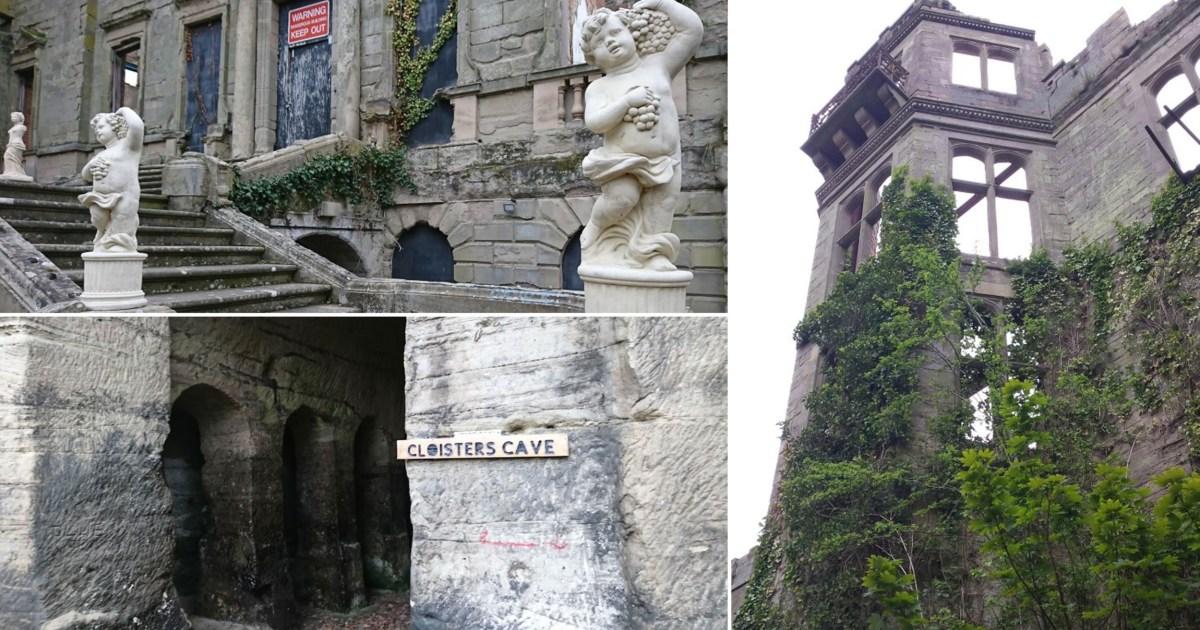
Guy’s Cliffe House: A Tapestry of Myth, History, and Mystery
Guy’s Cliffe House, nestled in the Warwickshire countryside along the River Avon, stands as a captivating enigma, shrouded in layers of myth, legend, and historical intrigue. Its story, beginning in the 5th century, intertwines with tales of saints, knights, and hidden passages, creating a rich tapestry of the past. The site’s recorded history commences with St. Dubricius, who is believed to have established an oratory there in 448 AD, converting pagan shrines to Christianity. This marked the beginning of Guy’s Cliffe’s religious significance, a theme that would continue to shape its destiny for centuries. Legend further embellishes the site’s mystique with the tale of Guy of Warwick, a knight who, according to folklore, spent his final years as a hermit in a cave at the foot of the cliffs. This narrative, interwoven with elements of romance and tragedy, solidified Guy’s Cliffe’s place in local lore.
The site’s religious significance grew over the years, evolving from a hermitage to a licensed place of worship in the 15th century, following a visit by King Henry V. However, this period of spiritual growth was punctuated by the tumultuous events of Henry VIII’s dissolution of the monasteries in the 16th century. This era of religious upheaval likely led to the creation or increased use of the rumored network of tunnels beneath Guy’s Cliffe, serving as potential escape routes or hiding places from the king’s inspectors. These tunnels remain a central mystery, their full extent and purpose yet to be unveiled.
The architectural evolution of Guy’s Cliffe continued with the construction of a Palladian Georgian house around 1750 by Samuel Greatheed, who acquired the estate as a symbol of his family’s wealth amassed through the Caribbean slave trade. This period marked a shift in the site’s character, from a place of religious seclusion to a grand family residence. However, the Greatheeds’ fortunes declined after World War II, leading to a period of ownership disputes and developmental uncertainties for Guy’s Cliffe. The property eventually found renewed purpose in the 1970s, with the Freemasons becoming tenants and undertaking restoration work. Their connection with the site deepened in 1981 when they acquired full ownership. A significant setback occurred in 1992 when a fire ravaged the main house during the filming of a Sherlock Holmes episode, adding another layer of complexity to the site’s already intricate history.
Today, Guy’s Cliffe House is a place of ongoing exploration and discovery, with modern technology playing a key role in unraveling its secrets. Teams from RiVR, a virtual reality production company, and Leica Geosystems, global surveying experts, are using cutting-edge tools like LiDAR (Light Detection and Ranging), drones, and ground-penetrating radar (GPR) to map the site and probe its subterranean depths. The initial findings have revealed several unexplained voids beneath the courtyard, fueling speculation about the existence and extent of the legendary tunnels. These voids, combined with the visible remnants of an archway suggesting a buried lower level and the documented existence of a passage to a rubble-filled subterranean layer, further deepen the mystery surrounding Guy’s Cliffe.
The scientific investigation extends beyond the tunnels, encompassing the potential for a larger pre-historic settlement pre-dating Warwick Castle. The possibility of interlinking tunnels connecting Guy’s Cliffe to this hypothetical earlier settlement adds another dimension to the ongoing research. The landscape itself contributes to the intrigue, with the sandstone cliffs holding geological significance dating back to the Triassic era. This juxtaposition of ancient geology and human history adds a unique layer to the site’s complexity. Within the house, enigmatic spaces like a dungeon-like cavity, possibly used as a holding cell or later repurposed as an ice house, further illustrate the intertwined layers of history and adaptation at Guy’s Cliffe. The site’s many caves, including the legendary "Guy’s Cave" where the knight is said to be buried, and a large, arched cave along the path leading away from the main buildings, continue to spark curiosity and investigation.
Beyond the technological exploration, the human element remains central to the story of Guy’s Cliffe. Custodian Adrian King, driven by a passion for the site’s history, is instrumental in piecing together the fragments of its past. His work, combined with the advanced surveying techniques employed by RiVR and Leica Geosystems, is gradually revealing a more comprehensive picture of Guy’s Cliffe’s hidden history. The Freemasons, as current owners, also play a significant role in preserving the site, acknowledging its historical significance and ongoing vulnerability. The ongoing investigation aims to not only uncover the physical remnants of the past but also to understand how the site has evolved over time, from a place of religious devotion and hermitage, to a grand family estate, and now, a site of historical and archaeological significance. The potential discoveries at Guy’s Cliffe hold the promise of revealing not just local history, but potentially insights into national history as well, making it a site of immense interest to historians, archaeologists, and those captivated by the mysteries of the past.