


McDonald’s, often a pit stop for quick meals, boasts several locations globally that defy the conventional fast-food aesthetic, transforming into architectural gems and historical landmarks. These unique establishments offer not only the familiar menu but also a rich blend of history and design, making them worthy destinations in their own right.
From the charming coastal town of Bray, Ireland, to the bustling metropolis of Budapest, Hungary, repurposed historical structures house these exceptional McDonald’s. In Bray, the restaurant occupies the former town hall, a visually striking building with wooden beams, Tudor-style windows, and an arched entrance. Meanwhile, nestled within Budapest’s Nyugati Railway Station, a McDonald’s resides in an 1877 building designed by August de Serres, an architect who contributed to the Eiffel Tower. The restaurant has been carefully renovated, restoring original features such as antique lamps and painted stucco ceilings, seamlessly blending the old-world charm with the modern fast-food experience.
Architectural grandeur continues in Porto, Portugal, where a McDonald’s occupies a former historic coffee shop. The palatial interior boasts ornate ceilings, glittering chandeliers, and marble floors, while the exterior features stained-glass windows and an eagle sculpture. Similarly, in Madrid, Spain, the first Spanish McDonald’s occupies a grand cream-colored corner building, previously a jewelry shop. The interior retains its original winding staircase, marble pillars, and statement chandeliers, offering a touch of elegance alongside the fast-food fare.
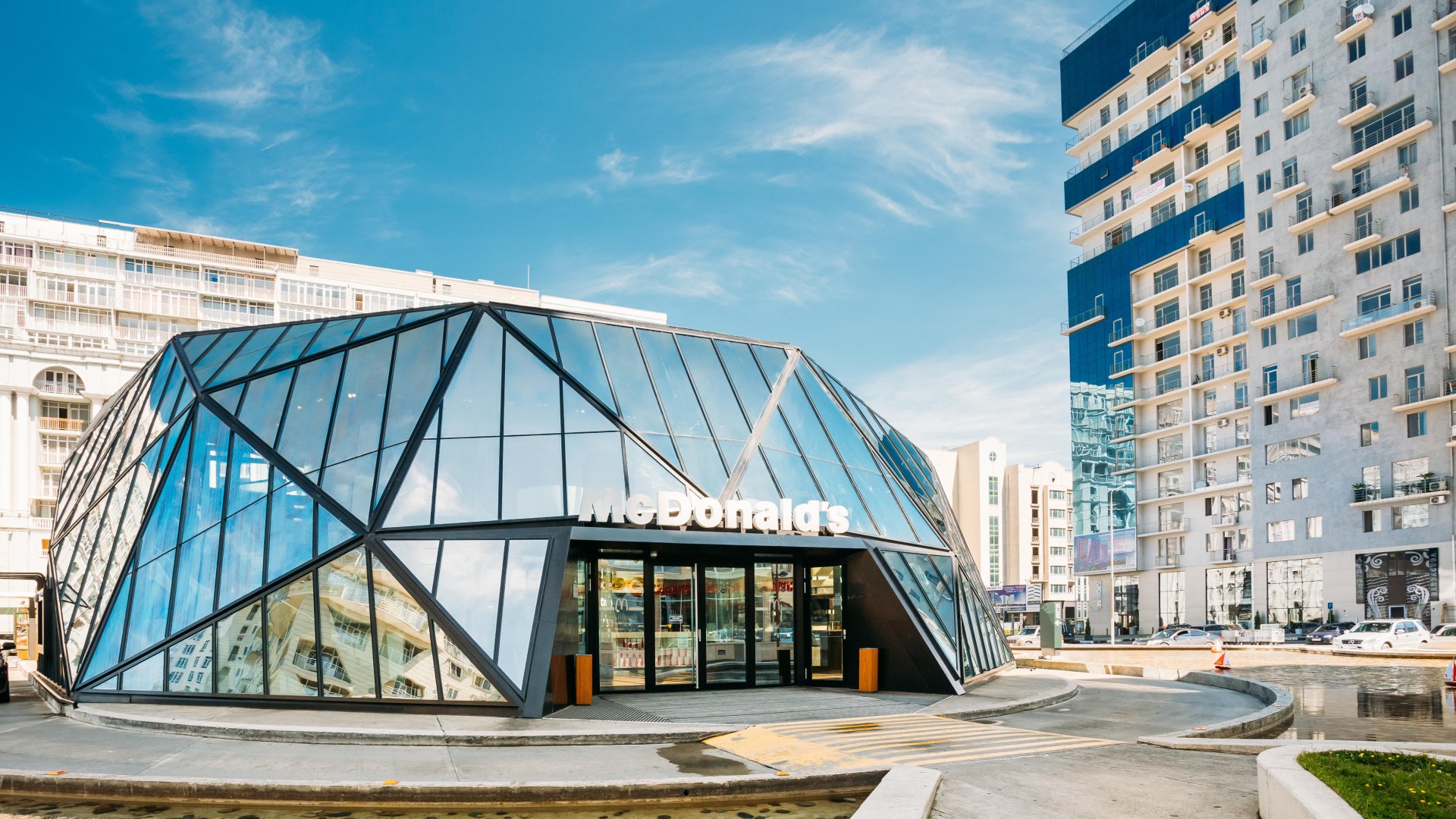
Modern architectural marvels are also part of the McDonald’s design portfolio. In Batumi, Georgia, a sleek, curvaceous glass structure with a surrounding pool stands in stark contrast to the natural landscape. This award-winning design by architect Giorgi Khmaladze has earned international acclaim. In Hangzhou, China, a McDonald’s operates within the former home of a Taiwanese leader, preserving the exterior while decorating the interior with posters about his life. Due to local restrictions, it functions as a McCafe rather than a full restaurant.
Repurposing existing structures has led to some intriguing transformations. A former bank in Kristiansand, Norway, now houses a McDonald’s, with the iconic golden arches positioned above the original grand columns. In Sydney, Australia, a McDonald’s occupies a former 1930s cinema, the Plaza Theatre, retaining the ornate stonework and elegant chandeliers within its otherwise nondescript exterior. Even a UNESCO World Heritage Site in Paris houses a McDonald’s, showcasing a half-timbered brick facade characteristic of Alsatian architecture.
Unique cultural touches and localized menus also distinguish some locations. In Barcelona, Spain, a McDonald’s near major tourist attractions offers beer, Spanish omelets, and macarons alongside the standard menu. In Belem, Portugal, a pastel-pink McDonald’s, reminiscent of a traditional Portuguese home, stands near the iconic Belem Tower and Jerónimos Monastery. In Rotterdam, the Netherlands, a futuristic McDonald’s designed by Mei Architects features a steel spiral staircase and gold aluminum panels depicting a pixellated crowd.
Themed restaurants add to the unique character of certain McDonald’s locations. In Roswell, New Mexico, a spaceship-shaped McDonald’s pays homage to the city’s association with UFOs. In Melbourne, Australia, a McDonald’s occupies the former art deco United Kingdom Hotel, designed by James Hastie, featuring rounded balconies and a retro dining room. Finally, in Downey, California, the oldest operating McDonald’s retains its original design, including the iconic golden arches, offering a glimpse into the fast-food empire’s humble beginnings. These diverse locations showcase McDonald’s adaptability and willingness to embrace local culture and architectural heritage, transforming the familiar fast-food experience into something extraordinary.