



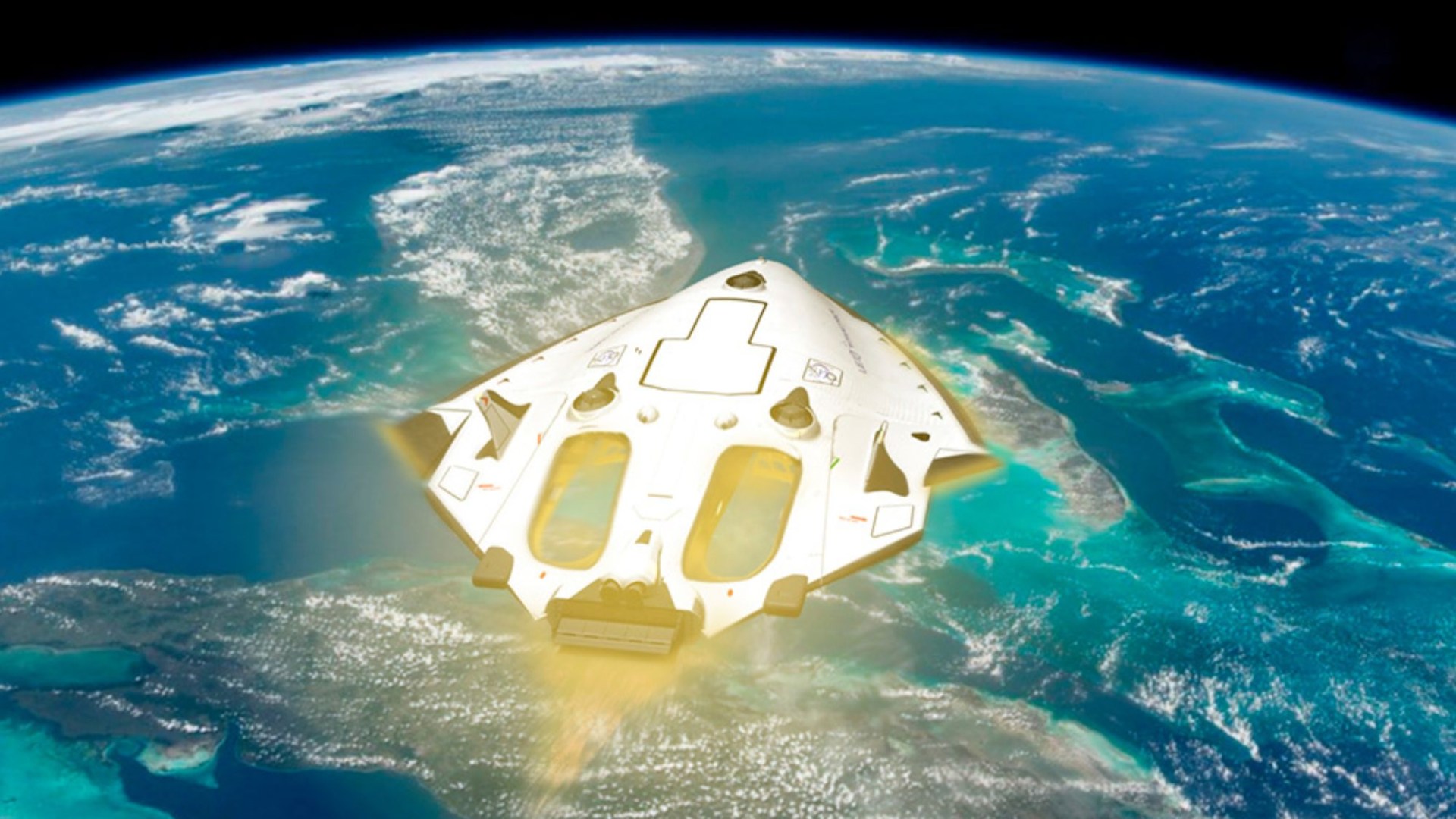
Oscar Viñals’ Leto Titan Cosmos presents a bold vision for the future of space travel, promising drastically reduced travel times and enhanced versatility for a wide range of missions. Inspired by NASA’s Space Shuttle and named after the Greek Titan goddess Leto, mother of Apollo and Artemis, the spacecraft aims to revolutionize space exploration through its innovative design and advanced propulsion system. This futuristic vessel is envisioned as a fully reusable system, designed to minimize costs and maximize sustainability, a crucial factor in the long-term viability of deep space exploration. The ambitious project proposes a journey to Mars in a mere 39 days, significantly faster than current estimates of 80-100 days by SpaceX and drastically shorter than NASA’s projected nine-month one-way trip. This dramatic reduction in travel time not only promises to accelerate exploration efforts but also to mitigate the psychological and physiological challenges associated with prolonged space travel.
Central to the Leto Titan Cosmos’s capabilities is its advanced propulsion system, which combines cutting-edge technologies to achieve unprecedented efficiency. While the specifics of this system remain conceptual, its potential impact on interplanetary travel is substantial. Coupled with a mothership for longer journeys, the Leto Titan Cosmos aims to carry up to five astronauts to Mars in record time. This ambitious goal seeks to overcome the current limitations of space travel, making Mars and other celestial destinations more accessible than ever before. The spacecraft’s versatility extends beyond Mars missions, encompassing satellite deployment, deep space exploration, and asteroid mining, positioning it as a multi-purpose platform for both governmental and private space ventures. This adaptability highlights the potential of the Leto Titan Cosmos to serve as a crucial tool in expanding human presence in space.
Beyond its propulsion system, the Leto Titan Cosmos boasts innovative design features aimed at ensuring safe and efficient operation in the harsh conditions of space. The spacecraft’s unique wavy shape and strategically placed diffusers are designed to manage the intense heat generated during atmospheric re-entry. This crucial feature distributes the superheated plasma created by atmospheric friction, preventing damage to the spacecraft’s structure and allowing for safe re-entry into various atmospheres. Further enhancing its resilience, the Leto Titan Cosmos incorporates advanced materials like thermal tiles and graphene-based structures, providing exceptional strength and heat resistance. This robust design enables the spacecraft to withstand the extreme temperatures and forces encountered during landings on diverse planetary and space surfaces, expanding its operational range and mission capabilities.
The interior of the Leto Titan Cosmos is conceptualized with a focus on crew well-being and comfort during long-duration missions. Drawing on research from the International Space Station (ISS), the design incorporates considerations for gravity, communal spaces, and the psychological challenges inherent in extended space travel. By minimizing travel time through its advanced propulsion system, the Leto Titan Cosmos aims to reduce the negative impacts of low-gravity environments on astronauts’ health. This, combined with innovative design elements addressing crew comfort and psychological well-being, aims to make long-term space missions more feasible and sustainable. The Leto Titan Cosmos represents a significant leap forward in spacecraft design, prioritizing crew comfort and safety in its vision for future space exploration.
Realizing the ambitious vision of the Leto Titan Cosmos presents significant challenges, primarily in securing the necessary financial backing and assembling a team of top aerospace experts. The project’s success hinges on attracting substantial investment and fostering collaboration with leading figures in the aerospace industry. While the designer, Oscar Viñals, acknowledges these hurdles, he emphasizes the revolutionary potential of the spacecraft and its capacity to reshape the future of space travel. Even if the project doesn’t fully materialize in its current form, the innovative concepts and design principles of the Leto Titan Cosmos could inspire future advancements in space exploration, paving the way for other groundbreaking projects.
Despite the considerable challenges ahead, the Leto Titan Cosmos represents a compelling vision for the future of space travel. Its innovative design, advanced propulsion system, and focus on crew well-being could significantly alter the landscape of space exploration. While the project’s ultimate success remains uncertain, its potential to inspire and drive innovation in the space sector is undeniable. The Leto Titan Cosmos embodies a future where humanity ventures deeper into the cosmos, pushing the boundaries of exploration and expanding our understanding of the universe. Its conceptual framework offers a glimpse into the possibilities of space travel, highlighting the importance of continued innovation and investment in space exploration technologies.