


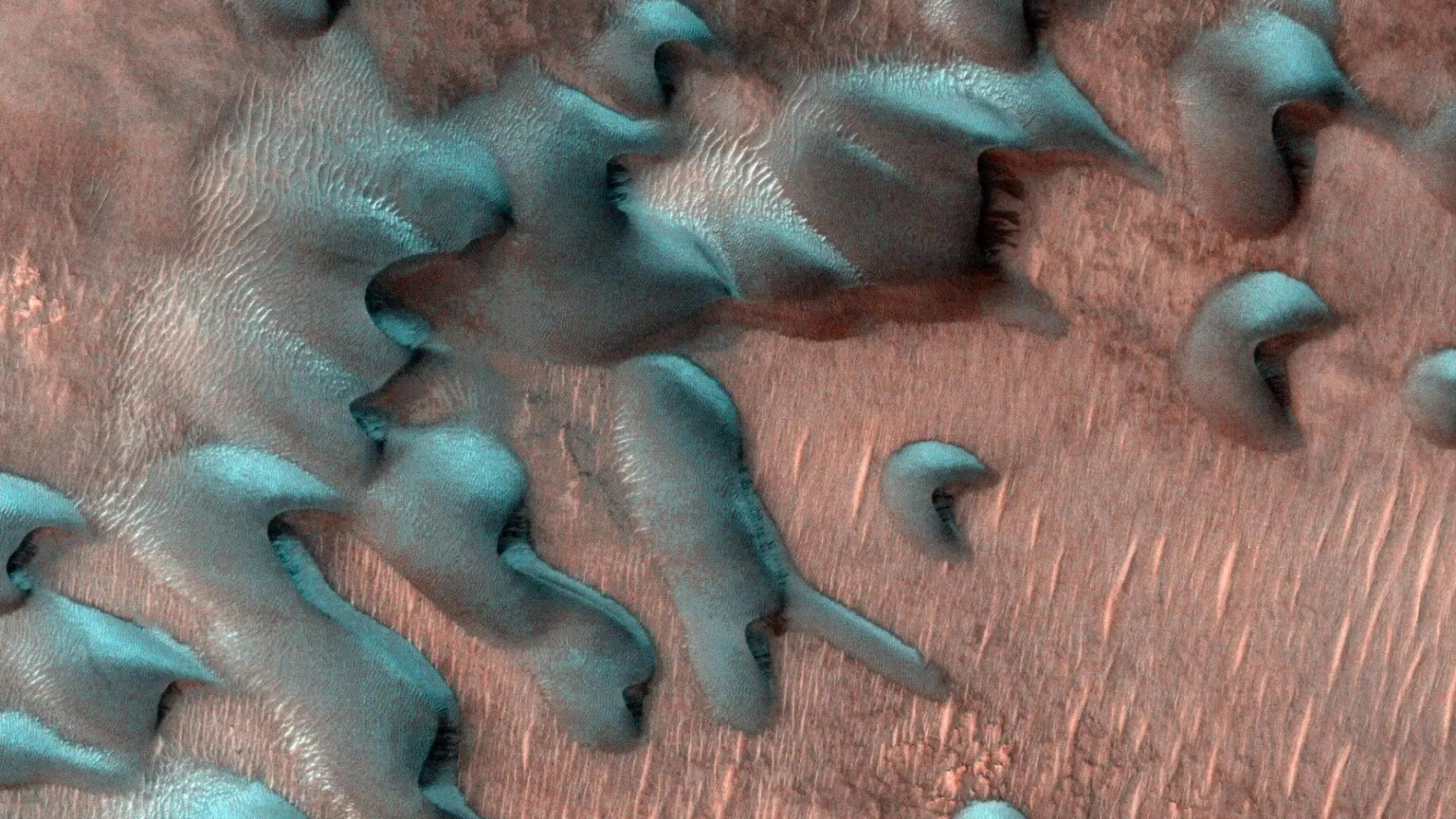
Mars, often depicted as a barren, red desert, transforms into a surprisingly wintry landscape during its coldest season. Though direct observation of snowfall remains elusive, evidence collected by various spacecraft reveals a unique and fascinating Martian winter characterized by cube-shaped snow, icy terrains, and widespread frost. The Red Planet’s average temperature is a bone-chilling -65°C (-85°F), plummeting to a staggering -123°C (-190°F) at the poles during winter, a season that occurs once every two Earth years – the length of a Martian year.
While frost is a common occurrence on Mars, snowfall is a more elusive phenomenon, confined to the planet’s north and south poles. This snow, falling primarily at night under the cover of thick clouds and extremely low temperatures, is of two types: water ice, similar to Earth’s snow, and dry ice, composed of carbon dioxide. Due to Mars’ incredibly thin atmosphere, over 100 times thinner than Earth’s, water-ice snow sublimates into gas before reaching the surface. Dry ice snow, however, survives the descent and settles on the Martian landscape. While a few feet might accumulate in certain areas, it wouldn’t be enough for deep drifts, but potentially sufficient for snowshoeing, albeit in extraordinarily harsh conditions. For skiing enthusiasts, crater slopes or cliffsides, where snow could accumulate on inclined surfaces, would offer more promising terrain.
Mars’ unique atmospheric conditions contribute to the peculiar nature of its snow. Instead of delicate flakes, Martian dry ice snow forms into tiny, cube-shaped particles, roughly the size of a human red blood cell. Rather than falling like a blizzard, the snow descends more like a mist, settling gradually onto the surface. This unusual form is due to the four-fold symmetry of carbon dioxide ice molecules. The existence of Martian snow, while theorized, wasn’t confirmed until relatively recently. Frost was first observed in the 1970s by NASA’s Viking landers, but the presence of actual snowfall wasn’t detected until 2003, using the Mars Reconnaissance Orbiter, which identified falling carbon dioxide snow through its ability to detect light invisible to the human eye. Later, in 2008, the Phoenix lander, situated near the north pole, confirmed the presence of falling water-ice snow using a laser instrument.
Despite these scientific breakthroughs, no direct images of falling Martian snow exist. Orbiting spacecraft cameras can’t penetrate the thick cloud cover during nighttime snowfall, and surface rovers cannot withstand the extreme polar temperatures required to witness the event directly. However, stunning images captured after the snow has settled offer a glimpse of a winter wonderland on Mars, a testament to the planet’s dynamic and often-surprising environment. One striking example of this frozen landscape is the Korolev crater, a vast depression measuring 50 miles across and containing a mile-thick permanent sheet of ice. This icy feature could potentially become a unique destination for future Martian explorers, perhaps even offering opportunities for extraterrestrial ice skating.
The journey to Mars, although a key focus of space exploration, remains a substantial undertaking due to the vast distance separating Earth and Mars. This distance, constantly fluctuating as the two planets orbit the Sun, ranges from a minimum of 33.9 million miles—nearly 10,000 times the distance between London and New York—to an average of 140 million miles. Based on previous missions, the trip duration with current technology varies considerably, from 128 to 333 days, a significant period for astronauts to be confined within a spacecraft. This considerable travel time underscores the logistical and technological challenges involved in human missions to Mars.
Exploring the Martian winter landscape offers valuable insights into the planet’s climate and potential for future human settlements. Understanding the dynamics of snow and ice formation is crucial for developing strategies for resource utilization, habitat construction, and mitigating the challenges posed by the extreme Martian environment. While the prospect of a Martian winter wonderland seems remote, the scientific data collected sheds light on the complexities of the Red Planet and informs our understanding of the potential for life beyond Earth. Future missions, equipped with more advanced technology, will undoubtedly continue to unravel the mysteries of Mars and bring us closer to experiencing its unique winter firsthand.