


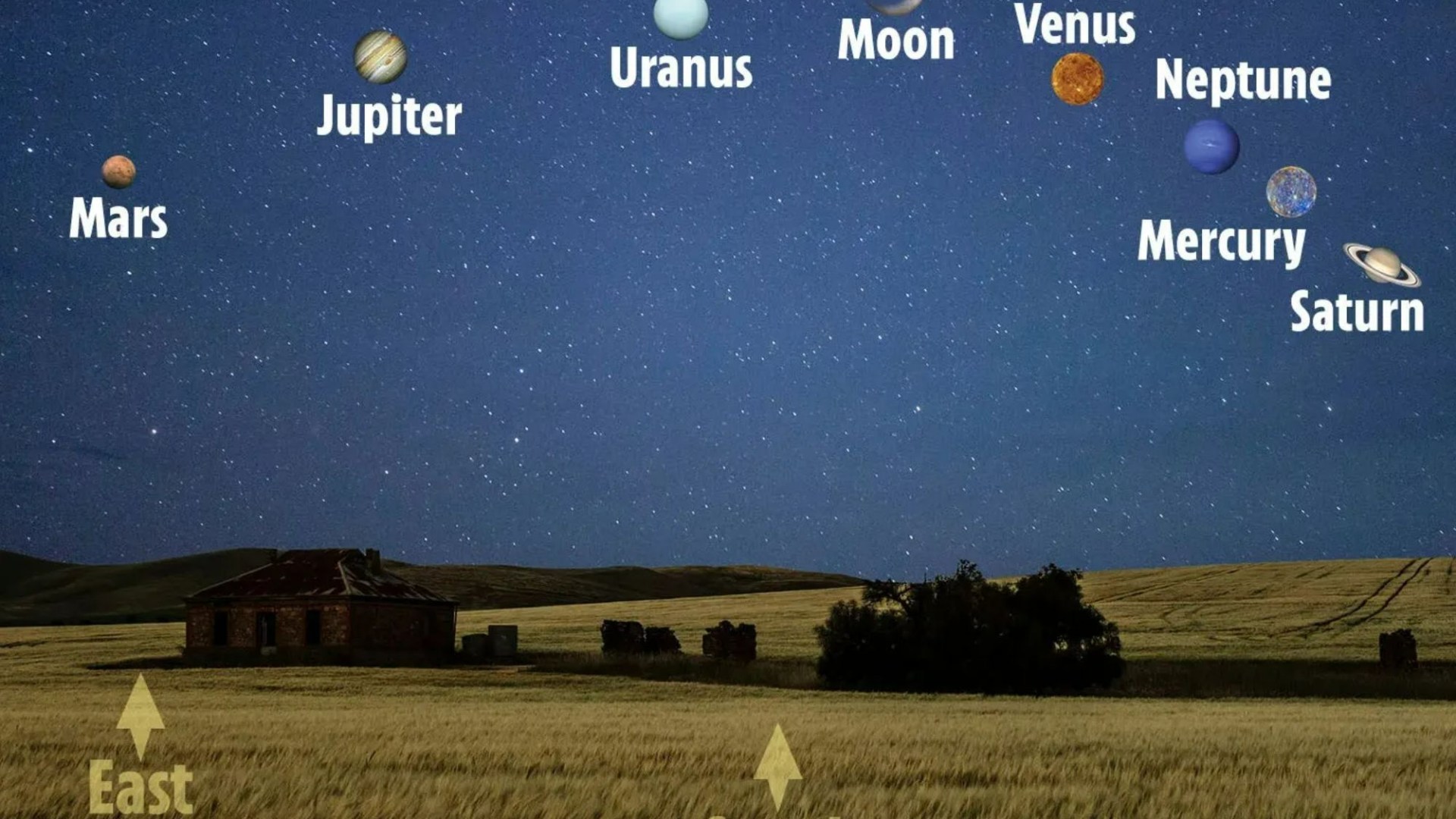
A rare celestial event, a “planet parade,” is set to occur on February 28th, showcasing all seven planets beyond Earth aligned in the night sky. While this alignment isn’t a perfectly straight line, the planets will be positioned along an arc, creating a visually stunning spectacle. Six of these planets – Mars, Jupiter, Uranus, Venus, Neptune, and Saturn – are currently visible, and they will be joined by Mercury towards the end of the month, completing the seven-planet alignment. This remarkable event offers a unique opportunity for skywatchers to witness a planetary gathering.
While all seven planets will technically be part of the alignment, only five – Mars, Jupiter, Saturn, Venus, and Mercury – will be visible to the naked eye. Venus will be the most luminous, outshining even the North Star, Polaris, with Jupiter following closely behind in brightness. Saturn, also visible without aid, will appear as a bright white dot, similar to a star. Mars, distinguishable by its characteristic orange hue, will also be readily observable. To observe Uranus and Neptune, however, stargazers will require binoculars or a telescope due to their immense distance from Earth.
Planetary alignments, while not exceptionally rare occurrences, depend on the planets’ positions relative to the Sun and Earth. While two or three planets aligning is relatively common, having six planets align simultaneously is less frequent, making the upcoming seven-planet alignment an even more special occasion. The alignment happens because all planets in our solar system orbit the Sun within a relatively flat plane, known as the ecliptic. From Earth’s perspective, this makes the planets appear to travel along a similar path in the sky, much like cars on a straight road. The varying distances between the planets and their visibility from Earth contribute to the rarity of these alignments.
Dr. Dan Brown, an astronomy expert at Nottingham Trent University, explains this phenomenon by comparing the planets’ movements to cars on a road. Just as cars are confined to the road, planets are confined to the ecliptic plane, creating the illusion of a linear arrangement. The key variables are the planets’ proximity to each other at any given time and their visibility from our vantage point on Earth. These factors influence the frequency and observability of planetary alignments.
To maximize the viewing experience of this planetary parade, aspiring astronomers are advised to venture outside shortly after sunset and allow their eyes to adapt to the darkness. This will enhance the visibility of Saturn, which is fainter than Mars, Venus, and Jupiter. While binoculars or telescopes can provide a closer look at the individual planets, they also restrict the field of view. Therefore, it’s recommended to initially observe the alignment with the naked eye to appreciate the overall spectacle.
The optimal viewing time will be just after sunset, with Jupiter setting around 6:30 pm GMT/EST in both the UK and the US. Mercury, being low on the horizon, will set soon after, disappearing from view around 7 pm GMT/EST. This narrow viewing window emphasizes the importance of timely observation. This celestial event presents a unique opportunity to witness a relatively rare alignment of our solar system’s planets, offering a glimpse into the dynamic dance of these celestial bodies.